Showing posts with label James Madison. Show all posts

Saturday, June 28, 2014

A Sad Day for the Friends of James Madison

James Madison has no monuments or fancy remembrances as do many of the other founding fathers (and mothers.) Yet without him, we might not have our republic, our constitution, and be an independent country today.

When Madison was a student, at what is now Princeton, he stayed another year to work on a study of the world's constitutions while soaking up the ideas of the Scottish Enlightenment from the university's president. This began his life-long passion for republican ideals and constitutions. After flailing about for a while after college, he was elected to the Virginia (Colonial) House of Burgesses and began his life as a politician. He followed this calling to public service until the end of his presidency. Those who call for term limits and hold their noses at the idea of a "politician" could learn a lot from his decades of devotion.

After the Revolution, he watched with mounting horror as self interest brought out the worst in the Virginia legislature and the Congress under the Articles of Confederation was worse than "do nothing." By 1878, the country was in turmoil, Congress was impotent, groups of States talked of leaving the fragile union spurred on by European powers, the economy was a shambles, and Shays' Rebellion in Massachusetts frightened every property owner. The prognosis for continued existence of the country was dire.

So Madison joined Alexander Hamilton and Ben Franklin to conspire to overthrow the government; they committed treason for the second time. Working with others, Madison persuaded General George Washington to join in the call for a Constitutional Convention to provide the political cover they needed. Madison got the resolution through the Confederation Congress and became a delegate along with Washington and others to the gathering. His long-time rival, Patrick Henry, refused to have anything to do with it; "I smell a rat!" He was right, of course. Madison's intent was not to amend the Articles but to abolish them.

Jemmy and Me

He arrived in Philadelphia early, having made a thorough study of republics and constitutions "ancient and modern." He persuaded the governor to present his draft as the "Virginia Plan." Although little of it remained in the final draft signed by the delegates, it did serve as the agenda and shaped the nature and substance of the debates. Madison and the most committed delegates toiled for four months in the Philadelphia summer heat with early morning committee meetings, all-day debates, and informal politicking in the evening. Madison took voluminous notes we still marvel at today and early Supreme Court justices used to unravel "original intent."

But when the delegates scattered back to their states, the work wasn't over. They had to get the special ratifying bodies to agree to the document. In Madison's Virginia, Patrick Henry led the anti-federalist forces. Despite Henry's legendary oratorical skills and political clout, Madison bested him and eked out a tiny margin of victory.

Then he was off to the new Congress as a Representative in the House and to serve as Washington's whip in that body to achieve his legislative agenda. He served as Jefferson's Secretary of State and then as President, presiding over the War of 1812. In fact, he was the only Commander in Chief to actually go into battle, despite having no military credentials.

He was the last of the "fathers" to depart this world and did so on this day, June 28, 1836. His parting words were, "Nothing more than a change of mind, my dear." James Monroe, who succeeded him as President, referred to Madison in his dying words, "I regret that I should leave this world without again beholding him."

In my Google Alert for Madison, about 95% of the mentions are from people, right or left, trying to claim his "authority" for their views. Like anyone quoted out of context, Madison's words are distorted. More importantly, because Madison was a patriot, a passionate politician, and as partisan as anyone, you can always find some snippet to support you. These folks do a disservice to the man, his memory, and his message.

Madison, like all of us, evolved and changed with age. At the end of the Convention, he thought the Constitution was a failure because it created a Senate representing the states and not the population. Yet he went to the ratifying convention and worked with Hamilton to write the Federalist Papers defending the new Constitution with every ounce of his considerable persuasive talent. By Washington's second term, he had joined Jefferson to destroy Hamilton and the Federalists and create the Republican Party (precursor of today's Democrats.) As president, he opposed legislation for building roads and canals or providing "charity." As an elder statesman, he made it clear he had evolved to support these government efforts.

What made Madison so great was he was NOT an ideologue. He constantly thought about things, changed his mind, and made it clear where he stood at any moment. He was prepared to compromise for the good of the nation. He seldom held real animosity for his opponents. (Today he'd be derided as a flip-flopper, drummed out of whatever party he was in, and excoriated by the chattering class and talk radio.)

What I've always found so appealing about Madison was his humanness. My favorite quote from him is (out of context, of course,) "If men were angels, no government would be necessary." Madison is great because he is no saint on a pedestal. He was dead wrong on many things. He made no claims to perfection. We can admire him, not because we agree with him or can find some phrase to prove our political point, but because he thought continuously and was willing to change and grow and leave old notions behind.

If today's leaders, whether in politics or business, would spend a little time with "Jemmy, the great little Madison," they might be less inclined to require unthinking adherence to a static idea. Madison's interpretation of the republic's mission statement, the Preamble to the Constitution, matured and morphed over time. If we could take a page from his book, we might all succeed in evolving, being more strategic, making better decisions...and leaving old ideas behind.

*   *   *   *   *
(c) Rebecca Staton-Reinstein and Advantage Leadership, Inc. 
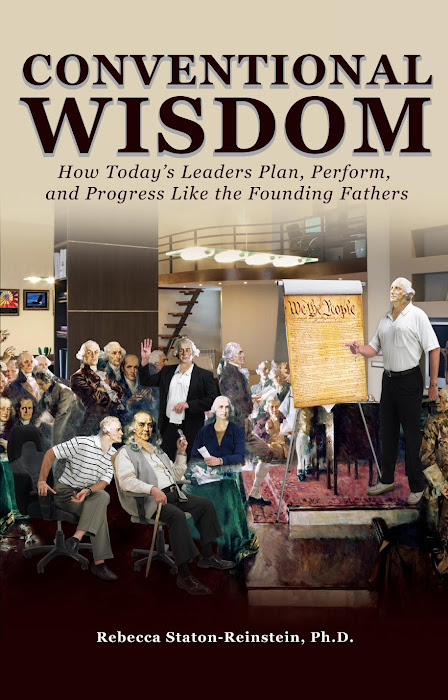
Want to know more about Madison and his role in the Constitution and early republic? Want to know how modern leaders exploit the Madison Factor? Check out Conventional Wisdom: How Today's Leaders Plan, Perform, and Progress Like the Founding Fathers. 
Your research into the planning sessions of the Constitutional Convention and the struggles that our framers of the Constitution faced has been cleverly weaved into the strategies of modern business. I am pleased to have your book.  
-- Justice Sandra Day O'Connor (RET) 

Monday, March 18, 2013

An uneventful birthday for Jemmy

It's really too bad. Even I forgot...and I'm a raving fan of James Madison...the mighty little Madison was 262 this past weekend, March 16 (1751.) Jemmy, as he was known to his friends and enemies, has no monuments in the nation's capitol, no face on the side of Mr. Rushmore, and no holiday marking him or his most amazing accomplishment, the U.S. Constitution.


Jemmy and Me
Think about it for a moment. We celebrate the Declaration of Independence, and we should. We celebrate Washington and Lincoln with the combined Presidents Day. We look at Mr. Rushmore and see them again along with Jefferson and Roosevelt (Teddy.) Washington's monument towers over the Mall, Jefferson, Roosevelt (Franklin,) and Lincoln gaze out from their memorials on the Mall. But Madison? Nowhere to be found except at his restored home and the Constitution Center in Philadelphia in the hall of the signers. Even there he is overshadowed by many of the others.

Why should we care? James Madison was slight of build but a giant when thinking about constitutions. He had studied every one he could lay his hands on, focusing as he said on republics "ancient and modern." But Jemmy was no dilettante. At 36, he was already an experienced politician having served in the Confederation Congress and the Virginia legislature. With Alexander Hamilton and Benjamin Franklin and a few others, he conspired to call the meeting we know as the Constitutional Convention, with a secret agenda to overthrow the existing Articles of Confederation.

The Articles had proven a disaster and the infant nation faced multiple crises including inability to pay its debts, threats of foreign invasion, individual states prepared to go to war with their neighbors or secede altogether, rampant inflation and foreclosures, open rebellion, and a deadlocked, impotent Congress.

When the delegates gathered in Philadelphia in May of 1787, it was Madison's "Virginia Plan" that formed the basis for the initial debates. The meeting was presided over by George Washington, who had been persuaded in part by Madison to come and provide political cover and credibility. Although when he signed his name to the final document, Madison was not happy with it, he was prepared to fight for it.

He teamed up with Hamilton and John Jay to write The Federalist to present a compelling case for ratification and then went into the Virginia Ratifying Convention to debate his high-profile adversary, Patrick Henry and win. Despite the fact that he was ill and exhausted from his non-stop work during the 4 months of the Constitutional Convention, he came out swinging and carried the day so Virginia ratified by a few votes. During the Convention he had been tireless, recording all the discussions, lobbying the delegates, and serving on committees.

But Madison wasn't through. He was elected to the new Congress and quickly became one of the most savvy and effective politicians and lawmakers. He gathered the suggestions for amendments into a package and fought for the passage of the Bill of Rights. He even engineered the passage of Hamilton's finance bill for the assumption of the state's war debts and the establishment of the first national bank, despite being opposed to the plan in principle.

Finally, after his long and successful legislative career and the appellation of "Father of the Constitution," which he rejected, he served in Jefferson's cabinet and then became the 5th president of the United States.

James Madison is as responsible for creating our country as any of the other more well-known figures. Without him, the Constitution might never have been written and accepted, and the country would have soon disappeared from history like so many other experiments in self-government. Madison would not have wanted a monument or public holiday for himself. He probably would have wanted a holiday for the signing of the Constitution, (September 17.)

As Madison himself wrote, "a crisis had arrived which was to decide whether the American experiment was to be a blessing to the world, or to blast for ever the hopes which the republican cause had inspired." Luckily for us, Madison was there to make the difference. Honor him by reading the Constitution and it's amendments.
*     *     *     *     *     *
(c) Rebecca Staton-Reinstein, Ph.D., president, Advantage Leadership, Inc.
Learn more about Madison's pivotal role in the Conventional Wisdom: How Today's Leaders Plan, Perform, and Progress Like the Founding Fathers (Check out the Madison's birthday special pricing.)
Please send us your comments and feedback.

Tuesday, November 6, 2012

Why Vote? To keep a republic

As the delegates were leaving the Pennsylvania State House that September day in 1787, having just written the U.S. Constitution, a woman approached the venerable Dr. Franklin and asked what sort of government they were proposing. He answered, "A republic, if your can keep it."

It's as simple as that. We can only keep our republic by exercising our right to vote and the corollary is informing ourselves about the candidates and the issues. Three thoughts come to mind:

A nation that expects to be ignorant and free in a state of civilization … expects what never was and never will be. - Thomas Jefferson
Liberty & Learning lean on each other for their mutual and surest support. – James Madison
Educate and inform the whole mass of the people...They are the only sure reliance for the preservation of our liberty. - Thomas Jefferson


It's as simple as that...inform yourself and vote. Yes it's tough with restricted hours or Sandy's devastation. Yes, the weather can be bad or the lines long or the choices difficult or...

If you don't vote, you have no voice and NO RIGHT TO WHINE! That's right. You can't go on and on about what's wrong with the "government" if you don't participate. No excuses.

In the '90s I was working in St. Petersburg, Russia when they held their first free election. I went with my host to the polls -- a high school gym. It was exciting and brought a lump to my throat. My friend was casting a vote in an independent election for the first time. I don't know how she voted - for reform or a return to the old regime. In the end, the important thing is to cast your ballot.

In a republic, we then accept the result. We don't always like the result and sometimes would have preferred a different outcome. Every election is about the future of the republic. Informed voting is the only way to keep our republic.
*   *   *   *   *
(c) Rebecca Staton-Reinstein, President, Advantage Leadership, Inc.
Author, Conventional Wisdom: How Today's Leaders Plan, Perform, and Progress Like the Founding Fathers (Check out the special election day offer)

Sunday, October 14, 2012

When did elections become American Idol?

Full disclosure: I love to watch debates - academic or political. I love the give and take. I watched every presidential primary debate this season. (The British call it the silly season with good reason.) I've watched both debates now between the candidates and will be glued to the last two. (Update: the second presidential debate does not change what I've already posted.)

I'm NOT looking for winners and losers. I'm looking for information. I'm not one of those over-hyped "undecided voters." I've made a choice and I don't think a debate will change my mind so I'll take advantage of my state's early voting. However, and this is a big "however," I still want to understand each candidate and party's ideas, desires, plans, history, and more. I never get tired of it. Sometimes I agree with my chosen candidate and sometimes I don't. Sometimes I like what he or she says and sometimes I don't. Sometimes I support their compromises and sometimes I don't. I'm not a single-issue voter, and since I cast my first presidential vote in the 60s, I've tried to look at the full package.

So what? I was watching some "news" coverage after the vice presidential debate and they were discussing what was trending on social media during the debate...DURING the debate.
  • We are NOT WIRED TO MULTITASK. When we're listening/watching the debate and start texting, tweeting or facebooking, our brain is simply switching back and forth very, very rapidly (below our ability to perceive.) So we're not actually attentive to either.
  • Much of the "trending" was about ridiculous topics including one candidate's workout photos and the other's use of words like "malarkey." ????? This is what's important in choosing a person who is "a heartbeat away from the president?" This is the how we choose a potential world leader?
When did the most important political decisions that will affect our lives become American Idol? Are we electing the Debater-in-Chief? Do we expect him or her to go mano a mano with other world leaders on TV to decide the fate of nations? Do we really think the endless dissection of jokes, wise cracks, facial expressions, body language, and zingers is the best way to make this important decision?

What about the Founding Fathers? How would they hold up?

Most wouldn't fare too well based on our pop-idol values.

George Washington hated to speak in public and many of his addresses were simply published and not spoken. He was self-conscious about his lack of formal education among the political elite of the late 18th century. He was intelligent, well-read, and a shrewd politician and judge of people and events but he would have appeared wooden and ill-at-ease in a public debate.

John Adams was scrappy and considered a good trial lawyer and effective legislator in the Continental Conventions. He defended British soldiers successfully after the Boston massacre (which would have been political death in today's world of negative ads.) He was also irritable and irritating and seldom curbed his tongue in his attacks on those who disagreed with him. He didn't play well with others when he disagreed.

Thomas Jefferson wrote soaring prose that still inspires us but he was a horrible speaker. This voice was weak and barely audible when he addressed any gathering and he avoided it whenever possible. He would have delighted in today's campaigns of negativity. Through his support of newspapers and others who he agreed with, he published or caused to be published, scathing attacks on his political enemies. His attacks, through his pal Jemmy Madison, went for the jugular in attempt to destroy Alexander Hamilton, and even George Washington while he served as his Secretary of State.

James (Jemmy) Madison was a masterful debater, although he too did not have a strong voice, and people often complained he was hard to hear in a large room. However, in his long state and federal legislative career and in the Constitutional Convention, he held his own with other more powerful debaters. Most famously, in the Virginia Ratifying Convention to ratify the new U.S. Constitution, he faced off against Patrick Henry. Although Henry brought his A game bombast and withering rhetoric, he turned out to be no match for Madison, an author of the document with intimate knowledge of every nook and cranny and how it had been debated and decided.

Today, we would not select the wooden Washington, the irascible Adams, the weak-voiced Jefferson or the egg-head Madison. We would have preferred the smooth-talking Aaron Burr, who kill Hamilton while still vice president; the pyrotechnic Henry who was an avowed anti-federalist who would have gotten rid of anything but independent, autonomous state governments; the avuncular, always charming and folksy and wily Ben Franklin, who would have only a one-house legislature, removing a critical check on popular passion; and who knows what other folly.

Presidential leadership is not about "optics." Would we elect Lincoln today? Would we elect the very short, "great little Madison?" Would "his rotundness," Adams receive our nod? Would we pick Jefferson who was famous for his slouching posture as well as his weak voice? Sadly, probably not.

I'll continue to enjoy the debates. I'll go to the polls and cast my ballot. But it would be more assuring to me if citizens watched the debates using the active listening techniques I teach managers and executives.
  • Quiet your mind and ignore stray thoughts or preparing a response.
  • Focus your entire attention on the other person.
  • Listen to what he or she is saying and observe the body language and tone.
  • Ask questions to make sure you understand the other person and that he or she knows you understand.
Finally, I can't help but quote from that poor debater, Thomas Jefferson:
"A nation that expects to be ignorant and free in a state of civilization … expects what never was and never will be."
Or maybe from that fierce debater, James Madison:
Liberty & Learning lean on each other for their mutual and surest support.
Please vote...and please, make a rational, informed decision. It ain't American Idol!
*     *     *     *     *     *
Check out more about the politics of the early republic and today's leaders in Conventional Wisdom: How Today's Leaders Plan, Perform, and Progress Like the Founding Fathers. http://advantageleadership.com/section/Conventional_Wisdom/17/

Monday, June 4, 2012

Dirtiest Election Ever: Beyond the F-Bomb

Every time a politician drops the F-bomb, the media are all atwitter. (Can Twitter be atwitter?) They run the clip over and over BLEEPING politely at the crucial moment so as not to offend us. The current two candidates for president are not the sort of folks who will be caught using this anglosaxonism although their associates may be. Jefferson and Adams in the election of 1800 usually preferred the perfect barbed comment also.

So what? Move off the "networks" and onto the cable channels and the F-Bomb is just another word among many floating across the airwaves. But looking back to the really nasty election of 1800 and its parallels with 2012, what is the story when it comes to salty language and attack words?

Today as in 1800 there were words that people thought too rude for public discourse. But what was happening behind the scenes? There folks weren't as gentlemanly as we like to think, especially when talking among themselves.

George Washington had a towering temper he kept in check for the most part. When he let it rip he could toss the verbal bombs with the best of them. When delegates to the Constitutional Convention sat with their pipes and port after dinner, they often swapped bawdy stories, just as people do today. One of their favorite games was inventing wilder and wilder puns about Gouverneur Morris' wooden leg and his way with the ladies. James Madison was infamous among his contemporaries for his off-color stories.

It's true they didn't throw the F-Bomb but they certainly came close. John Adams was no fan of Alexander Hamilton and in a letter to Benjamin Rush in 1806 let fly with this diatribe against Hamilton for remarks he had made denigrating George Washington.


John Adams
Although I read with tranquility and suffered to pass without animadversion in silent contempt the base insinuations of vanity and a hundred lies besides published in a pamphlet against me by an insolent coxcomb who rarely dined in good company, where there was good wine, without getting silly and vaporing about his administration like a young girl about her brilliants and trinkets, yet I lose all patience when I think of a bastard brat of a Scotch pedlar daring to threaten to undeceive the world in their judgment of Washington by writing an history of his battles and campaigns. This creature was in a delirium of ambition; he had been blown up with vanity by the tories, had fixed his eyes on the highest station in America, and he hated every man, young or old, who stood in his way or could in any manner eclipse his laurels or rival his pretensions. . . 

Pretty strong stuff...but not as strong as these "gentlemen" wrote under pen names in the popular press skewering one another and accusing one another of the worst intentions, treason, and more. Generally they lambasted one another with innuendo as well as direct attacks. In fact, what can be a delicious pastime is dissecting their elaborate language and watch as they slip the verbal knife between the ribs and give a fatal twist.

We seldom hear such creativity today where it's so easy to just go for the flat obscenity rather than the creative crudity. I was impressed when George Will called Donald Trump a bloviating ignoramus. The founding fathers would have liked that.

But are there any Leadership Lessons in all this?  Perhaps a few:
  • Leaders control themselves: George Washington was prickly and thin skinned and took offence easily. Yet his advice to himself and others was to show restraint of "tongues and pens." He kept his temper in check most of the time. "Losing it" on a regular basis causes people to disengage. 
  • Leaders cultivate creativity: "Bloviating" is such a yummy word and I'm sure many people scurried to google its meaning. (Synonym for blow hard) In our general anti-intellectual climate, leaders encourage their people to think and grow and become more articulate.
  • Leaders do not condone crudity: Leaders know that some language offends some people just like the bawdy stories and sexist remarks that have disappeared for most workplaces. They do not insist on better communication because of "political correctness." They want to be inclusive; they want everyone to be engaged.
Just because the founding fathers weren't saints doesn't mean we do not honor and respect them. We admire them because, like us, they were all too human, capable of pettiness and backbiting, and sometimes behaving badly. We can learn from them precisely because they are human. We can learn from their mistakes and when they triumphed over their human nature. And we can learn from their fierce honesty because they would call a bloviating ignoramus a bloviating ignoramus!
*     *     *     *     *     *     *     *

What's your idea: Can we joust with more inventive language without bloviating? Please post your comments.
* * * * * * *
Next: How foreign are foreign affairs?

* * * * * *
©Rebecca Staton-Reinstein, president, Advantage Leadership, Inc.
Want to know more about the tumultuous fights at the Constitutional Convention and the election of 1800? Check out Conventional Wisdom: How Today's Leaders Plan, Perform, and Progress Like the Founding Fathers

I NEED YOUR HELP: I'm beginning research for my new book on the influence of leaders on their organizations (Washington's Shadow) and I'm interested in your experiences or ideas for case studies. Do you know a leader who has had a profound influence shaping the organization's culture and changing it for the better? (I'm not interested in negative stories which are much more common.) Drop me a note:


We've started a companion YouTube series and the introduction is up. Check it out.

Tuesday, May 29, 2012

Dirtiest Election Ever: God or Not God, That is THE Question

Religion seems to always raise its specter during the silly season - the election cycle. This is one of the smarmier sides of politics - folks attacking Romney and his religion, Mormonism, as a cult and non-Christian; other folks accusing Obama of being either a secret Muslim or white-hating black Christian...

After a while it seems like outrages get more extreme...but is it anything new? Unfortunately not. The "dirtiest election ever" was held in 1800 when Thomas Jefferson faced off against John Adams...and guess what? Religion and accusations about religion were front and center. Remember, in 1800 ALL newspapers were affiliated with one or the other party. There was nothing that resembled unbiased journalism...and there were virtually no rules. NOTHING was sacred.

Jefferson, the Vice President, was the standard bearer for the Republicans. (No not the same party as the one today. Jefferson's Republicans morphed into the Democratic Republicans and later the Democratic Party.) Adams, the sitting President, represented the Federalists (who died off in the early 1800s.)

Both were "founding fathers" and recognized as great patriots.

Adams had been one of the first to push for a break with England and was a leading member of the Continental Congress and helped write the Constitution for the new State of Massachusetts. He had been part of the committee charged with writing the Declaration of Independence. He served as Washington's Vice President and kept the new country out of wars with England and France.

Jefferson was also part of the committee charged with drafting the Declaration. Adams  proposed Jefferson should create the draft to bring back for approval by Congress. Jefferson had served as war time governor of Virginia and was almost captured by the British. He had served as Adams' Vice President, Washington's Secretary of State, and,  earlier, been our representative to France.

Both men had sterling credentials...

This was the era of the Enlightenment that  swept Europe and the colonies. Adams, Jefferson, and the rest of the Revolutionary generation were weaned on John Locke's treatises. So it should come as no surprise that Jefferson was a Deist. In all probability so were Adams, Franklin, and Alexander Hamilton. The difference was these gentlemen never made public pronouncements or recorded their views in writing and Jefferson did.

If you're wondering what a Deist is...Essentially they believe god may have created the universe but does not intervene after the creation. Nature's laws can be studied and understood. There is no need for organized religion. Scriptures are interesting but not divine revelation. People must use and develop their rational capacities to solve the problems of the world. Logical belief for the children of the Enlightenment was heresy for the dominant Protestant culture of country in 1800. To add a little spice to the religious mixture, the late 18th century was the period known as the "Great Awakening" in America as a highly spiritual, evangelical spirit and "dissenting" religions spread across many states.

Jefferson had committed one huge sin in the eyes of many devout Christians (and political opponents.) He had written the Virginia Statute for Religious Freedom. Its goal was to disestablish the Episcopal Church as the official religion in the state, allow freedom of conscience for everyone, and no longer allow state taxes to go to support religious schools and churches. (His buddy, James Madison, a masterful politician, got it through the Virginia Assembly, used it as a basis for writing the First Amendment to the Constitution later, and incurred the wrath and retaliation of Patrick Henry.)

Jefferson created his own version of the bible

So let the games begin.

Adams was vilified as a monarchist, still a dirty word in 1800. He was accused of plotting to set up a hereditary monarchy beginning with his son John Quincy.

The common epithet thrown at Jefferson was atheist, an accusation attached to him throughout his long political career. During the 1800 elections cycle Jefferson's support of the French Revolution earned him yet another attack - Jacobin. Like his French counterparts, it was said he wanted to destroy religion and abolish churches and private property.

Jefferson was the subject of viral attacks in the press. Yes, that's nothing new - it just took a little longer as other papers and pamphlets copied the following from the Gazette of the United States, a Federalist paper, and spread it:

The Grand Question Stated: only question to be asked of every American...Shall I continue in allegiance to God and a religious president or impiously declare for Jefferson and no God? 

Substitute today's candidates and the effect is the same.

What are the lessons for leaders today?
  • Ignore labels: Successful strategic leaders know great ideas can come from anyone. They also know a religious or political label does not reveal how a person will behave and act. Bigotry, prejudice, and bias have no role for leaders. Savvy leaders search themselves for these traps and consciously refute them.
  •  
  • Advocate: Successful leaders will take their cue from James Madison. Madison was a religious man and member of the Episcopal Church. Yet it was he who brought his legislative skills to bear to oppose Patrick Henry and the Virginia elite and pass the Virginia Statue for Religious Freedom and penned the First Amendment to the US Constitution and shepherded it through the first Congress. It was Madison who championed the separation of church and state and opposed appointing a chaplain for Congress and opening sessions with prayer. Leaders advocate for the rights of those who have no advocate.
  •  
  • Practice What You Preach: Leaders put their faith or beliefs into action. We fault the founding fathers for their refusal to end slavery. Perhaps one of the most stunning exceptions was Robert Carter III, member of the Virginia elite. In 1791 he walked into the local courthouse and initiated the process to free all his enslaved people. He grew into his beliefs as part of the Great Awakening. He was a member of integrated churches, some of which had black clergy, and all of which preached complete equality. He freed over 450 people, more than anyone freed prior to emancipation 60 years later. Carter took what he believed to be the right action. His position was, "My plans and advice have never been pleasing to the world." Despite being ostracized by his fellow planters and ignoring the financial impact, he continued to support his former bondsmen, provided them land, and lived with them as neighbors.
  •  
  • Refute the Ridiculous: Leaders have the courage to refute the mud slung at their opponents. Throughout the down-and-dirty election of 1800, John Adams never refuted the attacks on Jefferson, nor did Jefferson refute those hurled at Adams. They were long-time friends and knew one another well. They knew the truth about one another. They missed an opportunity to demonstrate their greatness. Leaders defend the truth with enthusiasm as John McCain did in 2008 confronting the birthers.
What's your idea: Can we leave religion and matters of conscience out of politics and the workplace? Please post your comments.
* * * * * * *
Next: Discourse before the F-Bomb
* * * * * *
©Rebecca Staton-Reinstein, president, Advantage Leadership, Inc.
Want to know more about the tumultuous fights at the Constitutional Convention and the election of 1800? Check out Conventional Wisdom: How Today's Leaders Plan, Perform, and Progress Like the Founding Fathers

I NEED YOUR HELP: I'm beginning research for my new book on the influence of leaders on their organizations (Washington's Shadow) and I'm interested in your experiences or ideas for case studies. Do you know a leader who has had a profound influence shaping the organization's culture and changing it for the better? (I'm not interested in negative stories which are much more common.) Drop me a note:

Friday, March 23, 2012

Where is Stand Your Ground Leadership?

30 thousand people show up in Sanford, Florida. The BBC covers the rally. Morning Joe has serious, thoughtful, long discussions. One million people sign an on-line petition. After weeks of denial, avoidance, obfuscation, refusing to take any responsibility, and stonewalling, now a few anemic actions are taken in the State of Florida. (Full disclosure: my home since 1991.)

For those unfamiliar with the case here are the bare facts: (Timeline http://abcnews.go.com/blogs/headlines/2012/03/trayvon-martin-case-timeline-of-events/ )

On the night of February 26, 2012, teenager Trayvon Martin was returning from the store with candy and ice tea in a cloistered neighborhood in Sanford, Florida. George Zimmerman, a local self-appointed neighborhood watchman was cruising in his truck, armed with a 9 mm semi-automatic pistol. Moments later the kid was dead on the street and the police did not arrest Zimmerman who invoked Florida’s infamous Stand Your Ground law, which condones self-defense use of lethal force if you believe your life is in danger. The kid’s crimes? He was black. He brought Skittles to a gun fight.

What happened to the killer?
Nothing. Nothing!

Zimmerman went home, still packing. The cops, police chief, city manager, city council, and every other official went home, still wrapped in the odd notion of justifiable homicide of a kid who just wanted some snacks while watching the super bowl. No public statements of outrage or even a little handwringing over the tragic events.
The family demanded justice and got indifference. If this were the 1950s, maybe that would have been the end of it. But this is the age of the internet and the 24/7 news cycle. And this is not the South of the 1950s where I grew up and such travesties went unexamined. You can’t keep your dirty little secrets any more.

So yesterday 30,000 people showed up to say ENOUGH! By now a few small tokens of action have been taken.

But where were the leaders?

Where were the designated leaders who should have been standing their ground for justice and the American values we hear so much about in this political season?
  • Governor Scott finally made a public statement and started an investigation.
  • Authors of the original legislation said it didn’t apply in this case and defended the odious law.
  • The city council passed a nonbinding (?) 3-2 resolution suggesting the police chief step down.
  • The city manager, sounding like a corporate spokesman after an environmental disaster, stonewalled and said “we’re looking at it.”
  • The police chief finally went on leave.
Zimmerman is still wandering around out there, still armed. He appointed himself to: decide what a crime is and interpret the law; to bring the individual down; be judge, jury, and executioner.

Where are those defenders of the Constitution searching for original intent? Did James Madison intend to unleash vigilantes to stand their ground? Oops, Zimmerman wasn’t standing – he was running after the kid who was fleeing for his life.

This blog is usually reflecting on strategic leadership and our connection to the U.S. founding fathers. What has this to do with them? Everything…

True leaders stand their ground.

Certainly George Washington stood his ground when he faced enormous criticism from both political factions over remaining neutral in the endless wars between England and France.

John Adams stood his ground and lost his second presidential bid when he refused to go to war with France and pushed for a new treaty.

James Madison, no military man, stood his ground when he took his horse rode out to face the British invasion and defied his popular critics in the unpopular War of 1813.

In fact the Constitution exists because Madison, Franklin, Washington, and Hamilton and a few others stood their ground, conspired against the weak government under the Articles of Confederation, called the Convention, fought the new plan through state ratifying assemblies, and then made the experiment in republican government work.

So far, the elected and appointed leaders in this disgusting situation have not stood their ground. They have all been missing in action. The grieving family and their emerging multitude of supporters will overcome. Justice will eventually be done…that’s the power of a democratic society…if the leaders don’t lead, the people, standing their ground, will.

Of all the quotes on leadership that would fit this occasion, I’ll let founding mother, Abigail Adams, who always stood her ground, have the last word.

"We have too many high sounding words, and too few actions that correspond with them." 
*     *     *     *     *     *     *     *


Wednesday, February 29, 2012

Tea Party Rejoice - Rick Channels Patrick Henry

When candidate Rick Santorum said he "'almost threw up' when he read John F. Kennedy’s famous 1960 speech on the separation of church and state," my ears pricked up. Not because I want to discuss, support or trash any candidate, but because he was talking about a speech I remember rather fondly.

According to the Washington Post:
“Mr. Santorum said Kennedy was arguing that 'faith is not allowed in the public square'...
But Mr. Kennedy wasn’t telling people of faith to stay out of public life. He was restating the constitutional principle that has helped make America a great and resilient country: No faith should be able to dictate government policy, and government shouldn’t dictate theology to any faith.”

Tax to Support Christian Teachers

My thoughts immediately returned not to the Kennedy speech of 1960 (responding to accusations that as a Catholic he would consult the Vatican for his policy decisions) but to Virginia in 1784.

In that critical year, after the success of the American Revolution, James Madison was a delegate to the Virginia Assembly and looking forward to a session of modernizing the laws of the state left over from the colonial period. Instead he was confronted almost immediately with an attempt with "a torrent of eloquence from Patrick Henry…to support 'teachers of the Christian religion' by a general tax." Madison was both surprised and appalled.  "Madison thought it 'obnoxious on account of its dishonorable principle and dangerous tendency.'"

Important men such as George Washington, John Marshall, and others as well as Patrick Henry believed the morals of the state were in decline and believed religion had a positive influence on people. In fact, Madison himself was a religious man and member of a church. His horror at the proposed tax was not from distaste for religion. He argued the tax "would neither make religion more vital nor cure the alleged 'moral decay' in Virginia. It would…violate the natural right to liberty of conscience and involve the state in questions of heresy and orthodoxy entirely outside its province."

Madison, the master politician, supported another bill as a delaying tactic and then supported Patrick Henry’s bid for governor, getting him out of the legislature where he had amassed huge power.

Then Madison went to work, gathering every bit of available information, every book, every tract, and every ounce of data and digesting it. The result was his classic Memorial and Remonstrance against Religious Assessments. He used it as a petition to gain support against the bill. His 15 points brilliantly argue for the complete separation of church and state.

 Beating Patrick Henry

At the fall 1785 meeting of the Virginia Assembly, Madison was victorious.

The assessment bill of the previous session died silently and Madison quickly proposed adoption of Jefferson’s eloquent 'Bill for Establishing Religious Freedom.' After its enactment, Madison wrote its author that, 'I flatter myself [we] have in this country extinguished forever the ambitious hope of making laws for the human mind.' Of all his accomplishments as a legislator, Madison took greatest pleasure and pride in this victory.
In fact, religious liberty stands out as the one subject upon which Madison took an extreme, absolute, undeviating position throughout his life. The phrases he proposed for the first amendment to the federal Constitution–-'the full and equal rights of conscience [shall not] be in any manner, or on any pretext, infringed,' and 'no State shall violate the equal rights of conscience'—were less equivocal than the language final adopted.

In the Memorial he asserted the rights of both believers and nonbelievers. He later opposed paying for a congressional or military chaplain or presidential proclamations on religious holidays.

Religious liberty, Madison wrote, ought to be defined 'as distinctly as words can admit, and the limits to [religious laws] established with as much solemnity as the forms of legislation express…Every provision for [such laws] short of this principle, will be found to leave crevices at least through which bigotry may introduce persecution; a monster feeding and thriving on its own venom, gradually swells to a size and strength overwhelming all laws human and define.'...complete separation of church and state saved the church from the inevitable corrupting influence of civil authority.
 Original Intent

In my snarky title to this blog I refer to the tea party folks who want to "return to the US Constitution." They often support an ‘originalist’ approach. It’s hard to get more original than James Madison. He was part of a conspiracy to call the Constitutional Convention in 1787, drafted the Virginia Plan kicking off the debates, defeated Patrick Henry’s attempts to stop the new Constitution in the Virginia Ratifying Convention, and drafted the Bill of Rights and pushed through it the first Congress.

Over time, his views shifted on other aspects of his creations but never on the separation of Church and State. Of course, he did pay a certain political price at the time. Payback is as much a part of politics in the 18th century as it is today. Under the new Constitution, Senators were appointed by the Governor. Governor Henry blocked Madison’s nomination to the new upper house. He also saw to the gerrymandering of Madison's home congressional district in an attempt to stop him there and supported his opponent, James Monroe. Madison was not thwarted and went into the first Congress as George Washington’s whip to get the president’s agenda through the lower house.

There is no doubt that in the late 18th century there were those who would blur the lines between religion and republican government. However, the victors at the state and federal level, the founders and framers who shaped the Constitution, the Bill of Rights, and the new government, where staunchly in the camp that Kennedy reiterated.

Whether Mr. Santorum wins or loses is not the point.
Does the Constitution’s wall of separation between church and state stand or fall.
Do we stand with Madison or Henry?

*     *     *     *     *     *     *     *
© Rebecca Staton-Reinstein and Advantage Leadership, Inc.

References:

1-Washington Post

2-All quotes about Madison: Ralph Ketcham, James Madison, University of Virginia, 1990, pages 162-168.

I NEED YOUR HELP: I’m beginning research for my new book on the influence of leaders on their organizations (Washington’s Shadow) and I’m interested in your experiences or ideas for case studies. Drop me a note: Rebecca@AdvantageLeadership.com 

Learn more about "Conventional Wisdom: How Today's Leaders Plan, Perform, and Progress Like the Founding Fathers" (http://www.ConventionalWisdomCenter.com  and visit our Author Page on Amazon. (http://tinyurl.com/RSRpage )

Sign up for our Conventional Wisdom blog and read this and other leadership stories and tips. http://tinyurl.com/yk7bgtn 

Rebecca Staton-Reinstein, Ph.D., President
Advantage Leadership, Inc.
1835 NE Miami Gardens Drive, Suite 152
North Miami Beach, FL 33179


Friday, August 19, 2011

Nobody's Listening! And 5 actions you can take

Over 80% of people in any presentation - on line or live - are not paying attention! They are "multitasking." Have we all gone over to the Dark Side? Are we distracting ourselves to death?

The Professional Convention Management Association, UBM Studios, and The Virtual Edge Institute partnered up to conduct the research and published it as a white paper, Business Motivations and Social Behaviors for In-Person and Online Events.

The science is clear: Humans do not "multi-task." The brain just switches back and forth among things. Even the famous multi-tasking Millennials haven't changed evolution...yet. They've just trained themselves to move between tasks faster than us old folks.

The end result is still the same. Those milliseconds of distraction don't make it into short-term memory and therefore have no chance of transferring to long-term memory.

Our electronic companions just make it easier to be distracted. Back in the day, we used to doodle or daydream. Today we obsessively surf, text, and read email...What's the difference? When we doodled or daydreamed, we eventually realized our mind was wandering. When we do the digital dance we delude ourselves into thinking we're doing something important. We'll tune back in when the other person, speaker, or cars on the road do something interesting. Talk about destructive self-adsorption...

But this is not a new human phenomenon. Back in 1787 at the U.S. Constitutional Convention, one of the first tasks the delegates tackled was setting their meeting rules. They reveal their very human tendency to be distracted...

Every member, rising to speak, shall address the President; and whilst he shall be speaking, none shall pass between them, or hold discourse with another, or read a book, pamphlet or paper, printed or manuscript...A member may be called to order by any other member, as well as by the President; and may be allowed to explain his conduct or expressions supposed to be reprehensible.

I remember watching congress people texting and tweeting during the current president's State of the Union Address. Our founding fathers understood human nature quite well. As James Madison remarked, "If men were angels, no government would be necessary."

The debate about what to do about our total distraction infractions is hot. Some say, "let's tell people not to do it." Others say, "let's get the tweeting built into the program." Both miss the point. The first doesn't work because people will ignore such instructions. The second doesn't work because it only encourages what our 18th century predecessors recognized as reprehensible behavior.

Why are you attending the webinar or seminar, teleseminar or conference in the first place? Isn't part of your motivation to learn something? Research shows, if we want to remember something, that is, move it to long-term memory, we need to engage as many senses as possible. Watching, listening, and writing engage at least 3 senses. Suck on a lollipop and write with a scented pen and you hit them all.

So here's my prescription to apply a little Conventional Wisdom:
  1. Gandhi said it best: Be the change you want to see. You are in control of your own behavior. Stop distracting yourself.
  2. As our Zen masters teach us: Be in the moment - in the NOW. Engage yourself entirely in the presentation, conversation, event. Focus your energy.
  3. Use all 5 senses and maybe that elusive 6th sense. Emphasize your own preferred learning style to maximize retention and movement into short- and long-term memory.
  4.  A member may be called to order by any other member. Take responsibility for the success of every event yourself. Ask others (politely) to respect the speakers and give them full attention. Or suggest they help you by not behaving in a distracting manner.
  5. Practice Morita psychology: Know your purpose. Feel your feelings. Do what must be done. This simple prescription from Japanese psychologist, Shoma Morita, can be applied to anything. In this context: "My purpose is to gain this knowledge. I feel like every stray thought must be communicated to my tribe and every email must be read instantly. I quiet my mind and focus on the speaker and ignore my urge to distraction and self-importance."
Consider the advice of all these cool folks - the founding fathers, Gandhi, Morita, and thousands of years of human insights into grappling with our...ooh, bright shiny object...human nature.
I'm off to a webinar soon and will try to practice what I preach...
How about you? How do you un-distract yourself...or do you?
------------------
(C) Rebecca Staton-Reinstein, President, Advantage Leadership, Inc.
References:
Notes of Debates in the Federal Convention of 1787 reported by James Madison. editor, Adrienne Koch, W.W. Norton & Co., New York, 1987
Sign in and read the original report: http://www.virtualedgeinstitute.com/business-motivations-report/
Want to know more about what we can learn about business from the founding fathers and contemporary executives? http://www.ConventionalWisdomCenter.com