Posts
Posts


According to the Washington Post:
“Mr. Santorum said Kennedy was arguing that 'faith is not allowed in the public square'...
But Mr. Kennedy wasn’t telling people of faith to stay out of public life. He was restating the constitutional principle that has helped make America a great and resilient country: No faith should be able to dictate government policy, and government shouldn’t dictate theology to any faith.”
Tax to Support Christian Teachers
My thoughts immediately returned not to the Kennedy speech of 1960 (responding to accusations that as a Catholic he would consult the Vatican for his policy decisions) but to Virginia in 1784.
 In that critical year, after the success of the American Revolution, James Madison was a delegate to the Virginia Assembly and looking forward to a session of modernizing the laws of the state left over from the colonial period. Instead he was confronted almost immediately with an attempt with "a torrent of eloquence from Patrick Henry…to support 'teachers of the Christian religion' by a general tax." Madison was both surprised and appalled. "Madison thought it 'obnoxious on account of its dishonorable principle and dangerous tendency.'"
 Important men such as George Washington, John Marshall, and others as well as Patrick Henry believed the morals of the state were in decline and believed religion had a positive influence on people. In fact, Madison himself was a religious man and member of a church. His horror at the proposed tax was not from distaste for religion. He argued the tax "would neither make religion more vital nor cure the alleged 'moral decay' in Virginia. It would…violate the natural right to liberty of conscience and involve the state in questions of heresy and orthodoxy entirely outside its province."
Madison, the master politician, supported another bill as a delaying tactic and then supported Patrick Henry’s bid for governor, getting him out of the legislature where he had amassed huge power.
Then Madison went to work, gathering every bit of available information, every book, every tract, and every ounce of data and digesting it. The result was his classic Memorial and Remonstrance against Religious Assessments. He used it as a petition to gain support against the bill. His 15 points brilliantly argue for the complete separation of church and state.
At the fall 1785 meeting of the Virginia Assembly, Madison was victorious.
The assessment bill of the previous session died silently and Madison quickly proposed adoption of Jefferson’s eloquent 'Bill for Establishing Religious Freedom.' After its enactment, Madison wrote its author that, 'I flatter myself [we] have in this country extinguished forever the ambitious hope of making laws for the human mind.' Of all his accomplishments as a legislator, Madison took greatest pleasure and pride in this victory.
In fact, religious liberty stands out as the one subject upon which Madison took an extreme, absolute, undeviating position throughout his life. The phrases he proposed for the first amendment to the federal Constitution–-'the full and equal rights of conscience [shall not] be in any manner, or on any pretext, infringed,' and 'no State shall violate the equal rights of conscience'—were less equivocal than the language final adopted.
In the Memorial he asserted the rights of both believers and nonbelievers. He later opposed paying for a congressional or military chaplain or presidential proclamations on religious holidays.
Religious liberty, Madison wrote, ought to be defined 'as distinctly as words can admit, and the limits to [religious laws] established with as much solemnity as the forms of legislation express…Every provision for [such laws] short of this principle, will be found to leave crevices at least through which bigotry may introduce persecution; a monster feeding and thriving on its own venom, gradually swells to a size and strength overwhelming all laws human and define.'...complete separation of church and state saved the church from the inevitable corrupting influence of civil authority.
Original Intent
In my snarky title to this blog I refer to the tea party folks who want to "return to the US Constitution." They often support an ‘originalist’ approach. It’s hard to get more original than James Madison. He was part of a conspiracy to call the Constitutional Convention in 1787, drafted the Virginia Plan kicking off the debates, defeated Patrick Henry’s attempts to stop the new Constitution in the Virginia Ratifying Convention, and drafted the Bill of Rights and pushed through it the first Congress.
Over time, his views shifted on other aspects of his creations but never on the separation of Church and State. Of course, he did pay a certain political price at the time. Payback is as much a part of politics in the 18th century as it is today. Under the new Constitution, Senators were appointed by the Governor. Governor Henry blocked Madison’s nomination to the new upper house. He also saw to the gerrymandering of Madison's home congressional district in an attempt to stop him there and supported his opponent, James Monroe. Madison was not thwarted and went into the first Congress as George Washington’s whip to get the president’s agenda through the lower house.
There is no doubt that in the late 18th century there were those who would blur the lines between religion and republican government. However, the victors at the state and federal level, the founders and framers who shaped the Constitution, the Bill of Rights, and the new government, where staunchly in the camp that Kennedy reiterated.
Whether Mr. Santorum wins or loses is not the point.
Does the Constitution’s wall of separation between church and state stand or fall.
Do we stand with Madison or Henry?
* * * * * * * *
© Rebecca Staton-Reinstein and Advantage Leadership, Inc.References:
1-Washington Post
2-All quotes about Madison: Ralph Ketcham, James Madison, University of Virginia, 1990, pages 162-168.
I NEED YOUR HELP: I’m beginning research for my new book on the influence of leaders on their organizations (Washington’s Shadow) and I’m interested in your experiences or ideas for case studies. Drop me a note: Rebecca@AdvantageLeadership.com
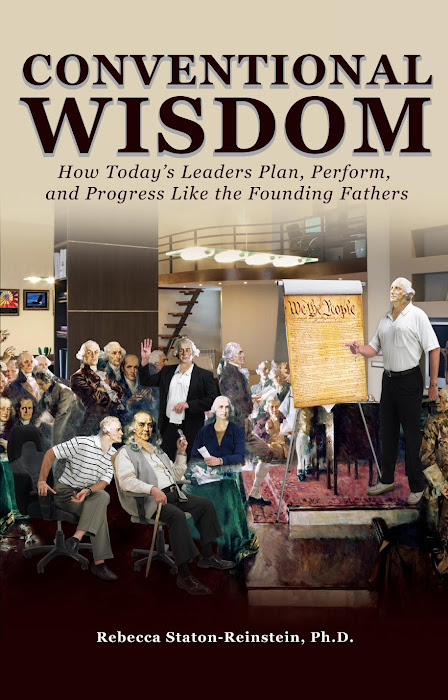
Learn more about "Conventional Wisdom: How Today's Leaders Plan, Perform, and Progress Like the Founding Fathers" (http://www.ConventionalWisdomCenter.com and visit our Author Page on Amazon. (http://tinyurl.com/RSRpage )
Sign up for our Conventional Wisdom blog and read this and other leadership stories and tips. http://tinyurl.com/yk7bgtn
Rebecca Staton-Reinstein, Ph.D., President
Advantage Leadership, Inc.
1835 NE Miami Gardens Drive, Suite 152
North Miami Beach, FL 33179