Showing posts with label Constitutional Convention. Show all posts

Saturday, June 28, 2014

A Sad Day for the Friends of James Madison

James Madison has no monuments or fancy remembrances as do many of the other founding fathers (and mothers.) Yet without him, we might not have our republic, our constitution, and be an independent country today.

When Madison was a student, at what is now Princeton, he stayed another year to work on a study of the world's constitutions while soaking up the ideas of the Scottish Enlightenment from the university's president. This began his life-long passion for republican ideals and constitutions. After flailing about for a while after college, he was elected to the Virginia (Colonial) House of Burgesses and began his life as a politician. He followed this calling to public service until the end of his presidency. Those who call for term limits and hold their noses at the idea of a "politician" could learn a lot from his decades of devotion.

After the Revolution, he watched with mounting horror as self interest brought out the worst in the Virginia legislature and the Congress under the Articles of Confederation was worse than "do nothing." By 1878, the country was in turmoil, Congress was impotent, groups of States talked of leaving the fragile union spurred on by European powers, the economy was a shambles, and Shays' Rebellion in Massachusetts frightened every property owner. The prognosis for continued existence of the country was dire.

So Madison joined Alexander Hamilton and Ben Franklin to conspire to overthrow the government; they committed treason for the second time. Working with others, Madison persuaded General George Washington to join in the call for a Constitutional Convention to provide the political cover they needed. Madison got the resolution through the Confederation Congress and became a delegate along with Washington and others to the gathering. His long-time rival, Patrick Henry, refused to have anything to do with it; "I smell a rat!" He was right, of course. Madison's intent was not to amend the Articles but to abolish them.

Jemmy and Me

He arrived in Philadelphia early, having made a thorough study of republics and constitutions "ancient and modern." He persuaded the governor to present his draft as the "Virginia Plan." Although little of it remained in the final draft signed by the delegates, it did serve as the agenda and shaped the nature and substance of the debates. Madison and the most committed delegates toiled for four months in the Philadelphia summer heat with early morning committee meetings, all-day debates, and informal politicking in the evening. Madison took voluminous notes we still marvel at today and early Supreme Court justices used to unravel "original intent."

But when the delegates scattered back to their states, the work wasn't over. They had to get the special ratifying bodies to agree to the document. In Madison's Virginia, Patrick Henry led the anti-federalist forces. Despite Henry's legendary oratorical skills and political clout, Madison bested him and eked out a tiny margin of victory.

Then he was off to the new Congress as a Representative in the House and to serve as Washington's whip in that body to achieve his legislative agenda. He served as Jefferson's Secretary of State and then as President, presiding over the War of 1812. In fact, he was the only Commander in Chief to actually go into battle, despite having no military credentials.

He was the last of the "fathers" to depart this world and did so on this day, June 28, 1836. His parting words were, "Nothing more than a change of mind, my dear." James Monroe, who succeeded him as President, referred to Madison in his dying words, "I regret that I should leave this world without again beholding him."

In my Google Alert for Madison, about 95% of the mentions are from people, right or left, trying to claim his "authority" for their views. Like anyone quoted out of context, Madison's words are distorted. More importantly, because Madison was a patriot, a passionate politician, and as partisan as anyone, you can always find some snippet to support you. These folks do a disservice to the man, his memory, and his message.

Madison, like all of us, evolved and changed with age. At the end of the Convention, he thought the Constitution was a failure because it created a Senate representing the states and not the population. Yet he went to the ratifying convention and worked with Hamilton to write the Federalist Papers defending the new Constitution with every ounce of his considerable persuasive talent. By Washington's second term, he had joined Jefferson to destroy Hamilton and the Federalists and create the Republican Party (precursor of today's Democrats.) As president, he opposed legislation for building roads and canals or providing "charity." As an elder statesman, he made it clear he had evolved to support these government efforts.

What made Madison so great was he was NOT an ideologue. He constantly thought about things, changed his mind, and made it clear where he stood at any moment. He was prepared to compromise for the good of the nation. He seldom held real animosity for his opponents. (Today he'd be derided as a flip-flopper, drummed out of whatever party he was in, and excoriated by the chattering class and talk radio.)

What I've always found so appealing about Madison was his humanness. My favorite quote from him is (out of context, of course,) "If men were angels, no government would be necessary." Madison is great because he is no saint on a pedestal. He was dead wrong on many things. He made no claims to perfection. We can admire him, not because we agree with him or can find some phrase to prove our political point, but because he thought continuously and was willing to change and grow and leave old notions behind.

If today's leaders, whether in politics or business, would spend a little time with "Jemmy, the great little Madison," they might be less inclined to require unthinking adherence to a static idea. Madison's interpretation of the republic's mission statement, the Preamble to the Constitution, matured and morphed over time. If we could take a page from his book, we might all succeed in evolving, being more strategic, making better decisions...and leaving old ideas behind.

*   *   *   *   *
(c) Rebecca Staton-Reinstein and Advantage Leadership, Inc. 
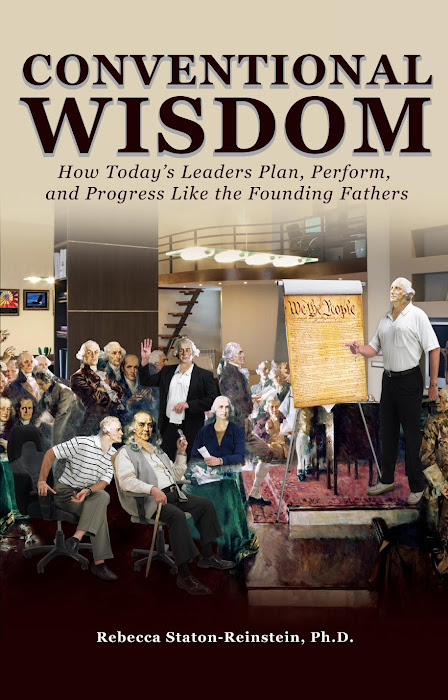
Want to know more about Madison and his role in the Constitution and early republic? Want to know how modern leaders exploit the Madison Factor? Check out Conventional Wisdom: How Today's Leaders Plan, Perform, and Progress Like the Founding Fathers. 
Your research into the planning sessions of the Constitutional Convention and the struggles that our framers of the Constitution faced has been cleverly weaved into the strategies of modern business. I am pleased to have your book.  
-- Justice Sandra Day O'Connor (RET) 

Wednesday, February 19, 2014

Slow Down to Speed Up

            Are you running like that rat in the wheel; up early, working late, vacationing with your tablet, and taking calls whizzing down the road? The labor movement fought hard for the 40-hour week. Do you scoff at working only 40 hours? When was the last time you slept 7 - 8 hours for weeks at a time?

            Everywhere I looked last week someone addressed the need to slow down. Bruce Turkel wrote a great blog; NPR's TED Radio Hour featured several presentations too. Wha's up?

            People are questioning the efficacy of our insane pace. Hundreds of studies over 50 years show these results; humans are designed to sleep 7 - 8 hours every night or we become sleep deprived. When we run on 5-6 hours for months, our health suffers, and more importantly for our productivity-obsessed business world, our efficiency plummets. We are not as mentally astute as we think; we make mistakes, have accidents, and destroy our mental capacity. The bad news? We cannot make up lost sleep. We sleep in, but that's exhaustion...no net gain.

            Here's some more bad scientific news; humans are designed to work 35 - 40 hours over a 7-day period. 50 years of data show a sad trajectory; once we work 9 or 10 hours a day, several days, our efficiency drops like a stone. Keep it up for weeks and we have to work 50 hours to do what we did in 40. The results on productivity, mistakes, mental keenness, and capacity mirror sleep deprivation. Depending on your health, age, physical and mental fitness, when you experience the toll varies. Even the heartiest lose productivity within weeks.

            Combine not-enough sleep with too-many work hours and you burnout. Period.

            Another scary reality: Large companies have Employee Assistance programs. If you're addicted to alcohol or drugs, they intervene and you can get treatment for your disease. Companies understand the destructive power of addiction. What about addiction to work? A joke, right? When they discover you're a workaholic, they rejoice and say silently, "We've got a live one!" and publically, "If you want something done, give it to a busy person!"

            I write about this because, "My name is Rebecca and I'm a workaholic." I've taken the first step and admitted it. I first realized this 20 years ago while dining with friends in Toronto. "Rebecca, you never talk about anything except work anymore." I was gob smacked. They were right.

My Simple Formula to Treat Work Addiction (most days):

·         Admit you have a problem.
·         Get 7-8 hours sleep.
·         Eat nutritiously.
·         Exercise.
·         Practice mindfulness.
·         FOCUS on important work only for an effective 35-hour week.
            When I do these things, I have more energy, get more done in less time, am rarely sick, feel better, and enjoy life more.

What a concept; sleep more, work less, and be more creative, efficient, and effective.

           I didn't change overnight and learned to decompress anywhere. For example, I arrived at an Asian airport 3 hours early, discovered a butterfly garden, and spent 2 hours in a peaceful, beautiful universe; no email, false urgency, distractions, or modern-life intrusions. I walked out calm, energized, and thoughtful to make the 30-hour flight a creative experience, not a dreaded ordeal.

           At the end of your path, no one writes on your tombstone, "He was a good corporate citizen," "She was a multitasking maven" or "The kids bragged about how many hours mommy and daddy worked."

           I always bring these discussions back to lessons from great leaders, especially the framers of the Constitution. The delegates included leisure naturally; they fished, trekked to factories, attended concerts, lectures, and religious services, read books, enjoyed tea with "the ladies" and dining with friends, kept up lively correspondence with family and friends, and ran businesses from afar. They mastered the art of a balanced life. Look what they accomplished; they created a Constitution for a successful republic, which is still in place. These guys had their wits about them. Can you say the same?

            Are you ready for workaholic rehab? Are you ready to change yourself and lead your team to be more creative and productive and transform the destructive workaholic culture of your organization?

            Dr. Deming, the great business guru said, "Why are we here [work]? We are here to come alive; to have joy in our work."

            You cannot be joyous, productive or creative when you?re running on empty. In other words, slow down to speed up.

*   *   *   *   *
©Rebecca Staton-Reinstein and Advantage Leadership, Inc

Let us help you and your team become more effective and efficient.

Subscribe to http://conventionalwisdominstitute.blogspot.com/ for leadership tips

 *   *   *   *   *
 Webinar: Get People on a Mission: Strategic Decision Making Drives Daily Action
    These extraordinary times require extraordinary performance by every manager and leader. Start with your mission and its power to galvanize people?s energy and imagination to accomplish more. Create a mission to guide robust planning, execution, and daily decision making. Get results that sustain and assure organizational growth. Sign up now! February 27, 2014 or listen at your convenience. http://tinyurl.com/5rcm256

Conventional Wisdom: How Today's Leaders Plan, Perform and Progress Like the Founding Fathers is packed with practical useful information from a group of remarkable CEOs and taps into the strategic leadership secrets of the US Constitutional Framers. Get your copy at a special price for newsletter subscribers: http://www.conventionalwisdomcenter.com/friends.html  

New Address:
Rebecca Staton-Reinstein, Ph.D., President, Advantage Leadership, Inc.
320 S. Flamingo Road, Suite 291, Pembroke Pines, FL 33027
Rebecca@AdvantageLeadership.com
www.AdvantageLeadership.com  

Monday, March 18, 2013

An uneventful birthday for Jemmy

It's really too bad. Even I forgot...and I'm a raving fan of James Madison...the mighty little Madison was 262 this past weekend, March 16 (1751.) Jemmy, as he was known to his friends and enemies, has no monuments in the nation's capitol, no face on the side of Mr. Rushmore, and no holiday marking him or his most amazing accomplishment, the U.S. Constitution.


Jemmy and Me
Think about it for a moment. We celebrate the Declaration of Independence, and we should. We celebrate Washington and Lincoln with the combined Presidents Day. We look at Mr. Rushmore and see them again along with Jefferson and Roosevelt (Teddy.) Washington's monument towers over the Mall, Jefferson, Roosevelt (Franklin,) and Lincoln gaze out from their memorials on the Mall. But Madison? Nowhere to be found except at his restored home and the Constitution Center in Philadelphia in the hall of the signers. Even there he is overshadowed by many of the others.

Why should we care? James Madison was slight of build but a giant when thinking about constitutions. He had studied every one he could lay his hands on, focusing as he said on republics "ancient and modern." But Jemmy was no dilettante. At 36, he was already an experienced politician having served in the Confederation Congress and the Virginia legislature. With Alexander Hamilton and Benjamin Franklin and a few others, he conspired to call the meeting we know as the Constitutional Convention, with a secret agenda to overthrow the existing Articles of Confederation.

The Articles had proven a disaster and the infant nation faced multiple crises including inability to pay its debts, threats of foreign invasion, individual states prepared to go to war with their neighbors or secede altogether, rampant inflation and foreclosures, open rebellion, and a deadlocked, impotent Congress.

When the delegates gathered in Philadelphia in May of 1787, it was Madison's "Virginia Plan" that formed the basis for the initial debates. The meeting was presided over by George Washington, who had been persuaded in part by Madison to come and provide political cover and credibility. Although when he signed his name to the final document, Madison was not happy with it, he was prepared to fight for it.

He teamed up with Hamilton and John Jay to write The Federalist to present a compelling case for ratification and then went into the Virginia Ratifying Convention to debate his high-profile adversary, Patrick Henry and win. Despite the fact that he was ill and exhausted from his non-stop work during the 4 months of the Constitutional Convention, he came out swinging and carried the day so Virginia ratified by a few votes. During the Convention he had been tireless, recording all the discussions, lobbying the delegates, and serving on committees.

But Madison wasn't through. He was elected to the new Congress and quickly became one of the most savvy and effective politicians and lawmakers. He gathered the suggestions for amendments into a package and fought for the passage of the Bill of Rights. He even engineered the passage of Hamilton's finance bill for the assumption of the state's war debts and the establishment of the first national bank, despite being opposed to the plan in principle.

Finally, after his long and successful legislative career and the appellation of "Father of the Constitution," which he rejected, he served in Jefferson's cabinet and then became the 5th president of the United States.

James Madison is as responsible for creating our country as any of the other more well-known figures. Without him, the Constitution might never have been written and accepted, and the country would have soon disappeared from history like so many other experiments in self-government. Madison would not have wanted a monument or public holiday for himself. He probably would have wanted a holiday for the signing of the Constitution, (September 17.)

As Madison himself wrote, "a crisis had arrived which was to decide whether the American experiment was to be a blessing to the world, or to blast for ever the hopes which the republican cause had inspired." Luckily for us, Madison was there to make the difference. Honor him by reading the Constitution and it's amendments.
*     *     *     *     *     *
(c) Rebecca Staton-Reinstein, Ph.D., president, Advantage Leadership, Inc.
Learn more about Madison's pivotal role in the Conventional Wisdom: How Today's Leaders Plan, Perform, and Progress Like the Founding Fathers (Check out the Madison's birthday special pricing.)
Please send us your comments and feedback.

Friday, August 19, 2011

Nobody's Listening! And 5 actions you can take

Over 80% of people in any presentation - on line or live - are not paying attention! They are "multitasking." Have we all gone over to the Dark Side? Are we distracting ourselves to death?

The Professional Convention Management Association, UBM Studios, and The Virtual Edge Institute partnered up to conduct the research and published it as a white paper, Business Motivations and Social Behaviors for In-Person and Online Events.

The science is clear: Humans do not "multi-task." The brain just switches back and forth among things. Even the famous multi-tasking Millennials haven't changed evolution...yet. They've just trained themselves to move between tasks faster than us old folks.

The end result is still the same. Those milliseconds of distraction don't make it into short-term memory and therefore have no chance of transferring to long-term memory.

Our electronic companions just make it easier to be distracted. Back in the day, we used to doodle or daydream. Today we obsessively surf, text, and read email...What's the difference? When we doodled or daydreamed, we eventually realized our mind was wandering. When we do the digital dance we delude ourselves into thinking we're doing something important. We'll tune back in when the other person, speaker, or cars on the road do something interesting. Talk about destructive self-adsorption...

But this is not a new human phenomenon. Back in 1787 at the U.S. Constitutional Convention, one of the first tasks the delegates tackled was setting their meeting rules. They reveal their very human tendency to be distracted...

Every member, rising to speak, shall address the President; and whilst he shall be speaking, none shall pass between them, or hold discourse with another, or read a book, pamphlet or paper, printed or manuscript...A member may be called to order by any other member, as well as by the President; and may be allowed to explain his conduct or expressions supposed to be reprehensible.

I remember watching congress people texting and tweeting during the current president's State of the Union Address. Our founding fathers understood human nature quite well. As James Madison remarked, "If men were angels, no government would be necessary."

The debate about what to do about our total distraction infractions is hot. Some say, "let's tell people not to do it." Others say, "let's get the tweeting built into the program." Both miss the point. The first doesn't work because people will ignore such instructions. The second doesn't work because it only encourages what our 18th century predecessors recognized as reprehensible behavior.

Why are you attending the webinar or seminar, teleseminar or conference in the first place? Isn't part of your motivation to learn something? Research shows, if we want to remember something, that is, move it to long-term memory, we need to engage as many senses as possible. Watching, listening, and writing engage at least 3 senses. Suck on a lollipop and write with a scented pen and you hit them all.

So here's my prescription to apply a little Conventional Wisdom:
  1. Gandhi said it best: Be the change you want to see. You are in control of your own behavior. Stop distracting yourself.
  2. As our Zen masters teach us: Be in the moment - in the NOW. Engage yourself entirely in the presentation, conversation, event. Focus your energy.
  3. Use all 5 senses and maybe that elusive 6th sense. Emphasize your own preferred learning style to maximize retention and movement into short- and long-term memory.
  4.  A member may be called to order by any other member. Take responsibility for the success of every event yourself. Ask others (politely) to respect the speakers and give them full attention. Or suggest they help you by not behaving in a distracting manner.
  5. Practice Morita psychology: Know your purpose. Feel your feelings. Do what must be done. This simple prescription from Japanese psychologist, Shoma Morita, can be applied to anything. In this context: "My purpose is to gain this knowledge. I feel like every stray thought must be communicated to my tribe and every email must be read instantly. I quiet my mind and focus on the speaker and ignore my urge to distraction and self-importance."
Consider the advice of all these cool folks - the founding fathers, Gandhi, Morita, and thousands of years of human insights into grappling with our...ooh, bright shiny object...human nature.
I'm off to a webinar soon and will try to practice what I preach...
How about you? How do you un-distract yourself...or do you?
------------------
(C) Rebecca Staton-Reinstein, President, Advantage Leadership, Inc.
References:
Notes of Debates in the Federal Convention of 1787 reported by James Madison. editor, Adrienne Koch, W.W. Norton & Co., New York, 1987
Sign in and read the original report: http://www.virtualedgeinstitute.com/business-motivations-report/
Want to know more about what we can learn about business from the founding fathers and contemporary executives? http://www.ConventionalWisdomCenter.com

Friday, May 27, 2011

The Heat are ON FIRE! 5 Actions to Burn Up the Courts

The headline in the Times today says it all:
Stars Lead Late Rally as Heat Advances
Of course I was rootin' for the home team..."In the finale, [LeBron] James and Dwyane Wade alternated big shots and suffocating stops as they crushed the Bulls’ spirit and ruthlessly erased a 12-point deficit in the final 3 minutes 2 seconds," the New York Times reported breathlessly. The Miami Heat beat the Chicago Bulls 83 - 80.
So what does this have to do with strategic leadership, the theme of this blog? Actually, a lot.
http://tinyurl.com/3wyvwmt
See the Heat were down 12 points -- it looked like a Bulls victory, game over...but LeBron, Dwyane, and Chris Bosh and the rest of the team didn't get the memo. And that's part of what sets strategic leaders apart. They're playing a different game.
When I write about the founding fathers and framers of the U.S. Constitution, I don't have to go far to find examples of that different game...think of George Washington and the Continental Army encamped at Valley Forge, crossing the Delaware or leading the far bigger and more professional British army on a wild goose chase up and down the eastern seaboard. Washington didn't know he was defeated by the major military power of the 1770s. Never-the-less, it was General Cornwallis who surrendered at Yorktown, not vice versa.
When George Hanbury began his tenure as city manager of Portsmouth, Virginia, he missed the notice that the city should be razed to the ground and rebuilt. He simply rolled up his sleeves and turned the city around. When Herb Kelleher had to sell a plane to make payroll, he missed the message from the competition that he should abandon his project to start a new airline. Instead, he and CEO Howard Putnam built a profitable, unique business that is still flying high. (The original competitors are long gone.)
In Conventional Wisdom, I recount these and other stories of strategic leaders who don't give up just because someone else thinks they should. What does it take? Here are 5 actions we can all take to "burn up the courts" and be successful in tough times.
  1. Know where you're headed: The Heat were headed to the Championship -- not just the playoffs. Washington was headed for an independent nation. Hanbury was headed for the return of a historic seaport where people wanted to live, work, and visit. They all had a driving, living VISION.
  2. Have a strategy: None of the top basketball players are just winging it any more than the successful executives. They all have a strategy and a plan. Of course, the plan has to be adjusted to deal with reality on the ground. LeBron, Dwyane, and Chris had a game plan, they had practiced and practiced, and at the end of the game knew they had to step up the pressure and simply stop the Bulls in their tracks. When Hanbury was asked to work his magic on Ft. Lauderdale, he ran into stiff opposition. He adjusted his strategy but kept the pressure on the opposition by continuing to move forward. When the French fleet arrived off Yorktown, Washington knew he had Cornwallis trapped and the troops charged the redoubts.
  3. Focus between your ears: Every new story on the brain and how it functions and the neuroscience of leadership and success shows the same thing that Henry Ford pointed out in the last millennium: "Whether you think you can or think you can't, you're right." Top athletes must have a mental game to win and hire success coaches to keep them sharp or to get back on track. Washington is well known for beginning to construct his winning character as a young man and learning from early, disastrous mistakes. Military historians may argue over how good a general he was, but there is no arguing with the results he got because of his tough mental discipline.
  4. Adopt Morita Psychology: Dr. Shoma Morita developed a powerful approach to dealing with the challenges of life. It comes down to this formula: Know Your Purpose. Feel Your Feelings. Do What You Must Do. Of course this prescription is difficult and almost impossible for some folks but not for strategic leaders. When public safety unions hired a sky writing plane to fly over the local stadium spelling out the message, "Fire Hanbury," he certainly wasn't a happy camper and he couldn't ignore his emotions. But he knew his purpose was to put the city back on a firm financial footing while transforming Ft. Lauderdale from a spring break wasteland into a vibrant, modern city. He kept to his message of fiscal responsibility with a promise of better times to come. At his retirement from the city, he was praised by the unions because he fulfilled his promises, and ignored their emotional meltdowns.
  5. Be relentless: When LeBron was interviewed at the end of that exciting winning game last night he said simply, and to the point, “There’s no sense of relief right now. We still got work to do.” As the founding fathers found out rather soon after the peace treaty with Britain (and as emerging governments are finding out today,) when the bullets stop flying there is still lots of work to do. Washington chaired the Constitutional Convention that put together a governing structure to save the barely united state from anarchy, dissolution, civil war, and absorption into Britain, France, and Spain. It's the last 3 minutes of the game...time to push! Sink 12 points and stop the offence and outsmart the defense.
It's time to Turn Up the Heat!
*   *   *   *   *   *   *   *   *
(c) Rebecca Staton-Reinstein, President, Advantage Leadership, Inc.
Read our latest strategy e-book on your Kindle. 30 Days to Building a Strategic Plan that Gets Results.
Find Conventional Wisdom, Success Planning, and 30 Days on our Amazon page.

Read more about the game in the New York Times: http://tinyurl.com/3wyvwmt

Thursday, February 3, 2011

Rabbit Chases Tiger – Good News?

Today the Year of the Rabbit dawns on the Lunar New Year. What will it bring? For those born in one of the Rabbit’s years if should be a quiet time for developing relations and propitious for starting a new business. For the rest of us, those who follow the lunar zodiac predict a calmer year with things running at a much slower pace.

"The Rabbit is one of the most gracious personalities of the zodiac…It'll be a time to nurture relationships at the many social events that will happen this year.” At least that’s what Laura Lau, co-author with her mother, Theodora Lau, of the best-selling The Handbook of Chinese Horoscopes, tells us. She believes the Tiger delivered on its reputation of unpredictability and lots of major disruptions. Many people report being happy to see the Rabbit chase the terrible Tiger out of the neighborhood.

But what does all this portend for you as a leader or business owner?

I happened to have been in Singapore as the Year of the Tiger dawned, blogged about it, and showed a clip of the Tiger making his way through the airport with much noise and excitement. That won’t be the case with the quiet and conservative Rabbit.

Lately there’s been a call for greater civility in our political discourse and that’s definitely a Rabbit-oriented wish. Whether it happens or not is another story – perhaps as fanciful as belief in mythical beasts.

However, in the world of business and work, a call for greater civility might not be so far fetched. When I entered the corporate world I was struck by the constant use of war analogies tossed off without much heed for what the words really implied. Early in my management career my boss handed me The Art of War and insisted I take it to heart and use it as an important supplement to my penchant for Drucker and Deming. Over the years I’ve come to see that in successful businesses with progressive leadership, the Rabbit rules over the Tiger.

Why? Because to get anything done in an organization with 2 people or 2 million, you must have cooperation. The old cliché, Together Everyone Achieves More, happens to be correct. When the Constitutional framers were hammering out their plan for the new nation, they had to cooperate; despite the fact the 55 delegates had strong opposing views. When John Zumwalt, CEO at PBS&J came to believe the company should reflect the communities in which it had offices, he needed the entire workforce to take on the mission. He didn’t set quotas or impose a program. He talked about the mission to everyone and enlisted their cooperation. In a few years the national engineering firm was being recognized and receiving awards for its diversity.

5 Actions to Usher in the Year of the Rabbit and Chase the Tiger

Stop the War Chatter – Record your next meeting. How often do war-related terms crop up? How often do you shoot down an idea; praise a straight shooter; develop a killer app? Ever hear the expression, As a man thinketh...? We don’t even hear the subtle messages we put out every day and reinforce in our own minds.

Stop Thinking the Competition is the Enemy – Our competitors are not our enemies. When I first started my business I was getting advice from a more experienced business owner. She bragged about how she had driven her major competitor out of business. I wasn’t impressed then or now. Why spend all that energy destroying someone else? Has airline or banking service improved with all the gobbling up of the competition? Personally, I want strong competitors. They keep me on my toes, innovating, and improving.

Start being Likable – Machiavelli helped spread the idea leaders should be feared rather than loved. Why do we associate likability with weak leadership? Joe Caccavo, the absolutely best boss I ever had, was loved and admired by his team. He was also tough and demanded our best from us. He took us to task when it was necessary. He was fair, patient, and supportive. He wanted to see each of us succeed and did everything he could to make that possible. We would have followed him anywhere and did more than any of us believed possible.

Start Looking for Synergy – I joined a new mastermind group recently. All of us are involved in the professional speaking business but none of us see one another as competitors. Instead we are all working together to help one another be more successful. Ideas and insights flow. We share our challenges and fears. The group dynamic creates a heady mix of inspiration, innovation, and tough love.

Start Caring for those you Disagree with – When we demonize those we disagree with, we stop having a dialogue; we stop learning; we stop understanding the complexity of our world. Corporate politics are just as nasty as the government-related kind. Enormous losses accrue to every organization when the politics become toxic and anti-productive. When Michael Howe took over Arby’s, he turned the chain around by leading a cultural revolution. It was certainly not easy but his efforts created a people-focused positive culture that doubled cash flow and grew revenue dramatically in a few years.

So give it some thought. Could you be more successful pursuing positive relationships and embracing your inner Rabbit and chasing out a little of your inner Tiger? I don’t know about you, but I’m certainly going to give it a go…It’s a New Year, so why not a new approach? Especially when it’s proved so successful as a business strategy.

* * * * * *

© Rebecca Staton-Reinstein, President, Advantage Leadership, Inc

Want to know more about the leaders in today’s blog and others who have transformed their organizational cultures to improve bottom- and top- line results? Check out Conventional Wisdom: How Today’s Leaders Plan, Perform, and Progress Like the Founding Fathers.

Thursday, September 16, 2010

Happy Unity Day


I sign the US Constitution
SEPTEMBER 17, 1787 -- That's the real birthday of the UNITED States! We may celebrate July 4 (1776) when we declared our independence from Great Britain but after the Revolution we were united in name only. By 1787 the States were squabbling with one another, blocking any meaningful legislation in the Congress established under the Articles of Confederation, and refusing to pay into any national fund. Each state issued its own (worthless) currency and inflation was destroying the income of farmers. That of course led to foreclosures and Captain Shays, a farmer and former army officer, mustered his fellow farmers to close down the courts and then marched on the state armory before being stopped by the Massachusetts militia. Britain, France, and Spain were plotting to pick off individual states while European creditors threatened to cut off all credit to the new country because of unpaid war debts. No, it was not a happy time. A few years after the hard-won revolution, the UN-united states faced dissolution.
James Madison, Alexander Hamilton, and Benjamin Franklin conspired to call what we know today as the Constitutional Convention. Fifty-five delegates from 12 of the 13 states met through four hot, muggy months, from May to September, in the Pennsylvania State House (now Independence Hall.) They hammered out a new Constitution using James Madison's draft as a jumping off point. They argued, postured, debated, and speechified. They were sometimes grumpy and occasionally even rude to one another. They caucused, cajoled, and compromised. (They also partied, went on excursions, dashed home to attend to business, and complained bitterly about the hard conditions in boarding houses and lack of money to pay for food and lodging.)

In the end, 40 men signed the document on September 17, 1787. We owe them a big debt. Once the Constitution was ratified in the states and the government was established with its three branches and a bicameral legislature, the states were no longer sovereign. That's right. Many states had considered themselves sovereign prior to this. Without the unity that was established with the Constitution, the likelihood that the new nation would have survived is quite slim.

Today we many argue about the amount of authority that should rest in the states and the federal government, and the framers left it a little vague in places. The fact is we are one united nation. So September 17 should be a big celebration for each American. And maybe its OK that it hasn't become another day to skip work, watch fireworks, and barbecue. Instead, why not take a little time to read the document itself. http://www.usconstitution.net/const.html Find out what it really says. It's quite short, even with the amendments. And, maybe just thank little Jemmy Madison and the boyz for persisting in their quest for a "more perfect Union."
***   ***   ***   ***   ****
(C) Rebecca Staton-Reinstein, Ph.D., President, Advantage Leadership, Inc.

Richard Brookhiser has written an excellent profile of James Madison recently. Check it out
Want to know more about the Constitutional Convention and how it functioned as a strategic planning session? Check it out: http://www.ConventionalWisdomCenter.com


Sunday, July 4, 2010

Feudin', Fightin' & Fussin' on the Fourth

I'm sick of it! Right Wingers, Left Wingers, and No Wingers...Get your facts straight...or I'll call down the wrath of Founding Fathers Past!

Got your attention? Here's what set me off on this beautiful 4th of July holiday...everybody trying to appropriate our founding fathers and mothers for their own purposes...Prove your point with logic, facts, and reason or get off the stage. (See my special offer at the end.)

What folks say: Politics are more divisive than ever...there was a time when we used to disagree without being disagreeable...viciousness in opposing parties is something new...let's bring back civility...

Folks, here's the fact...we have never been a country of sedate, soothing debate. Our founding fathers and mothers were brilliant and courageous but when it came to politics, it was no holds barred. The point was (as it still is) to prevail. They didn't cuss as much, but they were not above sexual innuendo, lying, or character assassination when it came to political opponents.

Ron Chernow (author of the excellent biography, Alexander Hamilton) wrote a delightful article in the Wall Street Journal. It starts,

Americans lament the partisan venom of today's politics, but for sheer verbal savagery, the country's founders were in a league of their own.

Chernow points out, "Despite their erudition, integrity, and philosophical genius, the founders were fiery men who expressed their beliefs with unusual vehemence." They didn't stop at criticizing one another’s politics; their barbs were often personal.

John Adams called Hamilton the "bastard son of a Scotch peddler," while James Callender exposed Hamilton's affair with his friend’s wife. Newspaper man Samuel Adams, seen as a great patriot in his own day and ours, was not above the fray. "Truth was his first victim...To radicalize the populace Adams had adopted a total disregard for it. In his writings he employed slanderous lies, unvarnished propaganda, and rabble-rousing rhetoric. He whipped the people of Massachusetts and many other colonies into an anti-British fury."

The favored form of political trash talk was the pamphlet and newspaper column, written under classical Roman pseudonyms or derived from clever puns. They hammered away at one another with great relish and no restraints. They would have embraced Tweeting and Blogging as great inventions and set out with glee to rip one another apart.

Thomas Jefferson, whose stirring prose in the Declaration of Independence animates this 4th of July and embodies our most noble ideals, shrunk from doing his own dirty work. As the formation of our first parties heated up, (Hamilton headed the Federalists and Jefferson, the Republicans) he called on his buddy, Jemmy Madison, "'For God's sake, my dear Sir, take up your pen, select the most striking heresies, and cut him (Hamilton) to pieces in the face of the public.' When Madison rose to the challenge, he sneered in print that the only people who could read Hamilton's essays with pleasure were 'foreigners and degenerate citizens among us.'" Jefferson who applauded Callender's attacks on Hamilton was not so enthusiastic when Callender turned on him exposing his affair with "dusky Sally," his slave and half-sister of his deceased wife. (quote from Chernow)

In the records of debates in the Constitutional Convention and state ratifying conventions, the rhetoric escalates, with wild accusations flying that might make some of our media mavens of mayhem blush. Remember, this was an era when people would be called to the "field of honor" (challenged to a duel) for an implied slight. Calling someone a liar to his face was such a justification. Listen to this exchange during the debate over the power of large states and small. Gunning Bedford, a "fat, tempestuous delegated from Delaware" drags his bulk in front of the delegates and in a frenzied harangue spits out, "I do not, gentlemen, trust you. If you possess the power, the abuse of it could not be checked; and what then would prevent you from exercising it to our destruction?...Is it come to this, then, that the sword must decide this controversy, and the horrors of war must be added to the rest of our misfortunes?..Sooner than be ruined, there are foreign powers who will take us by the hand."

Madison, one of the most brilliant debaters and politicians of the era, summed it up, "If men were angles, no government would be necessary." The debates roiling the late 18th and early 19th century were fierce. Federalists and Republicans accused one another of treason. They could turn on former allies over night. Madison and Hamilton engineered the Constitution Convention and co-authored the Federalist Papers (with contributions from John Jay) in its defense. Madison pushed Hamilton's financial reforms through Congress. (He twisted enough arms behind the scenes to secure passage so he could argue and vote against it in public to maintain his constituents back home. Sound familiar yet?) After the new parties formed, Madison assailed his former ally, never missing a chance to paint him in ignoble terms.

I don't like the partisan bickering, shouting, and backbiting. AND I admire Hamilton, Jefferson, Adam, Madison, and the framers and founders. My gripe is about our lack of historical knowledge, our tendency to make stuff up, and the habit of partisans of every stripe to lie to defend their cause. Let's face the brutal facts -- ones we like and ones we don't -- and debate with a goal of coming to consensus or close to it.

That was Washington's great desire. He truly hated the partisan wrangling, the unbridled press, and the inability of people to rise above their passions. Though he occasionally fell victim to his own monumental temper, mostly he was that wise, impartial leader we all admire. So on this wonderful 4th of July, while we're barbecuing, watching fireworks, or hitting the mall, let’s ask ourselves this: Am I following along in our country's long tradition of bashing and demonizing those with whom I disagree, or am I trying to follow Washington's advice and have "restraint in tongue and pen?" If you are going to evoke the founders and framers, read some real history and get it right!

-----

Want to know more about the founders and framers and how we can apply their positive and negative lessons today? CLICK HERE: Half off – 4th of July sale – Conventional Wisdom: How Today’s Leaders Plan, Perform, and Progress Like the Founding Fathers. Available ONLY on this HIDDEN web page. This is a limited offer so get your copy today. Rather buy it on Amazon (and miss out on this offer?)
® Rebecca Staton-Reinstein (all quotes fully cited in Conventional Wisdom except one about Sam Adams from Eric Burn’s Infamous Scribblers.

Thursday, May 27, 2010

223 years -- good enough track record?

223 years ago in May 1787, the U.S. Constitutional Convention opened on May 25 and began its debates. They were wrestling with how to form an effective republican government. They were responding to crises of huge proportions; a national legislature unable to act because of deep divisions, massive government debt, widespread foreclosures, foreign enemies prepared to strike, and extensive domestic strife.

Sound familiar?

On May 29, Edmund Randolph put forth the Virginia Plan -- authored by James Madison -- as an outline for the constitutional debates. Deliberations raged for four long months in the Philadelphia heat. At the end the produced the U.S. Constitution that was ratified the following year after extensive, rancorous debate in state ratifying conventions. This historic document is a strategic plan that has stood the test of time.

A few years ago, author David McCullough gave a speech at a leadership seminar entitled, "Knowing History and Knowing Who We Are." In it he quoted Daniel Boorstin, the late Librarian of Congress, saying 'trying to plan for the future without a sense of the past is like trying to plant cut flowers.' McCullough continued, "We're raising a lot of cut flowers and trying to plant them...One of the truths of history...is that nothing ever had to happen the way it happened...We just don't know how things are going to turn out for us, they [the revolutionary generation] didn't either...[John Adams in a letter to his wife wrote,] 'We can't guarantee success in this war, but we can do something better. We can deserve it.' Think how different that is from the attitude today when all that matters is success."

McCullough goes on to decry our lack of knowledge, much less understanding, of history and concludes, "History isn't just something that ought to be taught...or encouraged because it's going to make us a better citizen." [It will make us a better citizen, a more thoughtful and understanding human being, and will cause us to behave better.] History "should be taught for pleasure: The pleasure of history, like art or music or literature, consists of an expansion of the experience of being alive, which is what education is largely about."

What pleasure, guidance or understanding can you gain from the history of the making of the U.S. Constitution? What pragmatic lessons are there for your leadership efforts? According to many contemporary executives, there is a lot to learn. I interviewed 20 of them as well as poured over the records of the Constitutional Convention. I discovered the common strategic approaches of historic and modern leaders as they work to deserve success.

Here's what former Supreme Court Justice Sandra Day O'Connor had to say:

Thank you for sharing with me your new book Conventional Wisdom: How Today's Leaders Plan, Perform, and Progress Like the Founding Fathers. Your research into the planning sessions of the Constitutional Convention and the struggles that our framers of the Constitution faced has been cleverly weaved into the strategies of modern business. I am pleased to have your book.

I have been persuaded to reopen a "secret" webpage for a limited time so you can take advantage of a special offer and improve your own performance and learn from these historic and modern mentors. I did it myself. The very process of writing the book was a major learning experience. The insights I gained and applied helped me survive the economic downturn and thrive now that things are improving. You can do the same.
Discover your own conventional wisdom... Click here for the special offer.

* * * * * * * * *

(c) Rebecca Staton-Reinstein, Ph.D., President, Advantage Leadership, Inc.

Wednesday, September 30, 2009

Plan is a 4-letter word!

"Listen, Rebecca, nobody has time for this planning stuff in this economy. They just need to survive. Planning's for when things calm down."

That was the 'conventional wisdom' from a chum of mine recently. Well, I beg to differ -- I'm not being self serving -- so here's the 'evidence.'

The September 25 - October 1 edition of the South Florida Business Journal reported in two separate articles on local banks that are doing well because of their planning. We could all take a lesson from them.

Coral Gables, Florida is the home of Gibraltar Private Bank and Trust. Several years ago the bank, founded by Steve Hayworth in 1994, was acquired by Boston Private Financial Holdings. It has just been repurchased by Hayworth and a group of investors.

Hayworth said he moved to repurchase the bank because he felt it was in the best interests of his clients. The bank will stick to its business model.

"In this environment, I see an opportunity for an integrated private bank and wealth management," Hayworth said. "We are very focused on private banking and wealth advisory services for professionals and affluent families."
"The bank will stick to its business model." This is one of the keys to Gibraltar's success for many years, first as it prepared itself for acquisition, then as it prospered under the Boston company's auspices, and now as it strikes out on its own again. Steve Hayworth and Gibraltar were featured as a case study on the power of strategic planning and leadership in Conventional Wisdom: How Today's Leaders Plan, Perform, and Progress Like the Founding Fathers. They attributed their phenomenal growth and doubling their assets in four years to the robust strategic plan they put together and FOLLOWED. In fact, they coined a telling phrase, "The Plan is the Boss." When other banks were faltering, going under, or just flailing about in an economic downturn, Gibraltar and Hayworth stuck with their plan and forged ahead.
In the same issue of SFBJ an unrelated story featured the Florida Shores -- Southeast Bank, founded by Steven Hickman in 2006 in Pompano Beach, Florida. Obviously this wasn't a great time to start a new bank and the bank and Hickman took a lot of flack for their slow initial growth. According to the Business Journal

Hickman said he wanted a manageable rate of growth that stuck to the bank's business plan. Because of that, Florida Shores has a relatively clean balance sheet.

"A lot of the banks that grew faster are paying the price now," he said. "We have good capital and plenty of money to lend."
"Manageable rate of growth that stuck to the bank's business plan." There's that pesky planning again! Hickman, in an email, was quick to give credit to his entire team for being the fastest-growing South Florida bank. But as was clear from the leadership philosophy he shared in Conventional Wisdom: How Today's Leaders Plan, Perform, and Progress Like the Founding Fathers, Hickman had been an expert and booster of strategic planning since his early days in the banking business. He knew its power in helping keep any venture on track and successful over the long haul. The proof of the power of that approach is in his balance sheet.

Planning in tough times? Is it a must for survival? Think about the framers of the U.S. Constitution, also featured in Conventional Wisdom. The United States were hardly united. Europe had cut off our credit, inflation was rampant, and foreclosures were devastating the farm-based economy. The latter led directly to Shays' Rebellion where local farmers in Massachusetts closed down the bankruptcy courts and marched on the state arsenal. Foreign powers were perched on our borders just waiting to pick off the disintegrating states like road kill. In fact, the U.S. faced the most threatening crisis in its history, rivaled only by the winter of 1776-7, the Civil War, and the Great Depression. Tough times indeed!

So what was the response to this tough time? 55 men assembled in Philadelphia in the summer of 1787 to hammer out a strategic plan for the nation. That's right...a strategic plan...The Constitution. Want to know more? Check out Conventional Wisdom. Want to get through these tough times? Make a plan Stan and Fran! Create a strategic plan with short term actions that will move you toward your long-term goals. If you flail you fail. Or as that sage, business guru Yogi Berra said, "If you don't know where you're going, any road will do."

I don't know about you, but I'm following the lead of Hayworth, Hickman, and the framers.

(c) Rebecca Staton-Reinstein and Advantage Leadership, Inc.

Saturday, August 29, 2009

The Lions Sleep...


The Lion of the Senate, Ted Kennedy, has passed from the scene and both Democrats and Republicans, allies and opponents lionize his contributions of four decades plus service. All of them seem to agree that what made him such a legislative master was his ability to find common ground. On the Senate floor he might roar and attack but behind the scenes he was ready with a joke, a helping hand, and a genuine desire to work out a solution. At his wake earlier this evening, one of the speakers talked about his lack of pettiness or personal rancor.

What struck me about all of this were the parallels with my own favorite legislator, James Madison. Jemmy like Teddy mastered the art of being an effective legislator. From his mid-twenties on, he served in a series of legislative bodies and was seldom out of office. He started in the colonial Virginia House of Burgesses and moved through the independent Assembly and into the Continental Congress. His most important contribution was helping pass religious freedom legislation and to fight Patrick Henry’s favorite cause, state funding for religious institutions.

Madison is called the Father of the Constitution with good reason. He used the skills he had honed in the rough-and-tumble legislatures of the Revolution and post-Revolutionary period to make sure we built a more perfect union. Jemmy was one of the conspirators who brought the Constitutional Convention into existence. (Patrick Henry stayed home saying he smelled a rat!) He had done extensive homework and showed up early to meet the delegates, take their measure, and begin building relationships. He had a draft of a new constitution introduced as the Virginia Plan. He spoke on every issue, forcefully and often persuasively. He worked in committees and behind the scenes, looking for common ground, striking deals, and building consensus. He socialized and told great, if off-color stories, and seemed to be everywhere doing the one-on-one of good political organizing. In other words he was a great legislator.

Once the Constitution was finished he worked with Alexander Hamilton in a white heat of creativity to author the Federalist, one of the great political documents of all time, arguing persuasively for ratification. Of course he was elected to the Virginia ratifying convention and although he was very ill, probably as a result of his four months of non-stop work in the convention followed by months of work on Federalist, he faced down Patrick Henry’s bombast and dramatic attacks on the new Constitution. He worked his legislative skills to their limits and brought in a paper thin victory.

With the formation of a new Congress, there was a groundswell of support to appoint Madison to the Senate. But now political payback was at work. Patrick Henry blocked his nomination, still smarting from his most recent defeat and never forgiving him for the defeat of state support of religion. Although Henry also attempted to gerrymander his district later, Madison was elected to the House of Representatives every time he ran.

In the new Congress, Madison was in his element and served as Washington’s right-hand man, making sure his legislative agenda was realized. Madison first drafted and then engineered the passing of the Bill of Rights. But perhaps one of his most interesting feats was passing Hamilton’s financial legislation. Here we see a skilled legislator at work. Even though Madison was skeptical of the financial and monetary policy in the bill, he agreed to support it. He worked behind the scenes to line up enough votes so it could pass (and he could save face with constituents and vote against it.)

For most of his life, he was known to be a passionate supporter of republican values and government without being ideological, petty, or back biting. He did not hold grudges and worked to find common ground. But as Washington entered his second term, Madison teamed up with his best friend Thomas Jefferson and fell into the ideological trap as they worked to destroy Hamilton and form the first political party in the modern sense, the Republican Party which morphed into the Democratic Republican party which became the Democratic Party. (Note – the modern Republican party arose in the years before the Civil War.)

Once Jemmy went down this ideological trail, his effectiveness as a legislator declined. When he entered the Executive branch as Jefferson’s Secretary of State and later as President, he was out of his area of real expertise. The master legislator disappeared and the adequate, but not distinguished, executive took his place. In retirement, the gifted Madison returned, without rancor again, reconsidering earlier positions, and looking for common ground.

Perhaps Ted Kennedy’s most enduring legacy will be as a role model for accepting ones gifts, ones true talents, and building them into a lifetime of passionate service. Jemmy could have learned a few things from Teddy…and visa versa. At their best, both men showed us what legislators should be – people who get things done by looking for ways to compromise, to work together, to be collegial, and to eschew ideological and petty rancor, payback, and meanness. Jemmy and Teddy were lions many of today’s legislators should learn from…the lions are sleeping...but hopefully others will awaken...

(C) Rebecca Staton-Reinstein