Showing posts with label Mitt Romney. Show all posts

Monday, June 4, 2012

Dirtiest Election Ever: Beyond the F-Bomb

Every time a politician drops the F-bomb, the media are all atwitter. (Can Twitter be atwitter?) They run the clip over and over BLEEPING politely at the crucial moment so as not to offend us. The current two candidates for president are not the sort of folks who will be caught using this anglosaxonism although their associates may be. Jefferson and Adams in the election of 1800 usually preferred the perfect barbed comment also.

So what? Move off the "networks" and onto the cable channels and the F-Bomb is just another word among many floating across the airwaves. But looking back to the really nasty election of 1800 and its parallels with 2012, what is the story when it comes to salty language and attack words?

Today as in 1800 there were words that people thought too rude for public discourse. But what was happening behind the scenes? There folks weren't as gentlemanly as we like to think, especially when talking among themselves.

George Washington had a towering temper he kept in check for the most part. When he let it rip he could toss the verbal bombs with the best of them. When delegates to the Constitutional Convention sat with their pipes and port after dinner, they often swapped bawdy stories, just as people do today. One of their favorite games was inventing wilder and wilder puns about Gouverneur Morris' wooden leg and his way with the ladies. James Madison was infamous among his contemporaries for his off-color stories.

It's true they didn't throw the F-Bomb but they certainly came close. John Adams was no fan of Alexander Hamilton and in a letter to Benjamin Rush in 1806 let fly with this diatribe against Hamilton for remarks he had made denigrating George Washington.


John Adams
Although I read with tranquility and suffered to pass without animadversion in silent contempt the base insinuations of vanity and a hundred lies besides published in a pamphlet against me by an insolent coxcomb who rarely dined in good company, where there was good wine, without getting silly and vaporing about his administration like a young girl about her brilliants and trinkets, yet I lose all patience when I think of a bastard brat of a Scotch pedlar daring to threaten to undeceive the world in their judgment of Washington by writing an history of his battles and campaigns. This creature was in a delirium of ambition; he had been blown up with vanity by the tories, had fixed his eyes on the highest station in America, and he hated every man, young or old, who stood in his way or could in any manner eclipse his laurels or rival his pretensions. . . 

Pretty strong stuff...but not as strong as these "gentlemen" wrote under pen names in the popular press skewering one another and accusing one another of the worst intentions, treason, and more. Generally they lambasted one another with innuendo as well as direct attacks. In fact, what can be a delicious pastime is dissecting their elaborate language and watch as they slip the verbal knife between the ribs and give a fatal twist.

We seldom hear such creativity today where it's so easy to just go for the flat obscenity rather than the creative crudity. I was impressed when George Will called Donald Trump a bloviating ignoramus. The founding fathers would have liked that.

But are there any Leadership Lessons in all this?  Perhaps a few:
  • Leaders control themselves: George Washington was prickly and thin skinned and took offence easily. Yet his advice to himself and others was to show restraint of "tongues and pens." He kept his temper in check most of the time. "Losing it" on a regular basis causes people to disengage. 
  • Leaders cultivate creativity: "Bloviating" is such a yummy word and I'm sure many people scurried to google its meaning. (Synonym for blow hard) In our general anti-intellectual climate, leaders encourage their people to think and grow and become more articulate.
  • Leaders do not condone crudity: Leaders know that some language offends some people just like the bawdy stories and sexist remarks that have disappeared for most workplaces. They do not insist on better communication because of "political correctness." They want to be inclusive; they want everyone to be engaged.
Just because the founding fathers weren't saints doesn't mean we do not honor and respect them. We admire them because, like us, they were all too human, capable of pettiness and backbiting, and sometimes behaving badly. We can learn from them precisely because they are human. We can learn from their mistakes and when they triumphed over their human nature. And we can learn from their fierce honesty because they would call a bloviating ignoramus a bloviating ignoramus!
*     *     *     *     *     *     *     *

What's your idea: Can we joust with more inventive language without bloviating? Please post your comments.
* * * * * * *
Next: How foreign are foreign affairs?

* * * * * *
©Rebecca Staton-Reinstein, president, Advantage Leadership, Inc.
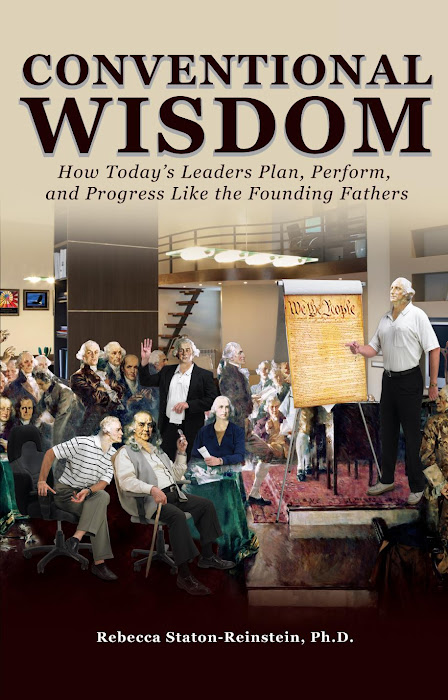
Want to know more about the tumultuous fights at the Constitutional Convention and the election of 1800? Check out Conventional Wisdom: How Today's Leaders Plan, Perform, and Progress Like the Founding Fathers

I NEED YOUR HELP: I'm beginning research for my new book on the influence of leaders on their organizations (Washington's Shadow) and I'm interested in your experiences or ideas for case studies. Do you know a leader who has had a profound influence shaping the organization's culture and changing it for the better? (I'm not interested in negative stories which are much more common.) Drop me a note:


We've started a companion YouTube series and the introduction is up. Check it out.

Tuesday, May 29, 2012

Dirtiest Election Ever: God or Not God, That is THE Question

Religion seems to always raise its specter during the silly season - the election cycle. This is one of the smarmier sides of politics - folks attacking Romney and his religion, Mormonism, as a cult and non-Christian; other folks accusing Obama of being either a secret Muslim or white-hating black Christian...

After a while it seems like outrages get more extreme...but is it anything new? Unfortunately not. The "dirtiest election ever" was held in 1800 when Thomas Jefferson faced off against John Adams...and guess what? Religion and accusations about religion were front and center. Remember, in 1800 ALL newspapers were affiliated with one or the other party. There was nothing that resembled unbiased journalism...and there were virtually no rules. NOTHING was sacred.

Jefferson, the Vice President, was the standard bearer for the Republicans. (No not the same party as the one today. Jefferson's Republicans morphed into the Democratic Republicans and later the Democratic Party.) Adams, the sitting President, represented the Federalists (who died off in the early 1800s.)

Both were "founding fathers" and recognized as great patriots.

Adams had been one of the first to push for a break with England and was a leading member of the Continental Congress and helped write the Constitution for the new State of Massachusetts. He had been part of the committee charged with writing the Declaration of Independence. He served as Washington's Vice President and kept the new country out of wars with England and France.

Jefferson was also part of the committee charged with drafting the Declaration. Adams  proposed Jefferson should create the draft to bring back for approval by Congress. Jefferson had served as war time governor of Virginia and was almost captured by the British. He had served as Adams' Vice President, Washington's Secretary of State, and,  earlier, been our representative to France.

Both men had sterling credentials...

This was the era of the Enlightenment that  swept Europe and the colonies. Adams, Jefferson, and the rest of the Revolutionary generation were weaned on John Locke's treatises. So it should come as no surprise that Jefferson was a Deist. In all probability so were Adams, Franklin, and Alexander Hamilton. The difference was these gentlemen never made public pronouncements or recorded their views in writing and Jefferson did.

If you're wondering what a Deist is...Essentially they believe god may have created the universe but does not intervene after the creation. Nature's laws can be studied and understood. There is no need for organized religion. Scriptures are interesting but not divine revelation. People must use and develop their rational capacities to solve the problems of the world. Logical belief for the children of the Enlightenment was heresy for the dominant Protestant culture of country in 1800. To add a little spice to the religious mixture, the late 18th century was the period known as the "Great Awakening" in America as a highly spiritual, evangelical spirit and "dissenting" religions spread across many states.

Jefferson had committed one huge sin in the eyes of many devout Christians (and political opponents.) He had written the Virginia Statute for Religious Freedom. Its goal was to disestablish the Episcopal Church as the official religion in the state, allow freedom of conscience for everyone, and no longer allow state taxes to go to support religious schools and churches. (His buddy, James Madison, a masterful politician, got it through the Virginia Assembly, used it as a basis for writing the First Amendment to the Constitution later, and incurred the wrath and retaliation of Patrick Henry.)

Jefferson created his own version of the bible

So let the games begin.

Adams was vilified as a monarchist, still a dirty word in 1800. He was accused of plotting to set up a hereditary monarchy beginning with his son John Quincy.

The common epithet thrown at Jefferson was atheist, an accusation attached to him throughout his long political career. During the 1800 elections cycle Jefferson's support of the French Revolution earned him yet another attack - Jacobin. Like his French counterparts, it was said he wanted to destroy religion and abolish churches and private property.

Jefferson was the subject of viral attacks in the press. Yes, that's nothing new - it just took a little longer as other papers and pamphlets copied the following from the Gazette of the United States, a Federalist paper, and spread it:

The Grand Question Stated: only question to be asked of every American...Shall I continue in allegiance to God and a religious president or impiously declare for Jefferson and no God? 

Substitute today's candidates and the effect is the same.

What are the lessons for leaders today?
  • Ignore labels: Successful strategic leaders know great ideas can come from anyone. They also know a religious or political label does not reveal how a person will behave and act. Bigotry, prejudice, and bias have no role for leaders. Savvy leaders search themselves for these traps and consciously refute them.
  •  
  • Advocate: Successful leaders will take their cue from James Madison. Madison was a religious man and member of the Episcopal Church. Yet it was he who brought his legislative skills to bear to oppose Patrick Henry and the Virginia elite and pass the Virginia Statue for Religious Freedom and penned the First Amendment to the US Constitution and shepherded it through the first Congress. It was Madison who championed the separation of church and state and opposed appointing a chaplain for Congress and opening sessions with prayer. Leaders advocate for the rights of those who have no advocate.
  •  
  • Practice What You Preach: Leaders put their faith or beliefs into action. We fault the founding fathers for their refusal to end slavery. Perhaps one of the most stunning exceptions was Robert Carter III, member of the Virginia elite. In 1791 he walked into the local courthouse and initiated the process to free all his enslaved people. He grew into his beliefs as part of the Great Awakening. He was a member of integrated churches, some of which had black clergy, and all of which preached complete equality. He freed over 450 people, more than anyone freed prior to emancipation 60 years later. Carter took what he believed to be the right action. His position was, "My plans and advice have never been pleasing to the world." Despite being ostracized by his fellow planters and ignoring the financial impact, he continued to support his former bondsmen, provided them land, and lived with them as neighbors.
  •  
  • Refute the Ridiculous: Leaders have the courage to refute the mud slung at their opponents. Throughout the down-and-dirty election of 1800, John Adams never refuted the attacks on Jefferson, nor did Jefferson refute those hurled at Adams. They were long-time friends and knew one another well. They knew the truth about one another. They missed an opportunity to demonstrate their greatness. Leaders defend the truth with enthusiasm as John McCain did in 2008 confronting the birthers.
What's your idea: Can we leave religion and matters of conscience out of politics and the workplace? Please post your comments.
* * * * * * *
Next: Discourse before the F-Bomb
* * * * * *
©Rebecca Staton-Reinstein, president, Advantage Leadership, Inc.
Want to know more about the tumultuous fights at the Constitutional Convention and the election of 1800? Check out Conventional Wisdom: How Today's Leaders Plan, Perform, and Progress Like the Founding Fathers

I NEED YOUR HELP: I'm beginning research for my new book on the influence of leaders on their organizations (Washington's Shadow) and I'm interested in your experiences or ideas for case studies. Do you know a leader who has had a profound influence shaping the organization's culture and changing it for the better? (I'm not interested in negative stories which are much more common.) Drop me a note: