Showing posts with label Alexander Hamilton. Show all posts

Saturday, March 5, 2016

Dirtiest Election Ever: Beyond Obscenity to Articulate a Vision

In the recent “presidential” debate, just when we thought it couldn’t get any lower, sure enough one of the candidates made a vulgar allusion. (Yes, you had to have a dirty mind to catch it.) Of course the media are all atwitter. (Can Twitter be atwitter?) They run the clip over and over, pretending to be offended, but they run it ad nauseam.

So what? Move off the networks and onto the cable channels and the Anglo-Saxonisms flow regularly across the airwaves. But looking back to the really nasty election of 1800 and its parallels with 2016, what is the story when it comes to salty language and attack words? At the time Thomas Jefferson and John Adams faced off in what historians cite as the dirtiest election ever, what was the state of public discourse? In some ways it was as coarse as today.


Today, as in 1800, there were words people thought too rude for public discourse. But behind the scenes? There folks weren't as gentlemanly as we like to think, especially when talking among themselves. Adams’ surrogates claimed Jefferson was an atheist who wanted to turn churches into brothels. Adams’ irascible personality and weight were always fair game for “His Rotundness.” 

George Washington had a towering temper he usually kept in check. When he let it rip he could toss the verbal bombs with the best of them. When delegates to the Constitutional Convention sat with their pipes and port after dinner, they often swapped bawdy stories. One of their favorite games was inventing wilder and wilder sexual puns about Gouverneur Morris' wooden leg and his way with the ladies. James Madison was infamous among his contemporaries for his dirty jokes.

It's true they didn't throw the F-Bomb but they certainly came close. John Adams was no fan of Alexander Hamilton and in an 1806 letter to Benjamin Rush hurled this diatribe against Hamilton for his remarks denigrating George Washington.

Although I read with tranquility and suffered to pass without animadversion in silent contempt the base insinuations of vanity and a hundred lies besides published in a pamphlet against me by an insolent coxcomb who rarely dined in good company, where there was good wine, without getting silly and vaporing about his administration like a young girl about her brilliants and trinkets, yet I lose all patience when I think of a bastard brat of a Scotch pedlar daring to threaten to undeceive the world in their judgment of Washington by writing an history of his battles and campaigns. This creature was in a delirium of ambition; he had been blown up with vanity by the tories, had fixed his eyes on the highest station in America, and he hated every man, young or old, who stood in his way or could in any manner eclipse his laurels or rival his pretensions. . .

Pretty strong stuff...but not as strong as these "gentlemen" wrote under pen names in the popular press skewering one another and accusing one another of the worst intentions and even treason. Generally they lambasted one another with innuendo as well as direct attacks. It can be a delicious pastime to dissect their elaborate language and watch as they slip the verbal knife between the ribs and give a fatal twist.

Today it's so easy go for the obvious obscenity rather than the creative cut. In the 2012 presidential race, George Will wondered why Candidate Mitt Romney was embracing Donald Trump, whom he called a “bloviating ignoramus,” certainly an arcane insult the founders could have appreciated in their own rough and tumble elections.

Is this what we want to hear from our leaders? Has reality become reality TV? Are there any Leadership Lessons in all this? Perhaps a few:

·  Leaders control themselves: George Washington was prickly, thin skinned, and took offence easily. Yet his advice to himself and others was to show restraint of "tongues and pens." He kept his temper in check most of the time. He knew "losing it" on a regular basis causes people to disengage.

·  Leaders cultivate creativity: "Bloviating" is such a yummy word, I'm sure folks scurried to google its meaning (synonym for blow hard.) In our general anti-intellectual climate, leaders encourage their people to think and grow and become more articulate, communicate better for collaboration, without reducing everything to the lowest common denominator.

·  Leaders do not condone crudity: Leaders know language can offend like the bawdy stories and sexist remarks disappearing from most workplaces. Leaders insist on better communication not to be "politically correct" but to be inclusive; they need everyone engaged. Leaders foster serious, passionate debate and discussion to unearth the best solutions.

Just because the founding fathers weren't saints doesn't mean we do not honor and respect them. We admire them because, like us, they were all too human, capable of pettiness and backbiting, and sometimes behaving badly. We learn from them precisely because they made mistakes and then triumphed over their human nature.
This doesn’t mean we want this dubious name-calling, sexual-innuendo tradition to continue. When I watch fired-up candidates yelling insults rather than debating issues and policies, I flash on our sons as teenagers sitting on the sofa hurling barbs and punching each other. Normal teenage malarkey...but not the vision of leadership, functioning on the global stage or wrestling with intractable conflicts and seeking resolutions and peace. I hope we deserve better.
Jefferson, Adams, and the other founders showed us real leadership in tough times. They rose above their character defects. Can we do the same as we select a world leader?
* * * * * * * *
What's your idea: Can we joust without bloviating?
* * * * * * *
(c) Rebecca Staton-Reinstein and Advantage Leadership, Inc.


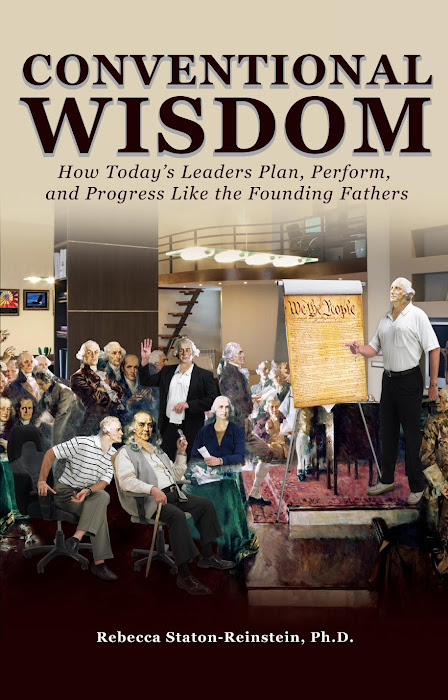
Want to know more about the tumultuous fights at the Constitutional Convention and the election of 1800? Check out Conventional Wisdom: How Today's Leaders Plan, Perform, and Progress Like the Founding Fathers

I started a companion video series during the 2012 elections that holds true today.
https://www.youtube.com/watch?v=RbcLmL3HuHo 

Saturday, June 28, 2014

A Sad Day for the Friends of James Madison

James Madison has no monuments or fancy remembrances as do many of the other founding fathers (and mothers.) Yet without him, we might not have our republic, our constitution, and be an independent country today.

When Madison was a student, at what is now Princeton, he stayed another year to work on a study of the world's constitutions while soaking up the ideas of the Scottish Enlightenment from the university's president. This began his life-long passion for republican ideals and constitutions. After flailing about for a while after college, he was elected to the Virginia (Colonial) House of Burgesses and began his life as a politician. He followed this calling to public service until the end of his presidency. Those who call for term limits and hold their noses at the idea of a "politician" could learn a lot from his decades of devotion.

After the Revolution, he watched with mounting horror as self interest brought out the worst in the Virginia legislature and the Congress under the Articles of Confederation was worse than "do nothing." By 1878, the country was in turmoil, Congress was impotent, groups of States talked of leaving the fragile union spurred on by European powers, the economy was a shambles, and Shays' Rebellion in Massachusetts frightened every property owner. The prognosis for continued existence of the country was dire.

So Madison joined Alexander Hamilton and Ben Franklin to conspire to overthrow the government; they committed treason for the second time. Working with others, Madison persuaded General George Washington to join in the call for a Constitutional Convention to provide the political cover they needed. Madison got the resolution through the Confederation Congress and became a delegate along with Washington and others to the gathering. His long-time rival, Patrick Henry, refused to have anything to do with it; "I smell a rat!" He was right, of course. Madison's intent was not to amend the Articles but to abolish them.

Jemmy and Me

He arrived in Philadelphia early, having made a thorough study of republics and constitutions "ancient and modern." He persuaded the governor to present his draft as the "Virginia Plan." Although little of it remained in the final draft signed by the delegates, it did serve as the agenda and shaped the nature and substance of the debates. Madison and the most committed delegates toiled for four months in the Philadelphia summer heat with early morning committee meetings, all-day debates, and informal politicking in the evening. Madison took voluminous notes we still marvel at today and early Supreme Court justices used to unravel "original intent."

But when the delegates scattered back to their states, the work wasn't over. They had to get the special ratifying bodies to agree to the document. In Madison's Virginia, Patrick Henry led the anti-federalist forces. Despite Henry's legendary oratorical skills and political clout, Madison bested him and eked out a tiny margin of victory.

Then he was off to the new Congress as a Representative in the House and to serve as Washington's whip in that body to achieve his legislative agenda. He served as Jefferson's Secretary of State and then as President, presiding over the War of 1812. In fact, he was the only Commander in Chief to actually go into battle, despite having no military credentials.

He was the last of the "fathers" to depart this world and did so on this day, June 28, 1836. His parting words were, "Nothing more than a change of mind, my dear." James Monroe, who succeeded him as President, referred to Madison in his dying words, "I regret that I should leave this world without again beholding him."

In my Google Alert for Madison, about 95% of the mentions are from people, right or left, trying to claim his "authority" for their views. Like anyone quoted out of context, Madison's words are distorted. More importantly, because Madison was a patriot, a passionate politician, and as partisan as anyone, you can always find some snippet to support you. These folks do a disservice to the man, his memory, and his message.

Madison, like all of us, evolved and changed with age. At the end of the Convention, he thought the Constitution was a failure because it created a Senate representing the states and not the population. Yet he went to the ratifying convention and worked with Hamilton to write the Federalist Papers defending the new Constitution with every ounce of his considerable persuasive talent. By Washington's second term, he had joined Jefferson to destroy Hamilton and the Federalists and create the Republican Party (precursor of today's Democrats.) As president, he opposed legislation for building roads and canals or providing "charity." As an elder statesman, he made it clear he had evolved to support these government efforts.

What made Madison so great was he was NOT an ideologue. He constantly thought about things, changed his mind, and made it clear where he stood at any moment. He was prepared to compromise for the good of the nation. He seldom held real animosity for his opponents. (Today he'd be derided as a flip-flopper, drummed out of whatever party he was in, and excoriated by the chattering class and talk radio.)

What I've always found so appealing about Madison was his humanness. My favorite quote from him is (out of context, of course,) "If men were angels, no government would be necessary." Madison is great because he is no saint on a pedestal. He was dead wrong on many things. He made no claims to perfection. We can admire him, not because we agree with him or can find some phrase to prove our political point, but because he thought continuously and was willing to change and grow and leave old notions behind.

If today's leaders, whether in politics or business, would spend a little time with "Jemmy, the great little Madison," they might be less inclined to require unthinking adherence to a static idea. Madison's interpretation of the republic's mission statement, the Preamble to the Constitution, matured and morphed over time. If we could take a page from his book, we might all succeed in evolving, being more strategic, making better decisions...and leaving old ideas behind.

*   *   *   *   *
(c) Rebecca Staton-Reinstein and Advantage Leadership, Inc. 
Want to know more about Madison and his role in the Constitution and early republic? Want to know how modern leaders exploit the Madison Factor? Check out Conventional Wisdom: How Today's Leaders Plan, Perform, and Progress Like the Founding Fathers. 
Your research into the planning sessions of the Constitutional Convention and the struggles that our framers of the Constitution faced has been cleverly weaved into the strategies of modern business. I am pleased to have your book.  
-- Justice Sandra Day O'Connor (RET) 

Monday, March 18, 2013

An uneventful birthday for Jemmy

It's really too bad. Even I forgot...and I'm a raving fan of James Madison...the mighty little Madison was 262 this past weekend, March 16 (1751.) Jemmy, as he was known to his friends and enemies, has no monuments in the nation's capitol, no face on the side of Mr. Rushmore, and no holiday marking him or his most amazing accomplishment, the U.S. Constitution.


Jemmy and Me
Think about it for a moment. We celebrate the Declaration of Independence, and we should. We celebrate Washington and Lincoln with the combined Presidents Day. We look at Mr. Rushmore and see them again along with Jefferson and Roosevelt (Teddy.) Washington's monument towers over the Mall, Jefferson, Roosevelt (Franklin,) and Lincoln gaze out from their memorials on the Mall. But Madison? Nowhere to be found except at his restored home and the Constitution Center in Philadelphia in the hall of the signers. Even there he is overshadowed by many of the others.

Why should we care? James Madison was slight of build but a giant when thinking about constitutions. He had studied every one he could lay his hands on, focusing as he said on republics "ancient and modern." But Jemmy was no dilettante. At 36, he was already an experienced politician having served in the Confederation Congress and the Virginia legislature. With Alexander Hamilton and Benjamin Franklin and a few others, he conspired to call the meeting we know as the Constitutional Convention, with a secret agenda to overthrow the existing Articles of Confederation.

The Articles had proven a disaster and the infant nation faced multiple crises including inability to pay its debts, threats of foreign invasion, individual states prepared to go to war with their neighbors or secede altogether, rampant inflation and foreclosures, open rebellion, and a deadlocked, impotent Congress.

When the delegates gathered in Philadelphia in May of 1787, it was Madison's "Virginia Plan" that formed the basis for the initial debates. The meeting was presided over by George Washington, who had been persuaded in part by Madison to come and provide political cover and credibility. Although when he signed his name to the final document, Madison was not happy with it, he was prepared to fight for it.

He teamed up with Hamilton and John Jay to write The Federalist to present a compelling case for ratification and then went into the Virginia Ratifying Convention to debate his high-profile adversary, Patrick Henry and win. Despite the fact that he was ill and exhausted from his non-stop work during the 4 months of the Constitutional Convention, he came out swinging and carried the day so Virginia ratified by a few votes. During the Convention he had been tireless, recording all the discussions, lobbying the delegates, and serving on committees.

But Madison wasn't through. He was elected to the new Congress and quickly became one of the most savvy and effective politicians and lawmakers. He gathered the suggestions for amendments into a package and fought for the passage of the Bill of Rights. He even engineered the passage of Hamilton's finance bill for the assumption of the state's war debts and the establishment of the first national bank, despite being opposed to the plan in principle.

Finally, after his long and successful legislative career and the appellation of "Father of the Constitution," which he rejected, he served in Jefferson's cabinet and then became the 5th president of the United States.

James Madison is as responsible for creating our country as any of the other more well-known figures. Without him, the Constitution might never have been written and accepted, and the country would have soon disappeared from history like so many other experiments in self-government. Madison would not have wanted a monument or public holiday for himself. He probably would have wanted a holiday for the signing of the Constitution, (September 17.)

As Madison himself wrote, "a crisis had arrived which was to decide whether the American experiment was to be a blessing to the world, or to blast for ever the hopes which the republican cause had inspired." Luckily for us, Madison was there to make the difference. Honor him by reading the Constitution and it's amendments.
*     *     *     *     *     *
(c) Rebecca Staton-Reinstein, Ph.D., president, Advantage Leadership, Inc.
Learn more about Madison's pivotal role in the Conventional Wisdom: How Today's Leaders Plan, Perform, and Progress Like the Founding Fathers (Check out the Madison's birthday special pricing.)
Please send us your comments and feedback.

Monday, June 4, 2012

Dirtiest Election Ever: Beyond the F-Bomb

Every time a politician drops the F-bomb, the media are all atwitter. (Can Twitter be atwitter?) They run the clip over and over BLEEPING politely at the crucial moment so as not to offend us. The current two candidates for president are not the sort of folks who will be caught using this anglosaxonism although their associates may be. Jefferson and Adams in the election of 1800 usually preferred the perfect barbed comment also.

So what? Move off the "networks" and onto the cable channels and the F-Bomb is just another word among many floating across the airwaves. But looking back to the really nasty election of 1800 and its parallels with 2012, what is the story when it comes to salty language and attack words?

Today as in 1800 there were words that people thought too rude for public discourse. But what was happening behind the scenes? There folks weren't as gentlemanly as we like to think, especially when talking among themselves.

George Washington had a towering temper he kept in check for the most part. When he let it rip he could toss the verbal bombs with the best of them. When delegates to the Constitutional Convention sat with their pipes and port after dinner, they often swapped bawdy stories, just as people do today. One of their favorite games was inventing wilder and wilder puns about Gouverneur Morris' wooden leg and his way with the ladies. James Madison was infamous among his contemporaries for his off-color stories.

It's true they didn't throw the F-Bomb but they certainly came close. John Adams was no fan of Alexander Hamilton and in a letter to Benjamin Rush in 1806 let fly with this diatribe against Hamilton for remarks he had made denigrating George Washington.


John Adams
Although I read with tranquility and suffered to pass without animadversion in silent contempt the base insinuations of vanity and a hundred lies besides published in a pamphlet against me by an insolent coxcomb who rarely dined in good company, where there was good wine, without getting silly and vaporing about his administration like a young girl about her brilliants and trinkets, yet I lose all patience when I think of a bastard brat of a Scotch pedlar daring to threaten to undeceive the world in their judgment of Washington by writing an history of his battles and campaigns. This creature was in a delirium of ambition; he had been blown up with vanity by the tories, had fixed his eyes on the highest station in America, and he hated every man, young or old, who stood in his way or could in any manner eclipse his laurels or rival his pretensions. . . 

Pretty strong stuff...but not as strong as these "gentlemen" wrote under pen names in the popular press skewering one another and accusing one another of the worst intentions, treason, and more. Generally they lambasted one another with innuendo as well as direct attacks. In fact, what can be a delicious pastime is dissecting their elaborate language and watch as they slip the verbal knife between the ribs and give a fatal twist.

We seldom hear such creativity today where it's so easy to just go for the flat obscenity rather than the creative crudity. I was impressed when George Will called Donald Trump a bloviating ignoramus. The founding fathers would have liked that.

But are there any Leadership Lessons in all this?  Perhaps a few:
  • Leaders control themselves: George Washington was prickly and thin skinned and took offence easily. Yet his advice to himself and others was to show restraint of "tongues and pens." He kept his temper in check most of the time. "Losing it" on a regular basis causes people to disengage. 
  • Leaders cultivate creativity: "Bloviating" is such a yummy word and I'm sure many people scurried to google its meaning. (Synonym for blow hard) In our general anti-intellectual climate, leaders encourage their people to think and grow and become more articulate.
  • Leaders do not condone crudity: Leaders know that some language offends some people just like the bawdy stories and sexist remarks that have disappeared for most workplaces. They do not insist on better communication because of "political correctness." They want to be inclusive; they want everyone to be engaged.
Just because the founding fathers weren't saints doesn't mean we do not honor and respect them. We admire them because, like us, they were all too human, capable of pettiness and backbiting, and sometimes behaving badly. We can learn from them precisely because they are human. We can learn from their mistakes and when they triumphed over their human nature. And we can learn from their fierce honesty because they would call a bloviating ignoramus a bloviating ignoramus!
*     *     *     *     *     *     *     *

What's your idea: Can we joust with more inventive language without bloviating? Please post your comments.
* * * * * * *
Next: How foreign are foreign affairs?

* * * * * *
©Rebecca Staton-Reinstein, president, Advantage Leadership, Inc.
Want to know more about the tumultuous fights at the Constitutional Convention and the election of 1800? Check out Conventional Wisdom: How Today's Leaders Plan, Perform, and Progress Like the Founding Fathers

I NEED YOUR HELP: I'm beginning research for my new book on the influence of leaders on their organizations (Washington's Shadow) and I'm interested in your experiences or ideas for case studies. Do you know a leader who has had a profound influence shaping the organization's culture and changing it for the better? (I'm not interested in negative stories which are much more common.) Drop me a note:


We've started a companion YouTube series and the introduction is up. Check it out.

Friday, March 23, 2012

Where is Stand Your Ground Leadership?

30 thousand people show up in Sanford, Florida. The BBC covers the rally. Morning Joe has serious, thoughtful, long discussions. One million people sign an on-line petition. After weeks of denial, avoidance, obfuscation, refusing to take any responsibility, and stonewalling, now a few anemic actions are taken in the State of Florida. (Full disclosure: my home since 1991.)

For those unfamiliar with the case here are the bare facts: (Timeline http://abcnews.go.com/blogs/headlines/2012/03/trayvon-martin-case-timeline-of-events/ )

On the night of February 26, 2012, teenager Trayvon Martin was returning from the store with candy and ice tea in a cloistered neighborhood in Sanford, Florida. George Zimmerman, a local self-appointed neighborhood watchman was cruising in his truck, armed with a 9 mm semi-automatic pistol. Moments later the kid was dead on the street and the police did not arrest Zimmerman who invoked Florida’s infamous Stand Your Ground law, which condones self-defense use of lethal force if you believe your life is in danger. The kid’s crimes? He was black. He brought Skittles to a gun fight.

What happened to the killer?
Nothing. Nothing!

Zimmerman went home, still packing. The cops, police chief, city manager, city council, and every other official went home, still wrapped in the odd notion of justifiable homicide of a kid who just wanted some snacks while watching the super bowl. No public statements of outrage or even a little handwringing over the tragic events.
The family demanded justice and got indifference. If this were the 1950s, maybe that would have been the end of it. But this is the age of the internet and the 24/7 news cycle. And this is not the South of the 1950s where I grew up and such travesties went unexamined. You can’t keep your dirty little secrets any more.

So yesterday 30,000 people showed up to say ENOUGH! By now a few small tokens of action have been taken.

But where were the leaders?

Where were the designated leaders who should have been standing their ground for justice and the American values we hear so much about in this political season?
  • Governor Scott finally made a public statement and started an investigation.
  • Authors of the original legislation said it didn’t apply in this case and defended the odious law.
  • The city council passed a nonbinding (?) 3-2 resolution suggesting the police chief step down.
  • The city manager, sounding like a corporate spokesman after an environmental disaster, stonewalled and said “we’re looking at it.”
  • The police chief finally went on leave.
Zimmerman is still wandering around out there, still armed. He appointed himself to: decide what a crime is and interpret the law; to bring the individual down; be judge, jury, and executioner.

Where are those defenders of the Constitution searching for original intent? Did James Madison intend to unleash vigilantes to stand their ground? Oops, Zimmerman wasn’t standing – he was running after the kid who was fleeing for his life.

This blog is usually reflecting on strategic leadership and our connection to the U.S. founding fathers. What has this to do with them? Everything…

True leaders stand their ground.

Certainly George Washington stood his ground when he faced enormous criticism from both political factions over remaining neutral in the endless wars between England and France.

John Adams stood his ground and lost his second presidential bid when he refused to go to war with France and pushed for a new treaty.

James Madison, no military man, stood his ground when he took his horse rode out to face the British invasion and defied his popular critics in the unpopular War of 1813.

In fact the Constitution exists because Madison, Franklin, Washington, and Hamilton and a few others stood their ground, conspired against the weak government under the Articles of Confederation, called the Convention, fought the new plan through state ratifying assemblies, and then made the experiment in republican government work.

So far, the elected and appointed leaders in this disgusting situation have not stood their ground. They have all been missing in action. The grieving family and their emerging multitude of supporters will overcome. Justice will eventually be done…that’s the power of a democratic society…if the leaders don’t lead, the people, standing their ground, will.

Of all the quotes on leadership that would fit this occasion, I’ll let founding mother, Abigail Adams, who always stood her ground, have the last word.

"We have too many high sounding words, and too few actions that correspond with them." 
*     *     *     *     *     *     *     *


Sunday, July 4, 2010

Feudin', Fightin' & Fussin' on the Fourth

I'm sick of it! Right Wingers, Left Wingers, and No Wingers...Get your facts straight...or I'll call down the wrath of Founding Fathers Past!

Got your attention? Here's what set me off on this beautiful 4th of July holiday...everybody trying to appropriate our founding fathers and mothers for their own purposes...Prove your point with logic, facts, and reason or get off the stage. (See my special offer at the end.)

What folks say: Politics are more divisive than ever...there was a time when we used to disagree without being disagreeable...viciousness in opposing parties is something new...let's bring back civility...

Folks, here's the fact...we have never been a country of sedate, soothing debate. Our founding fathers and mothers were brilliant and courageous but when it came to politics, it was no holds barred. The point was (as it still is) to prevail. They didn't cuss as much, but they were not above sexual innuendo, lying, or character assassination when it came to political opponents.

Ron Chernow (author of the excellent biography, Alexander Hamilton) wrote a delightful article in the Wall Street Journal. It starts,

Americans lament the partisan venom of today's politics, but for sheer verbal savagery, the country's founders were in a league of their own.

Chernow points out, "Despite their erudition, integrity, and philosophical genius, the founders were fiery men who expressed their beliefs with unusual vehemence." They didn't stop at criticizing one another’s politics; their barbs were often personal.

John Adams called Hamilton the "bastard son of a Scotch peddler," while James Callender exposed Hamilton's affair with his friend’s wife. Newspaper man Samuel Adams, seen as a great patriot in his own day and ours, was not above the fray. "Truth was his first victim...To radicalize the populace Adams had adopted a total disregard for it. In his writings he employed slanderous lies, unvarnished propaganda, and rabble-rousing rhetoric. He whipped the people of Massachusetts and many other colonies into an anti-British fury."

The favored form of political trash talk was the pamphlet and newspaper column, written under classical Roman pseudonyms or derived from clever puns. They hammered away at one another with great relish and no restraints. They would have embraced Tweeting and Blogging as great inventions and set out with glee to rip one another apart.

Thomas Jefferson, whose stirring prose in the Declaration of Independence animates this 4th of July and embodies our most noble ideals, shrunk from doing his own dirty work. As the formation of our first parties heated up, (Hamilton headed the Federalists and Jefferson, the Republicans) he called on his buddy, Jemmy Madison, "'For God's sake, my dear Sir, take up your pen, select the most striking heresies, and cut him (Hamilton) to pieces in the face of the public.' When Madison rose to the challenge, he sneered in print that the only people who could read Hamilton's essays with pleasure were 'foreigners and degenerate citizens among us.'" Jefferson who applauded Callender's attacks on Hamilton was not so enthusiastic when Callender turned on him exposing his affair with "dusky Sally," his slave and half-sister of his deceased wife. (quote from Chernow)

In the records of debates in the Constitutional Convention and state ratifying conventions, the rhetoric escalates, with wild accusations flying that might make some of our media mavens of mayhem blush. Remember, this was an era when people would be called to the "field of honor" (challenged to a duel) for an implied slight. Calling someone a liar to his face was such a justification. Listen to this exchange during the debate over the power of large states and small. Gunning Bedford, a "fat, tempestuous delegated from Delaware" drags his bulk in front of the delegates and in a frenzied harangue spits out, "I do not, gentlemen, trust you. If you possess the power, the abuse of it could not be checked; and what then would prevent you from exercising it to our destruction?...Is it come to this, then, that the sword must decide this controversy, and the horrors of war must be added to the rest of our misfortunes?..Sooner than be ruined, there are foreign powers who will take us by the hand."

Madison, one of the most brilliant debaters and politicians of the era, summed it up, "If men were angles, no government would be necessary." The debates roiling the late 18th and early 19th century were fierce. Federalists and Republicans accused one another of treason. They could turn on former allies over night. Madison and Hamilton engineered the Constitution Convention and co-authored the Federalist Papers (with contributions from John Jay) in its defense. Madison pushed Hamilton's financial reforms through Congress. (He twisted enough arms behind the scenes to secure passage so he could argue and vote against it in public to maintain his constituents back home. Sound familiar yet?) After the new parties formed, Madison assailed his former ally, never missing a chance to paint him in ignoble terms.

I don't like the partisan bickering, shouting, and backbiting. AND I admire Hamilton, Jefferson, Adam, Madison, and the framers and founders. My gripe is about our lack of historical knowledge, our tendency to make stuff up, and the habit of partisans of every stripe to lie to defend their cause. Let's face the brutal facts -- ones we like and ones we don't -- and debate with a goal of coming to consensus or close to it.

That was Washington's great desire. He truly hated the partisan wrangling, the unbridled press, and the inability of people to rise above their passions. Though he occasionally fell victim to his own monumental temper, mostly he was that wise, impartial leader we all admire. So on this wonderful 4th of July, while we're barbecuing, watching fireworks, or hitting the mall, let’s ask ourselves this: Am I following along in our country's long tradition of bashing and demonizing those with whom I disagree, or am I trying to follow Washington's advice and have "restraint in tongue and pen?" If you are going to evoke the founders and framers, read some real history and get it right!

-----

Want to know more about the founders and framers and how we can apply their positive and negative lessons today? CLICK HERE: Half off – 4th of July sale – Conventional Wisdom: How Today’s Leaders Plan, Perform, and Progress Like the Founding Fathers. Available ONLY on this HIDDEN web page. This is a limited offer so get your copy today. Rather buy it on Amazon (and miss out on this offer?)
® Rebecca Staton-Reinstein (all quotes fully cited in Conventional Wisdom except one about Sam Adams from Eric Burn’s Infamous Scribblers.

Wednesday, April 1, 2009

April 1 is not a foolish day

April 1 is an important day in American history, although few people know it. This is the anniversary of the first day the new Congress under the new Constitution met, had a quorum, and could conduct business. April 1, 1790. No foolin'...James Madison and the other delegates assembled to begin the business of putting the newly ratified Constitution into action. They began the business of ensuring the fragile union survived and grew strong.

This was no easy task. This was a new form of republican government. The delegates were serving two year terms in the newly established House of Representatives. They knew they would have some real power to get things done and to levy the necessary taxes to meet their obligations. Under the now-defunct Articles of Confederation, they were only able to beg the states to support initiatives with money. Now they represented specific geographical constituencies and each had a vote unlike the one vote per state under the Articles.

The crisis that brought on the Constitutional Convention and resulted in the new government was still raging; foreclosures, inflation, threatening foreign powers, creditors demanding payment for war debt, and more. The situation was not unlike today, although the country was more vulnerable than now.

As usual, James Madison had made a thorough study of the issues. He had the responsibility for seeing that George Washington's agenda made it through the new legislature. To gain ratification of the new Constitution, he had promised to bring a bill of rights into the amendment process. He would also have to see to it that the proposal for funding the debt and establishing a national bank would pass even though he had grave doubts about it. However, Alexander Hamilton, the new Secretary of the Treasury had convinced him it was a necessity to deal with their disastrous financial and credit situation.

Today's leaders face many of the same crises as the those in that first Congress. In fact the parallels are startling. They also face tough, even unpleasant choices. Several of the contemporary leaders profiled in my new book spoke at a seminar for local business people on March 27. They agreed with the premise that now is the time to focus on opportunity while doing what is necessary to get through the short term.

Greg Swienton, CEO of Ryder System, repeated his philosophy from his profile in the book. He has charged his team with looking for every alternative saving before letting an employee go. That means getting rid of things that make their lives more convenient or comfortable but do not actually contribute anything. He had already led the way by getting rid of the corporate jet when he became CEO.

Ben Baldanza, CEO of Spirit Airlines, was also on the panel and interviewed in the book. In a piece about him in the New York Times on Monday, the reporter was incredulous at his plain office in a nondescript office park. Baldanza was photographed with his own vacuum cleaner he uses to keep his office clean. But this is exactly the leadership image he is trying to set.

The key for all of the leaders on the panel is to focus on important isses with strong, decisive actions that are congruent with their larger mission.

So, no foolin'...take these leadership lessons to heart on this historic day.
(c) Rebecca Staton-Reinstein

Read more about these modern leaders and those of the early republic today -- Conventional Wisdom: How Today's Leaders Plan, Perform, and Progress Like the Founding Fathers http://www.conventionalwisdomcenter.com/

The full panel included: Greg Swienton, CEO, Ryder System; Ben Baldanza, CEO, Spirit Airlines; John Stunson, City Manager, Oakland Park, Florida; George Hanbury, COO/EVP Nova Southeastern University; Evan Rees, former President, CNL Bank, now working full time to raise money for the Boy Scouts and the Partnership for the Homeless.

The panel presentation will be available soon on our website. http://www.advantageleadership.com/

Saturday, January 24, 2009

Is George Washington or James Madison one of your peeps?


No, this is not a weird question. If you lead a team at any level of your organization, you should be on the look out for other potential leaders. If you’re a team member at any level of the organization, you should look at your own way of contributing. We have much to learn about successful team leadership and membership from George and Jemmy. Most of twenty executives and CEOs, interviewed for my new book on strategic leadership, chose George as a leader they admired from among the founding generation. Jemmy Madison emerged as an exemplary team member and leader. What can we learn from them?

George Washington --
--- was admired by his troops during the American Revolution, not because he was a nice guy – he was tough, insisted on discipline, and had a legendary temper. He was admired because the troops knew he cared about them, pleaded their case in the Continental Congress, and suffered hardships but never flinched in the face of the enemy.

--- became president in the midst of economic chaos, foreign plots to destroy the U.S., and internal political divisions. No one had ever been president of a republic covering so many people in such a large land mass. He had to invent the precedents from the most mundane to the most consequential.

--- could have been king – there were many who wanted to elect him king for life. Instead, he chose to serve two terms and then retire, just as he had when he resigned his commission at the end of the Revolution.

What does this teach us as leaders of teams from the executive suite to the shop floor?

The leader must:
* care about the team, share their situation, and fight for the team members’ success and recognition

* be creative, inventive, and make decisions based on vision and values

* know when to relinquish power and overcome the push of ego to hang on.

James Madison --
--- was the master of leading from behind, whether engineering the U.S. Constitutional Convention, drafting the outline for the Constitutional debates, or generating consensus behind the scenes.

--- articulated his case clearly and persuasively at every instance whether in the Constitutional Convention, the Virginia Constitutional ratifying convention or co-writing the The Federalist.

--- fought to pass the legislation that was necessary to establish the new republic as a strong nation – even when he was not 100% in support of the actions, such as authoring and championing the Bill of Rights or shepherding Alexander Hamilton’s financial plans through a reluctant Congress.

What does this teach us as team members from the executive suite to the shop floor?
* If you don’t take credit for everything, you can achieve more working to get the results the team and its leader need

* Learn to make clear and cogent contributions to every discussion – do your homework and share your insights

* Sometimes you must fight hard to accomplish something you don’t agree with 100% to further the results of the team and its leader.

Washington and Madison had a special relationship that developed over many years. George was the charismatic leader who wanted to build a strong republic. Jemmy was the brilliant thinker and politician who knew how to persuade people of the need for a robust republic and its institutions. They made a strong team to bring about the Constitution and to get the new government established.

But even their team didn’t last forever. As Washington’s first term was ending, his cabinet team that included Alexander Hamilton and Thomas Jefferson was breaking down. The enmity that developed between these two titans resulted in the formation of the first political parties in the U.S. – the Federalists led by Hamilton and the Republicans led by Jefferson. Once Madison opted for Jefferson’s team, the Washington-Madison team broke down.

You can learn a lot from Washington and Madison AND modern executives who are strategic leaders…Conventional Wisdom: How Today’s Leaders Plan, Perform, and Progress Like the Founding Fathers examines how contemporary executives exercise strategic leadership, utilize their own Madison Factor, build effective teams, and deal with mistakes and tough decisions.

Learn more from the Constitutional framers and modern leaders. Get your copy of Conventional Wisdom today using the special pre-publication offer at http://www.conventionalwisdomcenter.com/.

Rebecca Staton-Reinstein, President, Advantage Leadership, Inc. http://www.AdvantageLeadership.com
Author, Conventional Wisdom http://www.conventionalwisdomcenter.com/