Showing posts with label religious freedom. Show all posts

Tuesday, May 29, 2012

Dirtiest Election Ever: God or Not God, That is THE Question

Religion seems to always raise its specter during the silly season - the election cycle. This is one of the smarmier sides of politics - folks attacking Romney and his religion, Mormonism, as a cult and non-Christian; other folks accusing Obama of being either a secret Muslim or white-hating black Christian...

After a while it seems like outrages get more extreme...but is it anything new? Unfortunately not. The "dirtiest election ever" was held in 1800 when Thomas Jefferson faced off against John Adams...and guess what? Religion and accusations about religion were front and center. Remember, in 1800 ALL newspapers were affiliated with one or the other party. There was nothing that resembled unbiased journalism...and there were virtually no rules. NOTHING was sacred.

Jefferson, the Vice President, was the standard bearer for the Republicans. (No not the same party as the one today. Jefferson's Republicans morphed into the Democratic Republicans and later the Democratic Party.) Adams, the sitting President, represented the Federalists (who died off in the early 1800s.)

Both were "founding fathers" and recognized as great patriots.

Adams had been one of the first to push for a break with England and was a leading member of the Continental Congress and helped write the Constitution for the new State of Massachusetts. He had been part of the committee charged with writing the Declaration of Independence. He served as Washington's Vice President and kept the new country out of wars with England and France.

Jefferson was also part of the committee charged with drafting the Declaration. Adams  proposed Jefferson should create the draft to bring back for approval by Congress. Jefferson had served as war time governor of Virginia and was almost captured by the British. He had served as Adams' Vice President, Washington's Secretary of State, and,  earlier, been our representative to France.

Both men had sterling credentials...

This was the era of the Enlightenment that  swept Europe and the colonies. Adams, Jefferson, and the rest of the Revolutionary generation were weaned on John Locke's treatises. So it should come as no surprise that Jefferson was a Deist. In all probability so were Adams, Franklin, and Alexander Hamilton. The difference was these gentlemen never made public pronouncements or recorded their views in writing and Jefferson did.

If you're wondering what a Deist is...Essentially they believe god may have created the universe but does not intervene after the creation. Nature's laws can be studied and understood. There is no need for organized religion. Scriptures are interesting but not divine revelation. People must use and develop their rational capacities to solve the problems of the world. Logical belief for the children of the Enlightenment was heresy for the dominant Protestant culture of country in 1800. To add a little spice to the religious mixture, the late 18th century was the period known as the "Great Awakening" in America as a highly spiritual, evangelical spirit and "dissenting" religions spread across many states.

Jefferson had committed one huge sin in the eyes of many devout Christians (and political opponents.) He had written the Virginia Statute for Religious Freedom. Its goal was to disestablish the Episcopal Church as the official religion in the state, allow freedom of conscience for everyone, and no longer allow state taxes to go to support religious schools and churches. (His buddy, James Madison, a masterful politician, got it through the Virginia Assembly, used it as a basis for writing the First Amendment to the Constitution later, and incurred the wrath and retaliation of Patrick Henry.)

Jefferson created his own version of the bible

So let the games begin.

Adams was vilified as a monarchist, still a dirty word in 1800. He was accused of plotting to set up a hereditary monarchy beginning with his son John Quincy.

The common epithet thrown at Jefferson was atheist, an accusation attached to him throughout his long political career. During the 1800 elections cycle Jefferson's support of the French Revolution earned him yet another attack - Jacobin. Like his French counterparts, it was said he wanted to destroy religion and abolish churches and private property.

Jefferson was the subject of viral attacks in the press. Yes, that's nothing new - it just took a little longer as other papers and pamphlets copied the following from the Gazette of the United States, a Federalist paper, and spread it:

The Grand Question Stated: only question to be asked of every American...Shall I continue in allegiance to God and a religious president or impiously declare for Jefferson and no God? 

Substitute today's candidates and the effect is the same.

What are the lessons for leaders today?
  • Ignore labels: Successful strategic leaders know great ideas can come from anyone. They also know a religious or political label does not reveal how a person will behave and act. Bigotry, prejudice, and bias have no role for leaders. Savvy leaders search themselves for these traps and consciously refute them.
  •  
  • Advocate: Successful leaders will take their cue from James Madison. Madison was a religious man and member of the Episcopal Church. Yet it was he who brought his legislative skills to bear to oppose Patrick Henry and the Virginia elite and pass the Virginia Statue for Religious Freedom and penned the First Amendment to the US Constitution and shepherded it through the first Congress. It was Madison who championed the separation of church and state and opposed appointing a chaplain for Congress and opening sessions with prayer. Leaders advocate for the rights of those who have no advocate.
  •  
  • Practice What You Preach: Leaders put their faith or beliefs into action. We fault the founding fathers for their refusal to end slavery. Perhaps one of the most stunning exceptions was Robert Carter III, member of the Virginia elite. In 1791 he walked into the local courthouse and initiated the process to free all his enslaved people. He grew into his beliefs as part of the Great Awakening. He was a member of integrated churches, some of which had black clergy, and all of which preached complete equality. He freed over 450 people, more than anyone freed prior to emancipation 60 years later. Carter took what he believed to be the right action. His position was, "My plans and advice have never been pleasing to the world." Despite being ostracized by his fellow planters and ignoring the financial impact, he continued to support his former bondsmen, provided them land, and lived with them as neighbors.
  •  
  • Refute the Ridiculous: Leaders have the courage to refute the mud slung at their opponents. Throughout the down-and-dirty election of 1800, John Adams never refuted the attacks on Jefferson, nor did Jefferson refute those hurled at Adams. They were long-time friends and knew one another well. They knew the truth about one another. They missed an opportunity to demonstrate their greatness. Leaders defend the truth with enthusiasm as John McCain did in 2008 confronting the birthers.
What's your idea: Can we leave religion and matters of conscience out of politics and the workplace? Please post your comments.
* * * * * * *
Next: Discourse before the F-Bomb
* * * * * *
©Rebecca Staton-Reinstein, president, Advantage Leadership, Inc.
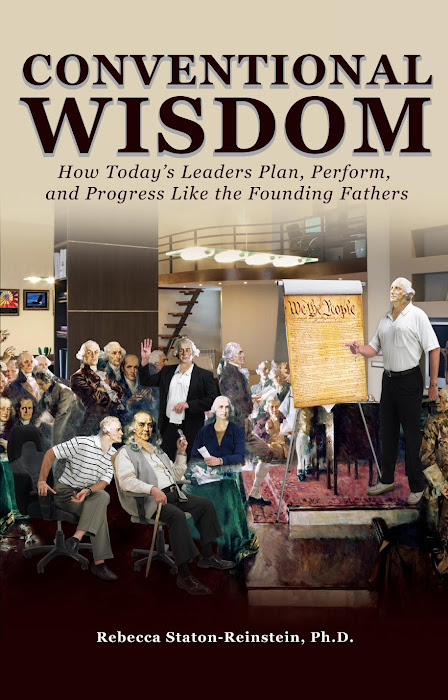
Want to know more about the tumultuous fights at the Constitutional Convention and the election of 1800? Check out Conventional Wisdom: How Today's Leaders Plan, Perform, and Progress Like the Founding Fathers

I NEED YOUR HELP: I'm beginning research for my new book on the influence of leaders on their organizations (Washington's Shadow) and I'm interested in your experiences or ideas for case studies. Do you know a leader who has had a profound influence shaping the organization's culture and changing it for the better? (I'm not interested in negative stories which are much more common.) Drop me a note:

Sunday, January 16, 2011

Thank you Jefferson and Madison for Religious Freedom

Imagine my surprise. It was a chill December day as I drove through rural South Carolina on my way home from a visit with my sister. As I flipped around the radio dial I found some easy-listening jazz and settled back to enjoy the winter landscape flying by my window. Now here’s the surprising part. When the commercial break arrived, I found I was listening to WLGI, a 50,000 watt radio station in Williamsburg County, S.C…but not just any small station…This was run by a local Bahá’i community institute. Bahá’i in the rural south?
My reaction in finding the radio station was, “Only in America!” I immediately fired off a text message to a Bahá’i friend in Brussels. Then I reflected a little more…The Bahá’i are persecuted, excluded, and murdered in their native Iran and have been since the 19th century. Here in the U.S. about 130,000 Bahá’i live and worship freely.

Then I reflected a little more…Only a few short months ago the TV was full of reports of a Florida preacher who threatened to burn a Koran and bitter opponents of an Islamic Center in lower Manhattan taking to the streets.

All these reflections and more bring me to the importance of today. On January 16, 1786 the Virginia legislature adopted the Virginia Statute for Religious Freedom. In 1993, the U.S. Congress commemorated this historic occasion by establishing National Religious Freedom Day.

Thomas Jefferson wrote the historic legislation but it took his friend, James Madison, to push it through the state legislature, opposed all the way by Patrick Henry. The immediate impact was to disestablish the Anglican Church as the official state church and stop laws persecuting other religions.

During the hot debates over the Statute, which would deprive the Anglican church of state tax revenues, representatives tried to limit the coverage to Christians. Madison successfully stopped the effort. Jefferson wrote he was delighted the move "was rejected by the great majority, in proof that they meant to comprehend within the mantle of its protection, the Jew and the Gentile, the Christian and Mahometan, the Hindoo, the infidel of every denomination."

The essence of the statute is clear: "all men shall be free to profess, and by argument to maintain, their opinion in matters of religion, and that the same shall in no wise diminish enlarge, or affect their civil capacities." Original intent is crystal clear in these and many statements by Madison, Jefferson, and others.

Later, when Madison took up his duties in the first U.S. Congress, his first duty was to draft a set of amendments to the new Constitution he helped create. The first of these comes down to us as the First Amendment, establishing religious freedom and separation of church and state. Madison drew on the Virginia Statue and his life-long devotion to freedom of conscience.

So celebrate Religious Freedom Day, by the dictates of your own conscience, not just today, but every day. Whether you embrace a particular religion, no religion or something in between, the spirit of this day belongs to you.

The Bahá’i belief of our universal family living in peace sure brings that message home.

* * * * * *
© Rebecca Staton-Reinstein, President, Advantage Leadership, Inc. http://www.advantageleadership.com/

If you’re unfamiliar with the Bahá’i Faith, it was founded in 1852 by a Persian nobleman while imprisoned in Teheran for his religious beliefs. Bahá'u'lláh, a monotheist, believed all humans are part of the same family and ultimately believe in the same god. He emphasized the importance of the messages and messengers of all religions, and living a moral, ethical, peaceful life while serving other. (Learn more at http://www.bahai.org/)

Jefferson included authorship of the Virginia Statute and the Declaration of Independence and the founding of the University of Virginia as the 3 accomplishments to be placed on his grave stone.

Tuesday, August 24, 2010

Brits Burn White House TODAY!

Yes, the British did burn the White House on this day (August 24) in 1814...just thought I'd throw in a screeching headline because they are all the rage as the media cover big events.  What was going on back in 1814? Why were the British so mad? Probably they were retaliating for the U.S. burning public buildings in York (Toronto) Canada...all part of the War of 1812.

The soldiers added insult to injury by eating the food set out on the dining room table and sarcastically drank to "Jemmy's health" with his fine wines in crystal glasses...then burned the house, capitol, and assorted other official buildings.

It was a bitter day in U.S. history after several humiliating defeats in the war. President Madison was not at home to great his unwelcome guests but was on horseback in the field with his army. He was the last Commander in Chief to actually take part in a battle. It was all the more surprising because of his frail physique.

Of course, Madison is not known for his military prowess. He has no eponymously named buildings in Washington, his face does not stare out from Mt. Rushmore, nor does he grace any money. But we should be thinking about James Madison today, on the anniversary of the burning of his official residence because of his pivotal role in the Constitution and the Bill of Rights. They are his monument.

What would Madison make of the current roiling debates about building an Islamic Center in New York City? There are several clues -- more than that, well established facts. Here's a brief entry from Wikipedia that summarizes those facts.

As a young lawyer, Madison defended Baptist preachers arrested for preaching without a license from the established Anglican Church. In addition, he worked with the preacher Elijah Craig on constitutional guarantees for religious liberty in Virginia.[10] Working on such cases helped form his ideas about religious freedom. Madison served in the Virginia state legislature (1776–79) and became known as a protégé of Thomas Jefferson. He attained prominence in Virginia politics, helping to draft the Virginia Statute for Religious Freedom. It disestablished the Church of England and disclaimed any power of state compulsion in religious matters. He excluded Patrick Henry's plan to compel citizens to pay for a congregation of their own choice.

Madison's cousin, the Right Reverend James Madison (1749–1812), became president of the College of William & Mary in 1777. Working closely with Madison and Jefferson, Bishop Madison helped lead the College through the difficult changes involving separation from both Great Britain and the Church of England.

Madison wrote widely about the issue of freedom of conscience and religion. Unlike Jefferson and Franklin for example, he was a religious person and a member of the Episcopal faith. During the fight to ratify the new Constitution, many opponents demanded the addition of a bill of rights. Madison, at first opposed such a list as both unnecessary and inadequate but was eventually convinced that it was important to gain support for the Constitution. He digested the hundreds of proposed amendments down to a manageable few and shepherded them through the first Congress to become the first 10 amendments,  the Bill of Rights. He crafted the first amendment based on the Virginia statute (written by Thomas Jefferson) that he got through the Virginia legislature.

Madison paid a price for opposing the powerful Henry on the religious freedom issue and winning the Constitution ratification debate in Virginia. Henry blocked his appointment as a Senator and supported powerful candidates against him in his congressional district. Madison prevailed.

As he did with the Baptists and other so called dissenting faiths in Virginia, he stood for absolute freedom of religion. When he helped dismantle the official religion of Virginia (his own Episcopal Church) he made it clear what the original intent of the First Amendment was.

The demagoguery that has replaced debate of the issue of the Sufi mosque would have disturbed Madison greatly. The religious hatred, intolerance, and lies that have circulated and not been refuted by so-called responsible politicians would have made him physically ill. There is no way of knowing what position Madison would have taken on the location of the center. But we do know what he said on the freedom to practice ones religion and the absolute separation of church and state.

196 years ago, our capitol was in flames and our president was leading an army to defend our country and the Constitution and Bill of Rights he helped author. I think Jemmy's advice to those who support and oppose the building of the mosque might have been the following:
  • read your history -- including the Constitution and Bill of Rights
  • dial back the rhetoric and emotion -- discussion and dialogue work where demagoguery doesn't
  • remember why we were fighting 200 years ago...
The world is watching -- will we actually uphold the separation of church and state, the freedom of religion and the freedom to assemble, and the great promise of pursuing life, liberty, and the pursuit of happiness?

*   *   *   *   *
(c) Rebecca Staton-Reinstein, President, Advantage Leadership, Inc.
Author: Conventional Wisdom: How Today's Leaders Plan, Perform, and Progress Like the Founding Fathers   http://www.conventionalwisdomcenter.com/