Sunday, March 11, 2012

Poor Evelyn: My 9 steps to destroying a good employee

I didn't set out to destroy poor Evelyn...my intentions were to "help her grow." Unfortunately, my mother's constant admonishment was correct: The road to hell is paved with good intentions.

It started off well enough. I managed a small division in a big corporation and had been given permission to hire an employee. I posted the job internally (we wanted to hire from within) and a friend in another area called to tell me she had the perfect person. I trusted her and her praises of Evelyn were effusive. (Another adage comes to mind: If it sounds too good to be true, it is.)

I had a couple of interviews with Evelyn and so did my counterpart in an associated division and we agreed Evelyn would be good. (I made the final decision so no blame goes to my counterpart.) Evelyn came on board and we got to work.

Evelyn was a boon to my team that included some long-term consultants. We coordinated with my counterpart easily and ran our two divisions almost as a single self-directed work team. (Because of a reorganization, we had no direct "boss" for quite a while and sailed along.) Even once we were given a new manager, things continued to move very collaboratively, we were making progress on our goals, and Evelyn was catching on to the work. In fact, we were charged with developing new methodologies, standards, and procedures and she had good ideas. Several of us went to training programs and conferences together and were excited about even more new ideas we could apply back at the company.

It's hard to say where it started to go bad. Maybe it was a missed deadline here or an assignment that wasn't quite up to the mark there. Maybe it was just a "personality" thing or a "social" thing or a "thing" thing. Whatever it was, slowly Evelyn's performance and results began to slip a little. Knowing what I know now, I should have handled it very differently...

Instead, I became more and more frustrated, had more and more unproductive conversations with Evelyn, and griped to my colleagues. I got lots of advice (most of it bad) and followed it with continuing poor results. I lost my temper with Evelyn. I tried (too late) to set up a more structured approach to her assignments but by now it was really too late.

Evelyn was in a classic lose-lose situation. She really did not have the right talent. In Marcus Buckingham's First Break All the Rules, he talks about the need to match talent to the needs of the job. Skills by definition can be learned. Talent is that unique combination of what you are born with and what you develop to a high degree over your lifetime. Talent is evident in consistently high performance.
I had made several classic mistakes.
  1. I did not select for talent. I selected Evelyn because of her technical background and skills and experience with the company. I had not made a thorough analysis of the talents I needed. Once I learned the powerful technique of Behavioral Interviewing (selecting for needed talents) I never made another hiring mistake.
  2. I did not set out a clear plan. When Evelyn first joined the team, we did not sit down and develop a written plan together of her work and how it would contribute to our goals and objectives. She wasn't encouraged to develop a detailed tactical plan with some input and course correction from me. 
  3. I dumped instead of delegated. With no clear plan in hand, Evelyn did the best she could to figure out what was needed. It should be no surprise to know she often missed the mark. In good delegation, Evelyn would have a plan she had been involved in creating, with clear metrics and timetables AND EVERYTHING SHE NEEDED TO EXECUTE THE PLAN.
  4. I didn't "motivate." This is a tough one because in reality, you cannot motivate anyone. What I failed to do was understand what really inspired her and then set up a situation in which she would motivate herself. Instead, I constantly de-motivated her using the wrong carrots and sticks.
  5. I didn't coach. Coaching is really about sitting down regularly and going over results and discussing what went well and why and what went wrong and why. It's a perfect time to give praise and specific feedback about what worked. It's a time to ask the person to analyze what didn't go well and figure out what needs to be done to make it better. Encouragement not badgering is the key here. At the end of such a session, Evelyn would be ready to create a modified plan and get on with it.
  6. I let things slide. Avoiding conflict was a strong motivator at that moment. Like many poor managers, I let the little things slide when they could have been fixed quickly. I finally got to the point that most bad managers get to: I'll deal with it in the annual evaluation. What a cop out. By then it is always too late.
  7. I didn't seek coaching from experts. I relied on friends, colleagues, HR, and anyone else who would listen to my sad victim's tale. I didn't seek out the coaching and help of successful managers who would have set me straight, pointed out where I NEEDED TO CHANGE, and helped me correct my own poor management behavior.
  8. I allowed Evelyn to fail miserably. It all came to a head in an event where Evelyn was to conduct an important session with folks from other departments and facilitate implementing a new procedure. Within 30 minutes we had to pull the plug...it was all going down in flames...were this a cop show instead of a corporate meeting the room would have looked like the last act of Hamlet.
  9. I passed the problem to HR: Now came the final dereliction of duty. I went to HR, presented an indictment of poor Evelyn to my sympathetic buddies there and they showed me how to document everything, build a case, and get her fired. It was all very mechanical and legalistic. I was vindicated. Evelyn was all wrong. End of story.
There is no happy ending to this story and it took me a long time to admit my own part in the debacle. As it turned out the company had gotten itself into a pickle...we read about it on the front page of the papers one morning on the way to work and the entire department and its divisions were axed. Nothing personal, just a typical downsizing bloodletting that put hundreds of us on the street -- with nice severance packages to ease the blow.

This happened many years ago but I still think about Evelyn and how I botched our work together and her chances for success. She got another job - as we all did - companies were hiring and there was no stigma in having been kicked off a sinking ship. (In fact, we had our farewell party on Friday and I started my new job on Monday.)

I owe Evelyn a big debt of gratitude. Because the whole experience, which lasted for over a year, was so painful, I was forced to go over and over it in my mind for a long time. I had to tease out all the lessons and analyze them. I had to completely reconstruct how I went about managing my team. I had to make amends by becoming a better manager, never repeating the Evelyn story again. I took the amends further and for many years I have been educating and coaching new and experienced managers in how to create an engaged workforce and setting up programs that groom managers for success.

So Evelyn, where ever you are: I'm sorry I made your life so miserable. AND thank you for teaching me the lessons of good management I needed to learn and can now pass on to others.

*     *     *     *     *     *     *     *     *
(c) Rebecca Staton-Reinstein, president Advantage Leadership, Inc.
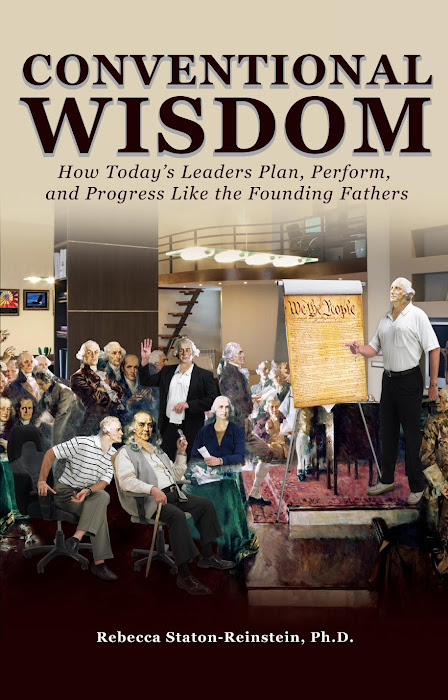
Author: Conventional Wisdom: How Today's Leaders Plan, Perform, and Progress Like the Founding Fathers

Want to improve your own management performance or develop the capabilities of your managers? Contact me to discuss bringing our unique Management Power Tools into your organization. We have also developed a special program for engineers and IT and technical professionals who find themselves in the uncomfortable world of managing people. We customize the program to your specific needs and organization and develop case studies based on your experience. The program can include education, coaching, and integration with your existing infrastructure.

Wednesday, February 29, 2012

Tea Party Rejoice - Rick Channels Patrick Henry

When candidate Rick Santorum said he "'almost threw up' when he read John F. Kennedy’s famous 1960 speech on the separation of church and state," my ears pricked up. Not because I want to discuss, support or trash any candidate, but because he was talking about a speech I remember rather fondly.

According to the Washington Post:
“Mr. Santorum said Kennedy was arguing that 'faith is not allowed in the public square'...
But Mr. Kennedy wasn’t telling people of faith to stay out of public life. He was restating the constitutional principle that has helped make America a great and resilient country: No faith should be able to dictate government policy, and government shouldn’t dictate theology to any faith.”

Tax to Support Christian Teachers

My thoughts immediately returned not to the Kennedy speech of 1960 (responding to accusations that as a Catholic he would consult the Vatican for his policy decisions) but to Virginia in 1784.

In that critical year, after the success of the American Revolution, James Madison was a delegate to the Virginia Assembly and looking forward to a session of modernizing the laws of the state left over from the colonial period. Instead he was confronted almost immediately with an attempt with "a torrent of eloquence from Patrick Henry…to support 'teachers of the Christian religion' by a general tax." Madison was both surprised and appalled.  "Madison thought it 'obnoxious on account of its dishonorable principle and dangerous tendency.'"

Important men such as George Washington, John Marshall, and others as well as Patrick Henry believed the morals of the state were in decline and believed religion had a positive influence on people. In fact, Madison himself was a religious man and member of a church. His horror at the proposed tax was not from distaste for religion. He argued the tax "would neither make religion more vital nor cure the alleged 'moral decay' in Virginia. It would…violate the natural right to liberty of conscience and involve the state in questions of heresy and orthodoxy entirely outside its province."

Madison, the master politician, supported another bill as a delaying tactic and then supported Patrick Henry’s bid for governor, getting him out of the legislature where he had amassed huge power.

Then Madison went to work, gathering every bit of available information, every book, every tract, and every ounce of data and digesting it. The result was his classic Memorial and Remonstrance against Religious Assessments. He used it as a petition to gain support against the bill. His 15 points brilliantly argue for the complete separation of church and state.

 Beating Patrick Henry

At the fall 1785 meeting of the Virginia Assembly, Madison was victorious.

The assessment bill of the previous session died silently and Madison quickly proposed adoption of Jefferson’s eloquent 'Bill for Establishing Religious Freedom.' After its enactment, Madison wrote its author that, 'I flatter myself [we] have in this country extinguished forever the ambitious hope of making laws for the human mind.' Of all his accomplishments as a legislator, Madison took greatest pleasure and pride in this victory.
In fact, religious liberty stands out as the one subject upon which Madison took an extreme, absolute, undeviating position throughout his life. The phrases he proposed for the first amendment to the federal Constitution–-'the full and equal rights of conscience [shall not] be in any manner, or on any pretext, infringed,' and 'no State shall violate the equal rights of conscience'—were less equivocal than the language final adopted.

In the Memorial he asserted the rights of both believers and nonbelievers. He later opposed paying for a congressional or military chaplain or presidential proclamations on religious holidays.

Religious liberty, Madison wrote, ought to be defined 'as distinctly as words can admit, and the limits to [religious laws] established with as much solemnity as the forms of legislation express…Every provision for [such laws] short of this principle, will be found to leave crevices at least through which bigotry may introduce persecution; a monster feeding and thriving on its own venom, gradually swells to a size and strength overwhelming all laws human and define.'...complete separation of church and state saved the church from the inevitable corrupting influence of civil authority.
 Original Intent

In my snarky title to this blog I refer to the tea party folks who want to "return to the US Constitution." They often support an ‘originalist’ approach. It’s hard to get more original than James Madison. He was part of a conspiracy to call the Constitutional Convention in 1787, drafted the Virginia Plan kicking off the debates, defeated Patrick Henry’s attempts to stop the new Constitution in the Virginia Ratifying Convention, and drafted the Bill of Rights and pushed through it the first Congress.

Over time, his views shifted on other aspects of his creations but never on the separation of Church and State. Of course, he did pay a certain political price at the time. Payback is as much a part of politics in the 18th century as it is today. Under the new Constitution, Senators were appointed by the Governor. Governor Henry blocked Madison’s nomination to the new upper house. He also saw to the gerrymandering of Madison's home congressional district in an attempt to stop him there and supported his opponent, James Monroe. Madison was not thwarted and went into the first Congress as George Washington’s whip to get the president’s agenda through the lower house.

There is no doubt that in the late 18th century there were those who would blur the lines between religion and republican government. However, the victors at the state and federal level, the founders and framers who shaped the Constitution, the Bill of Rights, and the new government, where staunchly in the camp that Kennedy reiterated.

Whether Mr. Santorum wins or loses is not the point.
Does the Constitution’s wall of separation between church and state stand or fall.
Do we stand with Madison or Henry?

*     *     *     *     *     *     *     *
© Rebecca Staton-Reinstein and Advantage Leadership, Inc.

References:

1-Washington Post

2-All quotes about Madison: Ralph Ketcham, James Madison, University of Virginia, 1990, pages 162-168.

I NEED YOUR HELP: I’m beginning research for my new book on the influence of leaders on their organizations (Washington’s Shadow) and I’m interested in your experiences or ideas for case studies. Drop me a note: Rebecca@AdvantageLeadership.com 

Learn more about "Conventional Wisdom: How Today's Leaders Plan, Perform, and Progress Like the Founding Fathers" (http://www.ConventionalWisdomCenter.com  and visit our Author Page on Amazon. (http://tinyurl.com/RSRpage )

Sign up for our Conventional Wisdom blog and read this and other leadership stories and tips. http://tinyurl.com/yk7bgtn 

Rebecca Staton-Reinstein, Ph.D., President
Advantage Leadership, Inc.
1835 NE Miami Gardens Drive, Suite 152
North Miami Beach, FL 33179


Thursday, February 23, 2012

Washington casts a long shadow... Do you?

The US celebrated President's Day this week with the usual patriotic events – giant sales at the malls. If you were out in the crush of traffic or just enjoying a day off from work it was easy to forget the holiday put together former February birthday celebrations for Presidents Abe Lincoln and George Washington. Today the holiday has become a generic occasion to honor all the US presidents…including the ubiquitous Abe and George ads hawking flat screen TVs and the latest fashions.

About once a decade, C-SPAN conducts a survey amonghistorians and presidential experts and ranks all the presidents. The 2009 survey findings are relevant and interesting for anyone anywhere who is a leader. Scholars use these leadership traits to rank the presidents:
  • Public Persuasion
  • Crisis Leadership
  • Economic Management
  • Moral Authority
  • International Relations
  • Administrative Skills
  • Relations with Congress
  • Vision/Setting An Agenda
  • Pursued Equal Justice For All
  • Performance Within Context of Times
Moving from the political to the organizational realm, you might want to exchange Relations with Congress for something like Relations with Stakeholders and you might want to add some other topics. For the most part, these are a good list of critical leadership traits.

How would you stack up? 

Would you be able to come close to the sort of scores George Washington racks up survey after survey? Washington's stature has grown and shrunk over the years. In his own time he was worshiped and vilified. Presidential historian Doris Kearns Goodwin commented recently that she would find it difficult to really get to know him and he has certainly eluded most biographers.

Yet Washington was a personification of the American dream of the self-made man. As a teenager he began jotting down advice about how to conduct himself. He did not have the formal education of many of the other founders and often felt he lacked their polish with language. He engaged Alexander Hamilton and James Madison as ghost writers to turn his thoughts into the acceptable style of the day.

Yet, when army officers threatened rebellion in the 1783 Newburgh Conspiracy, he was eloquent enough on his own. Richard Norton Smith describes it this way…

None of this had much effect until the general retrieved from his pocket a congressional message promising early redress of legitimate complaints. He fumbled with the paper for a few seconds, then reached again into his coat to fetch a pair of eyeglasses. Begging the indulgence of his men, he explained to a stunned audience, "I have already grown gray in the service of my country. I am now going blind." Instantly, rebellion melted into tears.

Examine the areas where Washington rated number 1 with the scholars:
Economic Management
Moral Authority
International Relations
Administrative Skills
Are any of these areas where you excel? The international relations category may not be germane if your organization is not working globally. However, the other three are critical for any successful leader whom we would want to follow.

Economic management: Whether for-profit or not, in today’s economic climate, you must manage the finances of the organization prudently. You must invest in areas that will help you continue to grow and develop while eliminating inefficiency and eliminating unnecessary expenses.

Moral Authority: This is the essence of the Leader’s shadow. Who are you as a person? Do you perform with integrity? Are you trustworthy? Reliable? Do you care about people? Do you inspire people to be their best selves?

Administrative Skills: Can you manage people, processes, and priorities? Do you delegate, motivate, and coach people? Do you turn vision and mission into reality? Do you create a working environment where employees are fully engaged?

I suggest you spend a little time looking through the lists and see where your favorites (and not so favorites) score on each of the issues. Try to remove your ideological and political blinders and consider each president in his leadership role. No matter what country you call home, these attributes make a good checklist for leadership. What can you learn from them? How would your employees or peers rate you?

What shadow are you casting?

*     *     *     *     *     *     *     *

© Rebecca Staton-Reinstein and Advantage Leadership, Inc.

(note: quote from Patriarch: George Washington and the New American Nation. Richard Norton Smith. Houghton Mifflin Company, 1993.)

I NEED YOUR HELP: I'm beginning research for my new book on the influence of leaders on their organizations (Washington's Shadow) and I'm interested in your experiences or ideas for case studies. Drop me a note: Rebecca@AdvantageLeadership.com  

Learn more about Conventional Wisdom: How Today's Leaders Plan, Perform, and Progress Like the Founding Fathers (http://www.ConventionalWisdomCenter.com  and visit our Author Page on Amazon. (http://tinyurl.com/RSRpage )

Sign up for our Conventional Wisdom blog and read this and other leadership stories and tips. http://tinyurl.com/yk7bgtn  


Rebecca Staton-Reinstein, Ph.D., President
Advantage Leadership, Inc.
1835 NE Miami Gardens Drive, Suite 152
North Miami Beach, FL 33179


Monday, February 20, 2012

Why does Asia keep eating US lunch?

I've just returned from a wonderful week working in Kuala Lumpur, Malaysia. If you've been there, you know its charms...if not, put it on your bucket list. My trip there was not just to revisit a favorite city or to purchase some lovely batik paintings from 2 artists I met there in 2009 or to eat too much great food or even to enjoy the 100+ bear statues contributed by every country in the world.

No, I was there to work with 14 CIOs and IT executives representing Malaysia's major economic sectors; banking and finance, oil and gas, government. These 5 men and 9 women were there to learn how to initiate and implement successful major changes in their companies. (The vast majority of such initiatives fail primarily because folks focus on technology and not on culture and people.)

These leaders were sent by their companies to make sure they were growing and developing their capabilities. And this is where the lunch eating comes in...Their companies were growing and developing their capabilities.

Meanwhile back in the States and Europe the usual scenario is continuing to play out...tough economy? Training and travel are the first things to go in the corporate budget...after all, they are overhead. Forget all the data about the real ROI for investing in training and professional conferences, just cut them out and save a couple of bucks.

I spent most of November in Korea, China, and Singapore -- economies are booming -- just walk down the street and feel the energy -- and seminars are also full of people eager to learn to enhance their management skills.

Oh, and another thing...in any public seminar or even those conducted for companies on site, people end up not showing at the last minute - busy or boss told them they had to stay and work on a project. In all 4 3-day seminars, only 2 partial absentees. And one more thing, people in the US always leave early, especially the last day. They blow off the last half day. In Asia (where I've been working since 1996) they want you to go beyond the scheduled end time...even on the last day.

The point I'm trying to make is this: Asian companies and governments are investing in their people. They are promoting growth and development. They're bringing in external experts and exposing employees to the best practices in the market place. They understand they must expand their company cultures and embrace change and encourage innovation and creativity. They know if you want people to "do more with less" you must train them and support them to do it.

In the US the opposite is the norm.

When I was first beginning my career, my department head was asked to train us on the latest management practices and technology. His response? "Why train 'em, they'll only leave!" Well, of course people did leave...because they couldn't get any training and couldn't develop.

Lunch anyone?

*   *   *   *   *   *   *
(c) Rebecca Staton-Reinstein, President, Advantage Leadership, Inc.
The founding fathers were all great believers in education...so are today's strategic leaders
Conventional Wisdom: How Today's Leaders Plan, Perform, and Progress Like the Founding Fathers

Monday, December 19, 2011

Are you casting a shadow like Washington or…?

Headlines bombard us about executive pay, the tax code, and growing disparity between rich and poor. Pundits pontificate "They should or shouldn't do this." We react based on our own point of view.

But what about a leader stepping forward and taking action?

I was chatting with such a leader the other day. (I can’t reveal his name or other identifying particulars because they are not public yet.) He’s the top official of a small city suffering like so many others in this economy. Revenues are down, demands from residents and businesses are still high, and layoffs and service suspension have become the norm.

Of course he’s fighting back looking at ways to keep the city viable, growing, and innovative. He is trying to keep morale high for city workers who must meet demands, enforce codes, and keep the city running.

But this guy is going the extra mile at a time when it’s out of fashion. He floated the idea among the department heads and managers about taking voluntary furloughs…days off without pay. No big fanfare, no announcements in the local papers, no breathless reports on the local news. Just an idea. "Let's make a small sacrifice to help our city through a tough time."

He was the first to sign up to ease the city’s budget woes. He knows the pain people are suffering because in another recession he was laid off from his city job. So far a couple of department heads have also stepped forward and more are expected to do so as word spreads.

Now the cynics among us are saying, “of course it’s no big deal. He can afford it and will probably take a nice vacation. It’s just symbolic.”

I disagree…not just because I know the guy and he’s sincere. He’s taking a concrete action and setting an example for the rest of the city leaders. He’s walking the talk…something people say is important.

The official is employing "Shadow of the Leader."

Shadow of the Leader is an observation that people in authority through their likes, dislikes, treatment of others, language, personal preferences, beliefs, and values shape the culture of the organization. Employees watch the leader for clues about what’s important.

Although the idea is not new, the first systematic study was done by Larry Senn in his 1970 doctoral dissertation. (In full disclosure, Shadow of the Leader was the subject of my own dissertation in 1979.)

Creating a culture is one of the most important functions of a leader. Whatever example he or she sets will determine whether the organization achieves its stated vision, mission, values, and goals or not. We take our lead from what the leader does, NOT what he or she says…human nature.

In his first inaugural address George Washington stated he would serve without a salary. Congress in its wisdom convinced him to take the salary based on the republican principle that an official who was not getting compensation would be prone to corruption.

It was Washington’s desire to stay above the fray, always display character and rectitude, and set an example for others to follow. He knew his every move would be watched and used to set a precedent for future presidents.

If we are serious about our visions, missions, values, and goals and about leading our organizations, whether a tiny team or a vast country, understanding the power of our shadow and stepping up to take the next right action is absolutely necessary.

So hats off to the city official and those who extend his shadow to help their city in a time of need.

What shadow are you casting?
***   ***   ***   ***   ***   ***   ***
(c) Rebecca Staton-Reinstein,  Ph.D., President, Advantage Leadership, Inc.


Wednesday, October 19, 2011

Mission Ain’t Wishin’ Drive Daily Results with a Powerful Mission

When John Zumwalt became CEO of PBS&J, a well-regarded engineering firm, he helped craft a new mission. When many managers thought missions were a little fluffy and wanted to focus more on their traditional measures of success, he told them something extraordinary.
Get people on a mission and the metrics will follow

For Zumwalt and PBS&J, the metrics did follow – dramatic revenue increases, outperforming peers in talent retention, and wide-spread recognition as an extraordinary company to work with and for.

When I interviewed Zumwalt and 19 other executives with a track record of turning vision into reality, most told me stories of being mission driven.
But the importance of a mission is not just anecdotal. The Gallup Group* and many others who have studied this in depth find some astounding results:
  • 83% of all workers believed having a clear mission was very important;
  • Importance of Mission
    When companies were ranked by how strongly their employees agreed with the importance of mission, the top quartile had profitability that was from 5 – 15% higher than the companies in the lowest quartile;
  • Work groups with a clear sense of mission had from 30 – 50% fewer accidents; and
  • Mission-driven work groups had from 15 – 30% percent less turnover.
It was "as if the employee can't energize himself to do all he could without knowing how his job fits into the grand scheme of things."

The Gallup research also found the most critical influence a leader has on the organization is through the mission. When the leader is on a mission, it cascades through the organization if the leader constantly reinforces it.

Does your team have a clear mission to guide daily decision making and action? In these times of 'do more with less,' a strong mission is a requirement for successful action and results.

5 steps to create and use a strong mission. 
  1. Team brainstorms important values and results
  2. Team prioritizes the list and chooses the top 3 – 5
  3. Team can keep these phrases or write a short, simple statement incorporating them
  4. Each team member discusses how his or her job contributes specifically to the mission
  5. Team discusses results regularly in relation to fulfilling mission.
Start getting your results using a powerful mission. Sign up for my first webinar as part of Advantage HR Seminars; Get People on a Mission: Strategic Decision Making Drives Daily Action. This seminar is an approved provider for the HR Certification Institute (PHR, SPHR, and GPHR.)  See details and Register here.

Apply these techniques to create or adapt your current mission to drive execution and daily decision making to get the results you need to sustain your organization and assure its growth. Live on October26, 2011 and available on DVD.

*     *     *     *     *
© Rebecca Staton-Reinstein, Ph.D., President, Advantage Leadership, Inc.

*Rodd Wagner and James Harter, 12: The Elements of Great Managing, Gallup Press, New York, 2006. Material in this blog is excerpted from Conventional Wisdom: How Today’s Leaders Plan, Perform, and Progress Like the Founding Fathers.

Friday, October 14, 2011

Hooray! My treadmill broke. Time to loaf and invite my soul

My morning routine when I'm home has been the same for years: wake up about 5:15, hop on the treadmill, and watch BBC and Morning Joe. The treadmill has been a little sickly for some time. I have to limit myself to 1 1/4 miles at a moderate pace but it gets the blood flowing and the mind ready for the day...or so I've been telling myself.

On the road (where I spend a lot of time) I often look for a place to take a good brisk, long walk. If there are other colleagues around, all the better. One client became a favorite walking partner and we hit the trail every morning in Kuala Lumpur and Divonne, France...memorable walks and talks in fascinating environments.

Back home? Not as exciting but a comfortable rut.

Monday, that all changed. The machine, which had been stopping after less than a half mile for a few days, just stopped and that was that. What to do?

I headed out the door. It was 7 a.m. the sun was lighting up the eastern horizon and the great walking path along Snake Creek was beckoning. Why had I given it up so many years ago? Who knows or cares. I've rediscovered it.

Last week I tweeted the following quote from Walt Whitman “I loaf and invite my soul.” I must have been sending a message to my own soul.

Walking along Snake Creek, the distant roar of I 95 becomes a barely heard continuo. The bird symphony starts up - boat tailed grackles, parrots, Muscovy ducks, finches, and so many more complemented by the periodic heroic leap of mullet grabbing insects and splashing back into the placid water. Ibis, great white herons, baba yaga footed moor hens, night herons, anhinga, and kingfishers search for breakfast among the reeds.

Why did I ever stop this wonderful morning walk; Listening to the sounds of the natural world and the greetings of fellow walkers as we pass; Watching the sky turn every color as the sun slowly makes its way up over to my left; A full moon dominating the sky and then slowly fading?

Why? It's easy to drift into a routine and tune out what's really important. It's so easy to forget to "loaf and invite my soul."

What does this have to do with my usual topics of the founding fathers and leadership? A lot actually. You see, they knew how to loaf and find their souls. They took daily walks and rides or fishing and botanizing trips. Even the framers in Philadelphia didn't neglect their loafing time and in addition to physical activity they went to plays, concerts, lectures, and visited museums and interesting places. They understood they needed to make time to think, to dream, and to restore their creative juices.

Most of the successful executives I interviewed for Conventional Wisdom understood there was more to life than running their companies or cities. They cherished time to loaf and renew their souls.

Here are 3 lessons I started re-learning this week as I walk that delightful 5K circuit.
  1. Creativity requires loafing. You need to create time and space to let your mind do more than attack the problems at hand. In fact, if you want to come up with innovative and creative solutions you must get the endorphins flowing and the mind floating along unconstrained paths.
  2. Nature is everywhere waiting to inspire you. In London last week, I wandered down a crooked alley and suddenly ended up in one of those marvelous little squares - quiet, tree shaded, no sounds from The Strand penetrating. I sat for a while just letting my mind drift. Later that day I came up with some surprising new ideas - no coincidence.
  3. You have to quiet your own mind so you can listen to your soul. When you allow yourself to be quite, fully present in the moment, and without conscious thought, the most amazing things happen. I'm not talking about the soul in a religious or even spiritual sense...I'm talking about that core of our being that gets drowned out amid the clacking of the computer keys, the endless meetings, and jangling phones, not to mention the babble of other people's conversations, road noise, and TV.
Smart people loaf...and invite their souls.

* * * * * * *

(c) Rebecca Staton-Reinstein, President, Advantage Leadership, Inc.

Learn more about the framers of the US Constitution and modern leaders: Conventional Wisdom: How Today's Leaders Plan, Perform, and Progress Like the Founding Fathers.

Want to learn more about harnessing the creativity of your team and using your mission to assure your success, join me in my new webinar adventure "Get People on a Mission: Strategic Decision Making Drives Daily Action"

http://www.advantagehrseminars.com/store/Get-People-on-a-Mission-Strategic-Decision-Making-Drives-Daily-Action/