Showing posts with label budget. Show all posts

Monday, September 24, 2012

"Why train 'em? They'll only leave!"

Those were the very words my department head Lenny, said to me some decades ago when we told him we wanted more training. Can you believe it? Of course you can. You've heard the same thing from bosses yourself.

This was misguided then and it's even more so now.

We're coming out of a very tough period for most companies. Everyone knows that when budget cutting is on the table, training gets the ax first. So what's new?

According to a new study published in the Harvard Business Review and highlighted in the Kansas City Star, high achievers who are 30 and under are abandoning ship in droves with an average stay of 18 months. Why? Simple. Lack of training and mentoring for growth.

Imagine that? Young workers want to grow and develop? Isn't that what every management guru since the beginning of time has been telling would-be managers? "Your job is to grow your people." Didn't managers get the memo? Evidently not.

People who have been following the discussions about the millennial generation (Gen Y) have decried the fact they grew up thinking everything they did deserved a "good job" and they all got a prize. But guess what, the reality is that every employee needs and deserves the chance to grow and develop. This isn't a new phenomenon. We are Homo sapiens -- the thinking ones. These young workers are just acting on what is deep-seeded in everyone. We want to learn and grow.

Although my old boss is long gone, his attitude isn't. Here are a few ideas to reverse the trend.
  1. Spend time with all employees finding out what their interests and talents are.
  2. Figure out how to develop those interests and talents for mutual benefit.
  3. Provide formal and informal training and mentoring.
  4. Encourage individual initiative and growth.
  5. Be ready to say "goodbye."
The best boss I ever had was Joe Caccavo. He reported to Lenny but he was not going to allow his views to affect our team. Joe developed a team of dedicated people who would have followed him to the ends of the earth. (Note: we were also civil service and unionized. Joe could not give us promotions or raises.) So how did he do it?
  1. Joe spent time with each of us just talking. He was genuinely interested in understanding our aspirations and talents and then doing what he could to fostering them.
  2. Joe kept looking for ways to give each of us opportunities to develop our talents on the projects we worked on. He allowed us to try different roles and tasks and discover where our real contributions lay.
  3. Joe set up "lunch and learn" sessions in the conference room one a week. They were voluntary but we never missed a one. He supplied the pizza and the knowledge. There was no budget but he found some local professors who were willing to come in once a month and give us more advanced training -- roast beef sandwiches on the menu for those sessions!
  4. He encouraged us to take additional courses on our own and join professional groups that provided educational programs. He attended those meetings with us and helped us network. He let us know when we made mistakes and inspired us to correct them. He was no "softy" and knew how to deliver tough love when we needed it.
  5. No one wanted to leave Joe's team. But Joe knew we needed to move on if we were going to continue to grow and develop. When I went to tell him that after 5 years I was going for a corporate position, Joe was thrilled. Because Joe had supported my development, his team had 5 years of results that benefited the organization. Other teams seldom kept people more than a year (yes even in that protected world.)
So which sort of boss are you? Joe or Lenny? I always tried to follow Joe's example and I still encourage my clients to do the same. If fact, my first advice when times are tough and budgets need to shrink? Increase training! After all, if you want people to do more with less, you need to train and mentor them to do that. Otherwise, they'll hit the road as soon as they can.
*     *     *     *     *     *     *     *
(c) Rebecca Staton-Reinstein, president, Advantage Leadership, Inc.
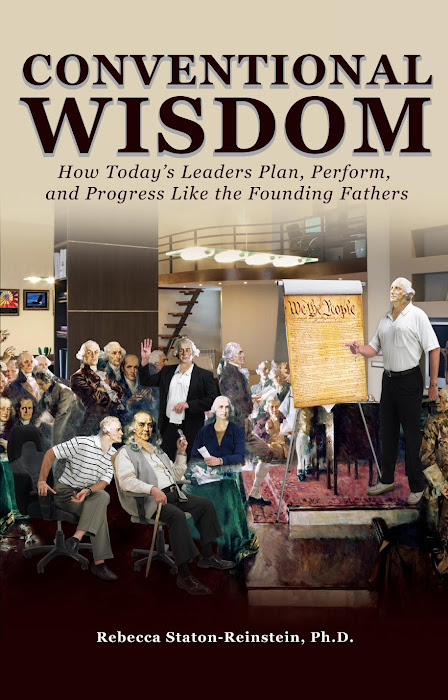
Author: Conventional Wisdom: How Today's Leaders Plan, Perform, and Progress Like the Founding Fathers. (This link takes you to a special page for a special offer not available publicly.)


Monday, December 19, 2011

Are you casting a shadow like Washington or…?

Headlines bombard us about executive pay, the tax code, and growing disparity between rich and poor. Pundits pontificate "They should or shouldn't do this." We react based on our own point of view.

But what about a leader stepping forward and taking action?

I was chatting with such a leader the other day. (I can’t reveal his name or other identifying particulars because they are not public yet.) He’s the top official of a small city suffering like so many others in this economy. Revenues are down, demands from residents and businesses are still high, and layoffs and service suspension have become the norm.

Of course he’s fighting back looking at ways to keep the city viable, growing, and innovative. He is trying to keep morale high for city workers who must meet demands, enforce codes, and keep the city running.

But this guy is going the extra mile at a time when it’s out of fashion. He floated the idea among the department heads and managers about taking voluntary furloughs…days off without pay. No big fanfare, no announcements in the local papers, no breathless reports on the local news. Just an idea. "Let's make a small sacrifice to help our city through a tough time."

He was the first to sign up to ease the city’s budget woes. He knows the pain people are suffering because in another recession he was laid off from his city job. So far a couple of department heads have also stepped forward and more are expected to do so as word spreads.

Now the cynics among us are saying, “of course it’s no big deal. He can afford it and will probably take a nice vacation. It’s just symbolic.”

I disagree…not just because I know the guy and he’s sincere. He’s taking a concrete action and setting an example for the rest of the city leaders. He’s walking the talk…something people say is important.

The official is employing "Shadow of the Leader."

Shadow of the Leader is an observation that people in authority through their likes, dislikes, treatment of others, language, personal preferences, beliefs, and values shape the culture of the organization. Employees watch the leader for clues about what’s important.

Although the idea is not new, the first systematic study was done by Larry Senn in his 1970 doctoral dissertation. (In full disclosure, Shadow of the Leader was the subject of my own dissertation in 1979.)

Creating a culture is one of the most important functions of a leader. Whatever example he or she sets will determine whether the organization achieves its stated vision, mission, values, and goals or not. We take our lead from what the leader does, NOT what he or she says…human nature.

In his first inaugural address George Washington stated he would serve without a salary. Congress in its wisdom convinced him to take the salary based on the republican principle that an official who was not getting compensation would be prone to corruption.

It was Washington’s desire to stay above the fray, always display character and rectitude, and set an example for others to follow. He knew his every move would be watched and used to set a precedent for future presidents.

If we are serious about our visions, missions, values, and goals and about leading our organizations, whether a tiny team or a vast country, understanding the power of our shadow and stepping up to take the next right action is absolutely necessary.

So hats off to the city official and those who extend his shadow to help their city in a time of need.

What shadow are you casting?
***   ***   ***   ***   ***   ***   ***
(c) Rebecca Staton-Reinstein,  Ph.D., President, Advantage Leadership, Inc.