Showing posts with label John Zumwalt. Show all posts

Wednesday, October 19, 2011

Mission Ain’t Wishin’ Drive Daily Results with a Powerful Mission

When John Zumwalt became CEO of PBS&J, a well-regarded engineering firm, he helped craft a new mission. When many managers thought missions were a little fluffy and wanted to focus more on their traditional measures of success, he told them something extraordinary.
Get people on a mission and the metrics will follow

For Zumwalt and PBS&J, the metrics did follow – dramatic revenue increases, outperforming peers in talent retention, and wide-spread recognition as an extraordinary company to work with and for.

When I interviewed Zumwalt and 19 other executives with a track record of turning vision into reality, most told me stories of being mission driven.
But the importance of a mission is not just anecdotal. The Gallup Group* and many others who have studied this in depth find some astounding results:
  • 83% of all workers believed having a clear mission was very important;
  • Importance of Mission
    When companies were ranked by how strongly their employees agreed with the importance of mission, the top quartile had profitability that was from 5 – 15% higher than the companies in the lowest quartile;
  • Work groups with a clear sense of mission had from 30 – 50% fewer accidents; and
  • Mission-driven work groups had from 15 – 30% percent less turnover.
It was "as if the employee can't energize himself to do all he could without knowing how his job fits into the grand scheme of things."

The Gallup research also found the most critical influence a leader has on the organization is through the mission. When the leader is on a mission, it cascades through the organization if the leader constantly reinforces it.

Does your team have a clear mission to guide daily decision making and action? In these times of 'do more with less,' a strong mission is a requirement for successful action and results.

5 steps to create and use a strong mission. 
  1. Team brainstorms important values and results
  2. Team prioritizes the list and chooses the top 3 – 5
  3. Team can keep these phrases or write a short, simple statement incorporating them
  4. Each team member discusses how his or her job contributes specifically to the mission
  5. Team discusses results regularly in relation to fulfilling mission.
Start getting your results using a powerful mission. Sign up for my first webinar as part of Advantage HR Seminars; Get People on a Mission: Strategic Decision Making Drives Daily Action. This seminar is an approved provider for the HR Certification Institute (PHR, SPHR, and GPHR.)  See details and Register here.

Apply these techniques to create or adapt your current mission to drive execution and daily decision making to get the results you need to sustain your organization and assure its growth. Live on October26, 2011 and available on DVD.

*     *     *     *     *
© Rebecca Staton-Reinstein, Ph.D., President, Advantage Leadership, Inc.

*Rodd Wagner and James Harter, 12: The Elements of Great Managing, Gallup Press, New York, 2006. Material in this blog is excerpted from Conventional Wisdom: How Today’s Leaders Plan, Perform, and Progress Like the Founding Fathers.

Thursday, February 3, 2011

Rabbit Chases Tiger – Good News?

Today the Year of the Rabbit dawns on the Lunar New Year. What will it bring? For those born in one of the Rabbit’s years if should be a quiet time for developing relations and propitious for starting a new business. For the rest of us, those who follow the lunar zodiac predict a calmer year with things running at a much slower pace.

"The Rabbit is one of the most gracious personalities of the zodiac…It'll be a time to nurture relationships at the many social events that will happen this year.” At least that’s what Laura Lau, co-author with her mother, Theodora Lau, of the best-selling The Handbook of Chinese Horoscopes, tells us. She believes the Tiger delivered on its reputation of unpredictability and lots of major disruptions. Many people report being happy to see the Rabbit chase the terrible Tiger out of the neighborhood.

But what does all this portend for you as a leader or business owner?

I happened to have been in Singapore as the Year of the Tiger dawned, blogged about it, and showed a clip of the Tiger making his way through the airport with much noise and excitement. That won’t be the case with the quiet and conservative Rabbit.

Lately there’s been a call for greater civility in our political discourse and that’s definitely a Rabbit-oriented wish. Whether it happens or not is another story – perhaps as fanciful as belief in mythical beasts.

However, in the world of business and work, a call for greater civility might not be so far fetched. When I entered the corporate world I was struck by the constant use of war analogies tossed off without much heed for what the words really implied. Early in my management career my boss handed me The Art of War and insisted I take it to heart and use it as an important supplement to my penchant for Drucker and Deming. Over the years I’ve come to see that in successful businesses with progressive leadership, the Rabbit rules over the Tiger.

Why? Because to get anything done in an organization with 2 people or 2 million, you must have cooperation. The old cliché, Together Everyone Achieves More, happens to be correct. When the Constitutional framers were hammering out their plan for the new nation, they had to cooperate; despite the fact the 55 delegates had strong opposing views. When John Zumwalt, CEO at PBS&J came to believe the company should reflect the communities in which it had offices, he needed the entire workforce to take on the mission. He didn’t set quotas or impose a program. He talked about the mission to everyone and enlisted their cooperation. In a few years the national engineering firm was being recognized and receiving awards for its diversity.

5 Actions to Usher in the Year of the Rabbit and Chase the Tiger

Stop the War Chatter – Record your next meeting. How often do war-related terms crop up? How often do you shoot down an idea; praise a straight shooter; develop a killer app? Ever hear the expression, As a man thinketh...? We don’t even hear the subtle messages we put out every day and reinforce in our own minds.

Stop Thinking the Competition is the Enemy – Our competitors are not our enemies. When I first started my business I was getting advice from a more experienced business owner. She bragged about how she had driven her major competitor out of business. I wasn’t impressed then or now. Why spend all that energy destroying someone else? Has airline or banking service improved with all the gobbling up of the competition? Personally, I want strong competitors. They keep me on my toes, innovating, and improving.

Start being Likable – Machiavelli helped spread the idea leaders should be feared rather than loved. Why do we associate likability with weak leadership? Joe Caccavo, the absolutely best boss I ever had, was loved and admired by his team. He was also tough and demanded our best from us. He took us to task when it was necessary. He was fair, patient, and supportive. He wanted to see each of us succeed and did everything he could to make that possible. We would have followed him anywhere and did more than any of us believed possible.

Start Looking for Synergy – I joined a new mastermind group recently. All of us are involved in the professional speaking business but none of us see one another as competitors. Instead we are all working together to help one another be more successful. Ideas and insights flow. We share our challenges and fears. The group dynamic creates a heady mix of inspiration, innovation, and tough love.

Start Caring for those you Disagree with – When we demonize those we disagree with, we stop having a dialogue; we stop learning; we stop understanding the complexity of our world. Corporate politics are just as nasty as the government-related kind. Enormous losses accrue to every organization when the politics become toxic and anti-productive. When Michael Howe took over Arby’s, he turned the chain around by leading a cultural revolution. It was certainly not easy but his efforts created a people-focused positive culture that doubled cash flow and grew revenue dramatically in a few years.

So give it some thought. Could you be more successful pursuing positive relationships and embracing your inner Rabbit and chasing out a little of your inner Tiger? I don’t know about you, but I’m certainly going to give it a go…It’s a New Year, so why not a new approach? Especially when it’s proved so successful as a business strategy.

* * * * * *

© Rebecca Staton-Reinstein, President, Advantage Leadership, Inc

Want to know more about the leaders in today’s blog and others who have transformed their organizational cultures to improve bottom- and top- line results? Check out Conventional Wisdom: How Today’s Leaders Plan, Perform, and Progress Like the Founding Fathers.

Sunday, May 24, 2009

World-Changing Anniversaries


This week marks two world-changing anniversaries -- they will go unnoticed on your Outlook calendar or CNN's news crawl. You won't hear your favorite NPR or PBS commentator wax eloquent about these propitious days. The blogosphere and talk show hosts, left, right, and center, will not be foaming at the mouth about them...BUT...

On May 25, 1787, the U.S. Constitutional Convention officially opened in Philadelphia. Delegates from 12 of the 13 states were drifting in with different agendas and expectations. Some thought they were just going to spend a few weeks making some amendments to the existing Articles of Confederation that had governed the new nation for a handful of years. Some weren't sure what was going to happen but they knew something had to be done to get the country out of the crisis at hand. A few had come to defend the status quo and try to stop any changes from being passed. And then there was that core group of conspirators that were preparing to commit treason for the second time...but more about them later...

What was that crisis facing the U.S. in 1787? A few years after the hard-fought Revolution, the country was on the verge of collapse.
  • With no central currency or monetary policy, states printed their own worthless paper money, driving triple-digit inflation.
  • Inflation led to foreclosures on many farms in the largely agricultural nation.
  • Taking matters into their own hands and led by Revolutionary soldier Captain Shays, a gaggle of Massachusetts farmers closed down the courts that were taking their farms, and marched on the arsenal in Springfield, declaring a second revolution. Although they were routed by the state militia, Shays' Rebellion sent a shock wave through the country.
  • The British, Spanish, and French were circling like vultures waiting to pick apart the new nation like road kill.
  • Meanwhile the states were feuding with one another over boundaries, fishing and navigation rights, and trade. Several were preparing to go to war while others considered abandoning the fragile union and going it alone or allying with a foreign power.
  • And what of the Confederation Congress? It was impotent since it could not impose any legislation on the sovereign states and could only beg for money, which was seldom forthcoming. The Articles could not be amended unless all 13 states agreed and that seldom happened.
Back to those treasonous conspirators...James Madison, Alexander Hamilton, Ben Franklin, and a handful of others decided that the time had come to overthrow the Articles of Confederation and establish a new constitution that would have authority over the states. To this end they called the convention, connived to get Congress to approve the session, and enlisted George Washington to come as a representative from Virginia and provide the political cover they needed to create the new constitution.
Of course, the Convention, as one of its first acts, elected Washington to preside over the meeting. And this brings us to our second important date, May 29, 1787.
On this day, the conspirators tipped their hand to the shock of many of the delegates. Edmund Randolph, the Governor of Virginia and host of the Convention, rose to present his opening remarks on the crisis and then read out the Virginia Plan. Authored for the most part by James Madison, it laid out a radical proposal for a republican form of government with representation of the people in a tripartite organization of legislative, executive, and executive branches. These were designed to check and balance one another. This bombshell plan became the agenda for debate that lasted for another four months. But in the end, the Constitution that we know today was written and then ratified by enough states to go into effect.

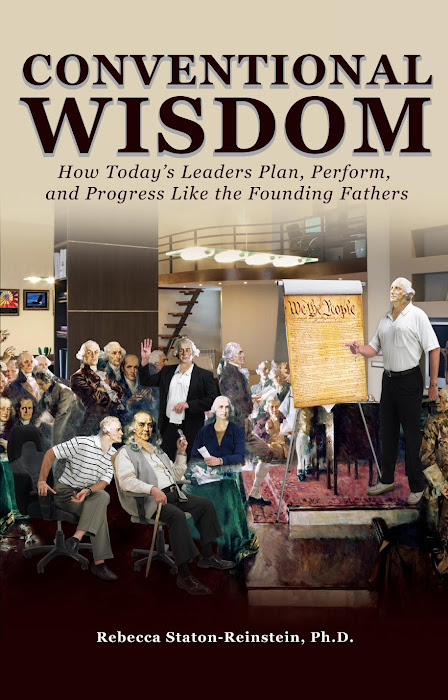
As the Convention ebbed and flowed, the delegates used many of the techniques we recognize today as strategic planning. In my new book, Conventional Wisdom: How Today's Leaders Plan, Perform, and Progress Like the Founding Fathers, 20 contemporary leaders describe how they use these same techniques.

  • Luda Kopeikina, CEO of Noventra, describes how she encourages debate and idea generation.
  • John Zumwalt describes how he uses a common mission to drive successful action at PBSJ just as that quintessential mission statement, the Constitution's Preamble, sets out our country's mission.
  • Howard Putnam, an early CEO at Southwest Airlines, used his planning session to set the floundering company on a new path and unite his team behind it.
  • Michael Howe describes his evolution as a strategic leader who decided to change the face of health care.
  • Alan Levine, now Secretary of Health and Hospitals for Louisiana, relates how he turned a county health care system into a world-class operation delivering high value to patients and lower costs to tax payers.

What can we learn from these remarkable anniversaries?

In times of crisis -- seek bold, break-through solutions -- reject the status quo and your comfort zone -- stick to your mission.

(c) Rebecca Staton-Reinstein

Check out the book for more tales of strategic leadership both at the Constitutional Convention and in today's successful organizations. http://ConventionalWisdomCenter.com/

To keep up with the latest news, sign up for the newly revamped Conventional Wisdom (Strategic Advantage) newsletter http://www.AdvantageLeadership.com/newsletter.html