Showing posts with label mission statement. Show all posts

Monday, June 23, 2014

What veterans can teach you about mission

“It's a smart business decision to hire veterans. Give vets a mission and the result you want and they will achieve it. That’s what they've been trained to do,” an entrepreneur pointed out on a recent business show.

What about your organization? Have your folks been trained to be laser-focused on the mission? Will they give it their all to get results? Is this what you've trained them to do?

In too many companies, employees may not even know the mission or it may have been relegated to meaningless words on a plaque. I recently had a poor experience with an airline and took a look at its mission. I couldn't find it on the website but an analyst’s report pulled a statement off the annual report that covered the territory...Not a word about the customer among its five focus areas. The airline believed if it was clean, safe, on time, had courteous employees, and delivered great revenue at competitive costs it would have “exceptional customer satisfaction.”

How does that happen exactly? If I'm an employee, focused on the five areas, as long as I stay courteous and don’t do anything to escalate costs, I'm fulfilling the mission.

This is not a rant about poor airline service. This is a rant about the power of mission to focus everyone’s energy to achieve company goals. Examiners for a major quality award routinely ask every employee they encounter, “What’s your role in achieving the corporate mission?” When people can tell you this in their own words, you get stellar results. The whole point of the mission is to guide daily action and decision making.

When a mid-sized commodity manufacturer was faced with an urgent need to transform or be acquired, it started by revamping its mission and vision.

Mission: The people of XYZ are leaders in the design and manufacture of abc solutions to meet your def needs.
Vision: To be a premier supplier of abc using innovative technology throughout our company while sustaining this in a positive and creative environment. 

This was a major change for the company; emphasizing people and a positive, creative environment. It was the first step on their successful, sustained renewal journey.

You can read about creating a mission and the bottom-line impact data in an earlier blog. http://tinyurl.com/3uz4mnb  To repeat one fact: in companies where almost every employee believes the mission is important, profits are 5 – 15% higher than in companies where few people believe mission is important.

My husband and I were honored to be part of a ceremony commemorating the 70th anniversary
Sculpture “Les Braves” by Anilore Banon,
Omaha Beach St. Laurent Sur Mer, France

of D-Day at Omaha beach. The band was conducted by Colonel Arnald Gabriel, Conductor Emeritus, The United States Air Force Band, who had come ashore on this beach that “longest day” as a young recruit. His mission was to get rid of the machine gun nests raining death on the troops wading ashore. The mission was clear so the results were clear.

If you want to put your people first in meeting goals, that must be clear in the mission. If you want to build a positive, creative environment, that must be in your mission. If you want to achieve "exceptional customer satisfaction," as the airline claimed, you must have that in your mission, train and empower employees, and reward them for doing everything to achieve the mission. 

“Get people on a mission and the metrics will follow,” John Zumwalt, former CEO of engineering firm PBS&J, told his company leaders when he took over. If you have a strong mission AND train your people to accomplish it, you will succeed. Learn from our veterans.
*    *    *    *
Join a live webinar, Get People on a Mission: Strategic Decision Making Drives Daily Action, Thursday, June 25, 1 PM Eastern or catch it on demand or on DVD. http://tinyurl.com/m8d6bf7   Learn from contemporary CEOs and the U.S. Founding Fathers about how to create a mission to drive results.

Wednesday, October 19, 2011

Mission Ain’t Wishin’ Drive Daily Results with a Powerful Mission

When John Zumwalt became CEO of PBS&J, a well-regarded engineering firm, he helped craft a new mission. When many managers thought missions were a little fluffy and wanted to focus more on their traditional measures of success, he told them something extraordinary.
Get people on a mission and the metrics will follow

For Zumwalt and PBS&J, the metrics did follow – dramatic revenue increases, outperforming peers in talent retention, and wide-spread recognition as an extraordinary company to work with and for.

When I interviewed Zumwalt and 19 other executives with a track record of turning vision into reality, most told me stories of being mission driven.
But the importance of a mission is not just anecdotal. The Gallup Group* and many others who have studied this in depth find some astounding results:
  • 83% of all workers believed having a clear mission was very important;
  • Importance of Mission
    When companies were ranked by how strongly their employees agreed with the importance of mission, the top quartile had profitability that was from 5 – 15% higher than the companies in the lowest quartile;
  • Work groups with a clear sense of mission had from 30 – 50% fewer accidents; and
  • Mission-driven work groups had from 15 – 30% percent less turnover.
It was "as if the employee can't energize himself to do all he could without knowing how his job fits into the grand scheme of things."

The Gallup research also found the most critical influence a leader has on the organization is through the mission. When the leader is on a mission, it cascades through the organization if the leader constantly reinforces it.

Does your team have a clear mission to guide daily decision making and action? In these times of 'do more with less,' a strong mission is a requirement for successful action and results.

5 steps to create and use a strong mission. 
  1. Team brainstorms important values and results
  2. Team prioritizes the list and chooses the top 3 – 5
  3. Team can keep these phrases or write a short, simple statement incorporating them
  4. Each team member discusses how his or her job contributes specifically to the mission
  5. Team discusses results regularly in relation to fulfilling mission.
Start getting your results using a powerful mission. Sign up for my first webinar as part of Advantage HR Seminars; Get People on a Mission: Strategic Decision Making Drives Daily Action. This seminar is an approved provider for the HR Certification Institute (PHR, SPHR, and GPHR.)  See details and Register here.

Apply these techniques to create or adapt your current mission to drive execution and daily decision making to get the results you need to sustain your organization and assure its growth. Live on October26, 2011 and available on DVD.

*     *     *     *     *
© Rebecca Staton-Reinstein, Ph.D., President, Advantage Leadership, Inc.

*Rodd Wagner and James Harter, 12: The Elements of Great Managing, Gallup Press, New York, 2006. Material in this blog is excerpted from Conventional Wisdom: How Today’s Leaders Plan, Perform, and Progress Like the Founding Fathers.

Thursday, January 10, 2008

Be Careful What You Ask For: Getting the Mission Wrong

Be Careful What You Ask For: Getting the Mission Wrong
Is your Mission statement leading you to new and greater accomplishments or down the road to perdition?

No, this is not a rhetorical question. Although everyone today is aware that they need a mission for their organization, just having one doesn't mean you will automatically be successful. In fact, many mission statements are simply meaningless. They've been wordsmithed by marketing types and vetted by the lawyers to a point where they no longer really say anything.

The mission should bind the individual to the organization. It should give him or her a clear statement of what the organization is all about. Then the person can make decisions and take actions by asking one simple strategic question:

Will this decision or action move me closer to or further from accomplishing my mission?

No firefighting. No knee-jerk reactions. No crisis management...or at least not as much!

The first step is to have a clear concise mission statement. It should be short and to the point. It should provide guidance for action.

Ritz Carleton Hotels stated in its credo: We are Ladies and Gentlemen Serving Ladies and Gentlemen. Every employee can view his or her work through this clear lens.

It's 2 AM and you're the desk clerk facing a disgruntled guest who just got in from a grueling trip. He's tired and cranky and taking it out on you. What do you do? In most hotels the rest of the story would not be pretty. At Ritz Carlton, the clerk goes through something like this in his or her head: 'I'm a gentle person and that guest is a gentle person having a very bad day. What can I do to help?' And then the clerk acts accordingly...the key word is 'act' not 'react.'

A couple of decades ago the city of Portsmouth, Virginia was down on its luck...but not completely out of luck. The City brought in a remarkable and talented City Manager who set a new -- simple -- mission for the city: ‘Clean City, Economic Development, and Customer Service.’ And then George Hanbury spread that mission and it's meaning to every official and employee.

The city turned around under Hanbury's leadership. Eighteen years later they invited him back for a special 'George Hanbury Day.' At the reception a man came up to him. "I'm sure you don't remember me but I drove a garbage truck when you became City Manager. I still remember that mission you gave us, 'Clean City, Economic Development, and Customer Service.' It changed everything."

That's the power of a good mission. It's transformational.

But there is a nasty little problem hiding under the surface in many mission statements. They can contain the seeds of their own destruction. And when you get it wrong and follow it successfully, you can destroy yourself. A major utility company presents an object lesson. The company decided to reinvent itself and implement a new quality philosophy. They stated their road map for action this way.

"During the next decade, we want to become the best managed electric utility in the United States and an excellent company overall, and be recognized as such."

On the surface it looks fine. It is striving to be well managed and excellent. These are admirable goals if a little vague. But the problem comes in the final part of the statement, 'be recognized as such.' At first it seems reasonable. Come up with a measurement that will demonstrate this excellence. Sounds OK. It helps counteract the vagueness.

Here's where things took a wrong turn. The CEO and his team decided that the 'recognition' would be winning the Deming Prize. This was the prestigious Japanese quality award named for the great guru of quality, Dr. W. Edwards Deming, who had been pivotal in helping Japanese industry recover after World War II. A special foreign division prize had just been announced. So the company decided to 'go for it.'

Now this in itself was not necessarily a bad thing. The prize required great rigor, dedication and leadership to be achieved. It would certainly be an important recognition of excellence. So far so good...

They set off on their excellence journey. Without meaning to or even noticing it, the mission shifted to emphasize the 'recognized as such' part of the mission. This happened slowly, imperceptibly despite a lot of good intentions and excellent improvement results that were well documented. As the prize itself slowly refocused people's efforts, a 'quality bureaucracy' materialized. As a former employee quipped, 'you couldn't plan lunch without doing a 7 step storyboard!'

The great day came and sure enough the company achieved its mission measurement -- the Deming Prize. It was a Pyrrhic victory.

First they were attacked in the local paper and then Public Service Commission got into the act. Who was going to pay for all of this? The rate-payers didn't want to foot the bill! This was despite the fact that the company made significant strides and reduced costs. There was that initial investment that people did not want to pay for. Later that year there was a freak storm and service was interrupted significantly. The howling media jumped all over the notion that the company was 'excellent' or 'well-managed.'

It wasn't long before the CEO was out of work and a memo was 'leaked' to the papers announcing the dismantling of the quality improvement program and its infrastructure.

What went wrong? That decision to add 'be recognized as such' led to choosing to win a prize and then to a distortion of the company's focus. No one meant it to happen. These were bright, experienced and well intentioned people. And the media weren't fair but by that time it was really too late. Chasing the prize (which Dr. Deming himself always criticized) did the damage long before the papers got into the act.

The point here is not to 'put down' the company. In fact, I was a great admirer of their efforts and accomplishments. I used much of their methodology to accomplish some great results. The point is to be very careful in constructing your mission. If you use it right, you will accomplish it, unintended consequences and all.

The mission requires regular scrutiny. Is it still leading us in the right direction? Is it as powerful in achieving results as those of the city of Portsmouth and Ritz Carlton Hotels? Have we slipped off the path without noticing it? Does every single person understand it, embrace it and use it every day? Are we on the happy path or the road to perdition?

There's a wonderful old country tune that the Carter Family used to sing:
Keep on the sunny side, always on the sunny side,Keep on the sunny side of life. It will help you on your way, It will help you every day,If you keep on the sunny side of life.

Keep your mission on the sunny side.

-- Rebecca Staton-Reinstein, Ph.D., President


Advantage Leadership, Inc.


* * * * *


Want to learn more about creating a strategic plan that gets robust results?

There are two easy ways to get our best selling book, Success Planning: A 'How-To' Guide for Strategic Planning. It is now used in hundreds of companies world wide and is part of the curriculum at one of the US military War Colleges.

(1) Buy it directly from our website: www.AdvantageLeadership.com/book.html Add on our unique 30-day e-mail mini-course on strategic planning for more practical tips and techniques.

(2) Buy it on Amazon: Search on Strategic Planning -- we are on one of the first few pages

* * * * *


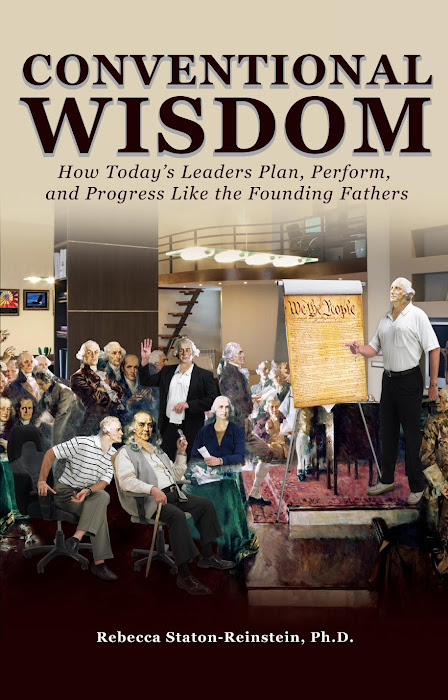
Look for our new book, Conventional Wisdom How Today's Leaders Plan, Perform and Progress Like the Founding Fathers early in 2008 and read more about how leaders handle mistakes and much more.

Based on the US Constitutional Convention of 1787 and interviews with successful CEOs, this unique business book combines history and business. I examine the Convention as an example of typical strategic planning with all of its creativity and messiness. Spring forward to the present and see how today's CEOs use the same techniques to transform their companies and translate vision into reality. Learn from all of the leaders --what works in the real world so that you can improve your own abilities as a strategic leader.