Monday, March 18, 2013

An uneventful birthday for Jemmy

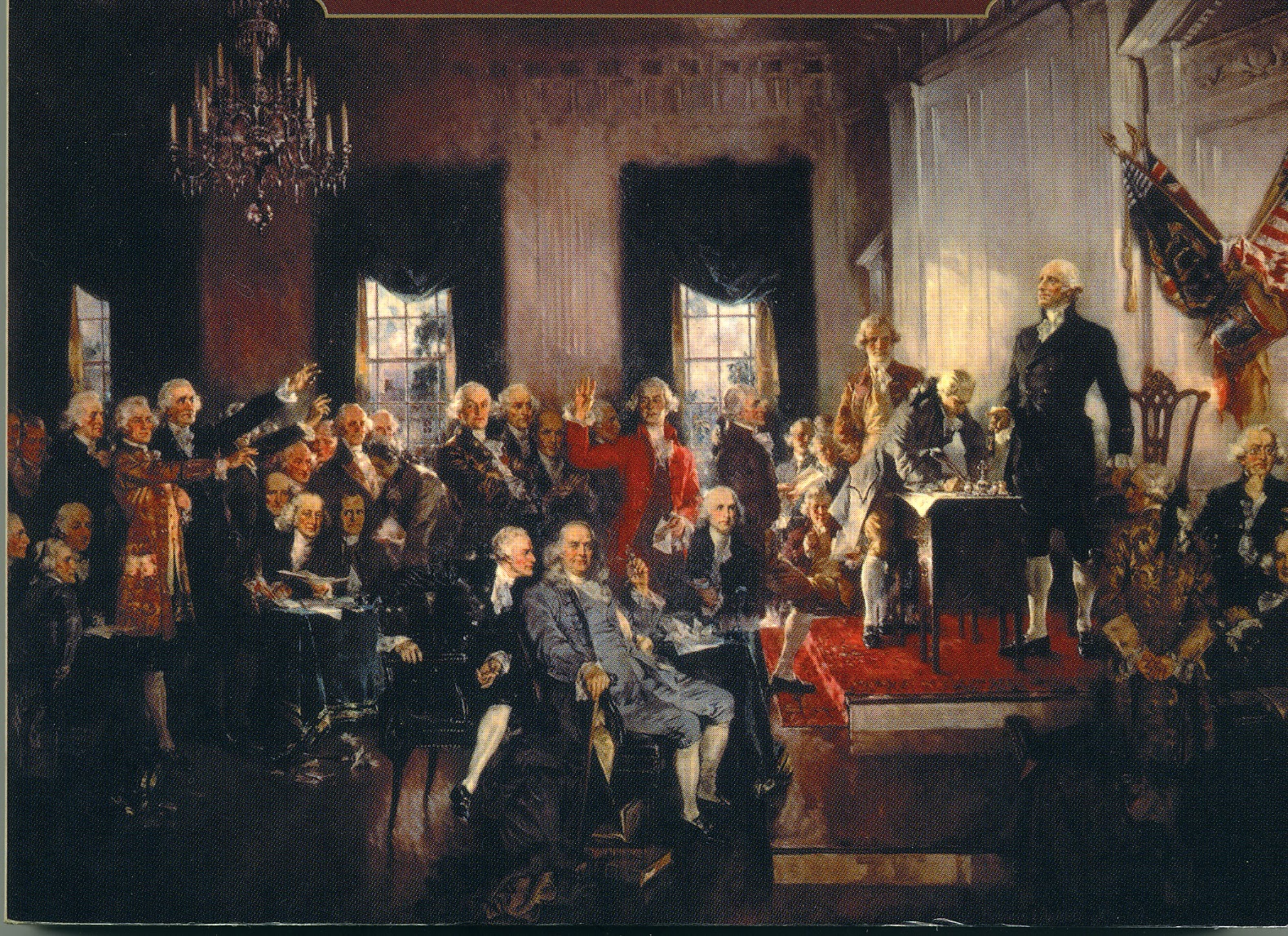
It's really too bad. Even I forgot...and I'm a raving fan of James Madison...the mighty little Madison was 262 this past weekend, March 16 (1751.) Jemmy, as he was known to his friends and enemies, has no monuments in the nation's capitol, no face on the side of Mr. Rushmore, and no holiday marking him or his most amazing accomplishment, the U.S. Constitution.


Jemmy and Me
Think about it for a moment. We celebrate the Declaration of Independence, and we should. We celebrate Washington and Lincoln with the combined Presidents Day. We look at Mr. Rushmore and see them again along with Jefferson and Roosevelt (Teddy.) Washington's monument towers over the Mall, Jefferson, Roosevelt (Franklin,) and Lincoln gaze out from their memorials on the Mall. But Madison? Nowhere to be found except at his restored home and the Constitution Center in Philadelphia in the hall of the signers. Even there he is overshadowed by many of the others.

Why should we care? James Madison was slight of build but a giant when thinking about constitutions. He had studied every one he could lay his hands on, focusing as he said on republics "ancient and modern." But Jemmy was no dilettante. At 36, he was already an experienced politician having served in the Confederation Congress and the Virginia legislature. With Alexander Hamilton and Benjamin Franklin and a few others, he conspired to call the meeting we know as the Constitutional Convention, with a secret agenda to overthrow the existing Articles of Confederation.

The Articles had proven a disaster and the infant nation faced multiple crises including inability to pay its debts, threats of foreign invasion, individual states prepared to go to war with their neighbors or secede altogether, rampant inflation and foreclosures, open rebellion, and a deadlocked, impotent Congress.

When the delegates gathered in Philadelphia in May of 1787, it was Madison's "Virginia Plan" that formed the basis for the initial debates. The meeting was presided over by George Washington, who had been persuaded in part by Madison to come and provide political cover and credibility. Although when he signed his name to the final document, Madison was not happy with it, he was prepared to fight for it.

He teamed up with Hamilton and John Jay to write The Federalist to present a compelling case for ratification and then went into the Virginia Ratifying Convention to debate his high-profile adversary, Patrick Henry and win. Despite the fact that he was ill and exhausted from his non-stop work during the 4 months of the Constitutional Convention, he came out swinging and carried the day so Virginia ratified by a few votes. During the Convention he had been tireless, recording all the discussions, lobbying the delegates, and serving on committees.

But Madison wasn't through. He was elected to the new Congress and quickly became one of the most savvy and effective politicians and lawmakers. He gathered the suggestions for amendments into a package and fought for the passage of the Bill of Rights. He even engineered the passage of Hamilton's finance bill for the assumption of the state's war debts and the establishment of the first national bank, despite being opposed to the plan in principle.

Finally, after his long and successful legislative career and the appellation of "Father of the Constitution," which he rejected, he served in Jefferson's cabinet and then became the 5th president of the United States.

James Madison is as responsible for creating our country as any of the other more well-known figures. Without him, the Constitution might never have been written and accepted, and the country would have soon disappeared from history like so many other experiments in self-government. Madison would not have wanted a monument or public holiday for himself. He probably would have wanted a holiday for the signing of the Constitution, (September 17.)

As Madison himself wrote, "a crisis had arrived which was to decide whether the American experiment was to be a blessing to the world, or to blast for ever the hopes which the republican cause had inspired." Luckily for us, Madison was there to make the difference. Honor him by reading the Constitution and it's amendments.
*     *     *     *     *     *
(c) Rebecca Staton-Reinstein, Ph.D., president, Advantage Leadership, Inc.
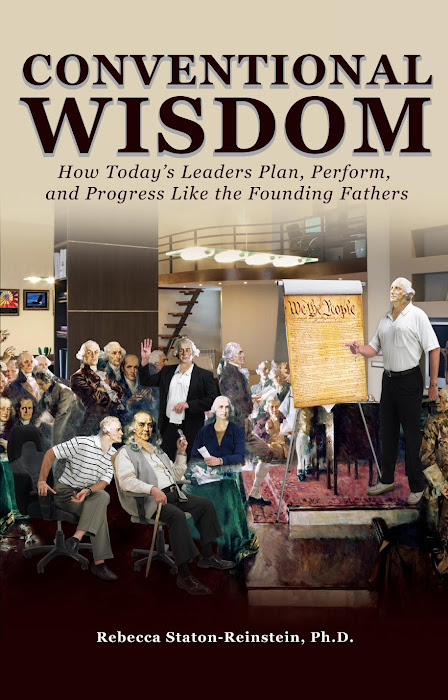
Learn more about Madison's pivotal role in the Conventional Wisdom: How Today's Leaders Plan, Perform, and Progress Like the Founding Fathers (Check out the Madison's birthday special pricing.)
Please send us your comments and feedback.

Tuesday, November 6, 2012

Why Vote? To keep a republic

As the delegates were leaving the Pennsylvania State House that September day in 1787, having just written the U.S. Constitution, a woman approached the venerable Dr. Franklin and asked what sort of government they were proposing. He answered, "A republic, if your can keep it."

It's as simple as that. We can only keep our republic by exercising our right to vote and the corollary is informing ourselves about the candidates and the issues. Three thoughts come to mind:

A nation that expects to be ignorant and free in a state of civilization … expects what never was and never will be. - Thomas Jefferson
Liberty & Learning lean on each other for their mutual and surest support. – James Madison
Educate and inform the whole mass of the people...They are the only sure reliance for the preservation of our liberty. - Thomas Jefferson


It's as simple as that...inform yourself and vote. Yes it's tough with restricted hours or Sandy's devastation. Yes, the weather can be bad or the lines long or the choices difficult or...

If you don't vote, you have no voice and NO RIGHT TO WHINE! That's right. You can't go on and on about what's wrong with the "government" if you don't participate. No excuses.

In the '90s I was working in St. Petersburg, Russia when they held their first free election. I went with my host to the polls -- a high school gym. It was exciting and brought a lump to my throat. My friend was casting a vote in an independent election for the first time. I don't know how she voted - for reform or a return to the old regime. In the end, the important thing is to cast your ballot.

In a republic, we then accept the result. We don't always like the result and sometimes would have preferred a different outcome. Every election is about the future of the republic. Informed voting is the only way to keep our republic.
*   *   *   *   *
(c) Rebecca Staton-Reinstein, President, Advantage Leadership, Inc.
Author, Conventional Wisdom: How Today's Leaders Plan, Perform, and Progress Like the Founding Fathers (Check out the special election day offer)

Sunday, October 14, 2012

When did elections become American Idol?

Full disclosure: I love to watch debates - academic or political. I love the give and take. I watched every presidential primary debate this season. (The British call it the silly season with good reason.) I've watched both debates now between the candidates and will be glued to the last two. (Update: the second presidential debate does not change what I've already posted.)

I'm NOT looking for winners and losers. I'm looking for information. I'm not one of those over-hyped "undecided voters." I've made a choice and I don't think a debate will change my mind so I'll take advantage of my state's early voting. However, and this is a big "however," I still want to understand each candidate and party's ideas, desires, plans, history, and more. I never get tired of it. Sometimes I agree with my chosen candidate and sometimes I don't. Sometimes I like what he or she says and sometimes I don't. Sometimes I support their compromises and sometimes I don't. I'm not a single-issue voter, and since I cast my first presidential vote in the 60s, I've tried to look at the full package.

So what? I was watching some "news" coverage after the vice presidential debate and they were discussing what was trending on social media during the debate...DURING the debate.
  • We are NOT WIRED TO MULTITASK. When we're listening/watching the debate and start texting, tweeting or facebooking, our brain is simply switching back and forth very, very rapidly (below our ability to perceive.) So we're not actually attentive to either.
  • Much of the "trending" was about ridiculous topics including one candidate's workout photos and the other's use of words like "malarkey." ????? This is what's important in choosing a person who is "a heartbeat away from the president?" This is the how we choose a potential world leader?
When did the most important political decisions that will affect our lives become American Idol? Are we electing the Debater-in-Chief? Do we expect him or her to go mano a mano with other world leaders on TV to decide the fate of nations? Do we really think the endless dissection of jokes, wise cracks, facial expressions, body language, and zingers is the best way to make this important decision?

What about the Founding Fathers? How would they hold up?

Most wouldn't fare too well based on our pop-idol values.

George Washington hated to speak in public and many of his addresses were simply published and not spoken. He was self-conscious about his lack of formal education among the political elite of the late 18th century. He was intelligent, well-read, and a shrewd politician and judge of people and events but he would have appeared wooden and ill-at-ease in a public debate.

John Adams was scrappy and considered a good trial lawyer and effective legislator in the Continental Conventions. He defended British soldiers successfully after the Boston massacre (which would have been political death in today's world of negative ads.) He was also irritable and irritating and seldom curbed his tongue in his attacks on those who disagreed with him. He didn't play well with others when he disagreed.

Thomas Jefferson wrote soaring prose that still inspires us but he was a horrible speaker. This voice was weak and barely audible when he addressed any gathering and he avoided it whenever possible. He would have delighted in today's campaigns of negativity. Through his support of newspapers and others who he agreed with, he published or caused to be published, scathing attacks on his political enemies. His attacks, through his pal Jemmy Madison, went for the jugular in attempt to destroy Alexander Hamilton, and even George Washington while he served as his Secretary of State.

James (Jemmy) Madison was a masterful debater, although he too did not have a strong voice, and people often complained he was hard to hear in a large room. However, in his long state and federal legislative career and in the Constitutional Convention, he held his own with other more powerful debaters. Most famously, in the Virginia Ratifying Convention to ratify the new U.S. Constitution, he faced off against Patrick Henry. Although Henry brought his A game bombast and withering rhetoric, he turned out to be no match for Madison, an author of the document with intimate knowledge of every nook and cranny and how it had been debated and decided.

Today, we would not select the wooden Washington, the irascible Adams, the weak-voiced Jefferson or the egg-head Madison. We would have preferred the smooth-talking Aaron Burr, who kill Hamilton while still vice president; the pyrotechnic Henry who was an avowed anti-federalist who would have gotten rid of anything but independent, autonomous state governments; the avuncular, always charming and folksy and wily Ben Franklin, who would have only a one-house legislature, removing a critical check on popular passion; and who knows what other folly.

Presidential leadership is not about "optics." Would we elect Lincoln today? Would we elect the very short, "great little Madison?" Would "his rotundness," Adams receive our nod? Would we pick Jefferson who was famous for his slouching posture as well as his weak voice? Sadly, probably not.

I'll continue to enjoy the debates. I'll go to the polls and cast my ballot. But it would be more assuring to me if citizens watched the debates using the active listening techniques I teach managers and executives.
  • Quiet your mind and ignore stray thoughts or preparing a response.
  • Focus your entire attention on the other person.
  • Listen to what he or she is saying and observe the body language and tone.
  • Ask questions to make sure you understand the other person and that he or she knows you understand.
Finally, I can't help but quote from that poor debater, Thomas Jefferson:
"A nation that expects to be ignorant and free in a state of civilization … expects what never was and never will be."
Or maybe from that fierce debater, James Madison:
Liberty & Learning lean on each other for their mutual and surest support.
Please vote...and please, make a rational, informed decision. It ain't American Idol!
*     *     *     *     *     *
Check out more about the politics of the early republic and today's leaders in Conventional Wisdom: How Today's Leaders Plan, Perform, and Progress Like the Founding Fathers. http://advantageleadership.com/section/Conventional_Wisdom/17/

Monday, September 24, 2012

"Why train 'em? They'll only leave!"

Those were the very words my department head Lenny, said to me some decades ago when we told him we wanted more training. Can you believe it? Of course you can. You've heard the same thing from bosses yourself.

This was misguided then and it's even more so now.

We're coming out of a very tough period for most companies. Everyone knows that when budget cutting is on the table, training gets the ax first. So what's new?

According to a new study published in the Harvard Business Review and highlighted in the Kansas City Star, high achievers who are 30 and under are abandoning ship in droves with an average stay of 18 months. Why? Simple. Lack of training and mentoring for growth.

Imagine that? Young workers want to grow and develop? Isn't that what every management guru since the beginning of time has been telling would-be managers? "Your job is to grow your people." Didn't managers get the memo? Evidently not.

People who have been following the discussions about the millennial generation (Gen Y) have decried the fact they grew up thinking everything they did deserved a "good job" and they all got a prize. But guess what, the reality is that every employee needs and deserves the chance to grow and develop. This isn't a new phenomenon. We are Homo sapiens -- the thinking ones. These young workers are just acting on what is deep-seeded in everyone. We want to learn and grow.

Although my old boss is long gone, his attitude isn't. Here are a few ideas to reverse the trend.
  1. Spend time with all employees finding out what their interests and talents are.
  2. Figure out how to develop those interests and talents for mutual benefit.
  3. Provide formal and informal training and mentoring.
  4. Encourage individual initiative and growth.
  5. Be ready to say "goodbye."
The best boss I ever had was Joe Caccavo. He reported to Lenny but he was not going to allow his views to affect our team. Joe developed a team of dedicated people who would have followed him to the ends of the earth. (Note: we were also civil service and unionized. Joe could not give us promotions or raises.) So how did he do it?
  1. Joe spent time with each of us just talking. He was genuinely interested in understanding our aspirations and talents and then doing what he could to fostering them.
  2. Joe kept looking for ways to give each of us opportunities to develop our talents on the projects we worked on. He allowed us to try different roles and tasks and discover where our real contributions lay.
  3. Joe set up "lunch and learn" sessions in the conference room one a week. They were voluntary but we never missed a one. He supplied the pizza and the knowledge. There was no budget but he found some local professors who were willing to come in once a month and give us more advanced training -- roast beef sandwiches on the menu for those sessions!
  4. He encouraged us to take additional courses on our own and join professional groups that provided educational programs. He attended those meetings with us and helped us network. He let us know when we made mistakes and inspired us to correct them. He was no "softy" and knew how to deliver tough love when we needed it.
  5. No one wanted to leave Joe's team. But Joe knew we needed to move on if we were going to continue to grow and develop. When I went to tell him that after 5 years I was going for a corporate position, Joe was thrilled. Because Joe had supported my development, his team had 5 years of results that benefited the organization. Other teams seldom kept people more than a year (yes even in that protected world.)
So which sort of boss are you? Joe or Lenny? I always tried to follow Joe's example and I still encourage my clients to do the same. If fact, my first advice when times are tough and budgets need to shrink? Increase training! After all, if you want people to do more with less, you need to train and mentor them to do that. Otherwise, they'll hit the road as soon as they can.
*     *     *     *     *     *     *     *
(c) Rebecca Staton-Reinstein, president, Advantage Leadership, Inc.
Author: Conventional Wisdom: How Today's Leaders Plan, Perform, and Progress Like the Founding Fathers. (This link takes you to a special page for a special offer not available publicly.)


Tuesday, September 18, 2012

Happy Birthday, US Constitution

On September 17, 1787, delegates lined up to put their names on the document they had agonized over for the last four sweltering months in the Pennsylvania State House. Through it all, James Madison sat near the front of the delegates' meeting hall taking notes in his own shorthand of all the debates, discussions, and final compromises that made it into the document.
 
Three delegates refused to sign in the very end, holding out for a Bill of Rights. Others of the original 55 representatives from 12 states had drifted away or left in disgust. Rhode Island was not represented. It had refused to participate. Despite everything, with political divides as deep as any today, the remaining delegates signed and sent the new Constitution to Congress to pass on to State ratifying conventions.
 
Visualize Benjamin Franklin in his eighties, overweight and crippled with a gout attack. He asks James Wilson to read his remarks, which are addressed directly to the handful of delegates who announced they would not sign the Constitution.

I confess that I do not entirely approve this Constitution at present…[H]aving lived long, I have experienced many instances of being obliged…to change opinions even on important subjects…[T]he older I grow, the more apt I am to doubt my own judgment and pay more respect to the judgment of others…I cannot help expressing a wish that every member of the convention who may still have objections to it, would … doubt a little of his own infallibility…and put his name to this instrument.

Franklin speaks down the centuries to leaders. Although the three reluctant delegates were not swayed that day, Franklin captured a key element of great leaders. They all know they make bad decisions sometimes. They know they are fallible and question their preconceived notions.
 
As our presidential election draws near, the attack ads continue relentlessly, and candidates play fast and loose with the facts, heed Franklin's advice. Celebrate this Constitution and pay more respect to the judgment of others.
*     *     *     *     *     *     *     *     *
 
To find out more about this important day in U.S. history, the strategic planning and leadership of the framers, and the wisdom of today's strategic leaders, read Conventional Wisdom: How Today's Leaders Plan, Perform, and Progress Like the Founding Fathers. (This link takes you to a special page for a special offer not available publicly.)


Saturday, July 14, 2012

Black Lung Is Back: For My Family It Never Left

NPR highlighted new evidence that the killer of coal miners - Black Lung - is back. http://tinyurl.com/88c76uq For my family, it never left. In the early part of the last century, my maternal grandfather, Rufus Necessary, was a coal miner in Wise County in Southwest Virginia. He had a wife, Lula, and several children; 2 daughters and 2 sons. He came down with black lung prior to 1912. The mining company moved him into the office to do bookkeeping. Sometime in 1912 just before the birth of his youngest child, he died. Lula and the children were taken in by relatives but it was not a permanent solution. The family decided to distribute the older children to various relatives nearby. That left an 18 month old baby girl who bore her father's name, Rufus Necessary.

Ruth nee Rufus at 2 with Mike the dog
What was to become of her? None of the family members wanted to take on a younin' so through the local church network the word went out. Living not too far away in the little town of Appalachia were a childless couple, Rob and Lottie Jett. They adopted the little girl and changed her name to Ruth Jett. Rob worked for a small coal-hauling railroad where he had started out as a telegrapher and worked his way up to finally becoming a superintendent. Little Ruth grew up in somewhat more fortunate circumstances in the little town. Almost unheard of at the time, she eventually went to William and Mary and started a new life as a teacher. She eventually married and had a family, continued teaching and studying, and ended up with masters degrees in English and Counseling and a PhD in English education. She finished her long career as a professor at a local college in Roanoke, Virginia.

But Ruth still bore the scars of the death of her father. She loved her adopted parents and they doted on her. As an adult she was close to one of her brothers and they visited back and forth. Still there was a gnawing feeling of loss and abandonment flying under the surface. Black lung had stripped her of her biological family.

The mining companies and industry groups continued to deny reality and death certificates almost never bore the words "black lung" as cause of death. Today with a resurgence of the disease exacerbated by the addition of silica to the deadly coal dust not much changes. The industry denies, allies in Congress want to investigate the folks who did the latest study, the President doesn't want to push the issue in an election year, and with the general gridlock, there is no hope of action now.

 In 1912, Lula Necessary was faced with a bleak future and devastating choices. She had no government safety net, no access to the courts, and no skills with which to make a living and support her kids. She had to give away her children and hope for the best. Records show she eventually found work as a domestic servant and may have married. Her children all did well and entered the middle class as professionals. Rufus and Lula's grandchildren also became professionals and raised families of their own. None of us bear the scars but we do have the sad family memories and an abiding belief that it should not have to happen to others.

My mother, Ruth/Rufus, and her family were victims exactly 100 years ago. In that time, how many more miners and their families have been destroyed?

Why am I posting this on my strategic leadership blog? Simple,

Black Lung is back because of lack of leadership at every level. The feds, the states, the coal companies, the unions, and industry associations have all been complicitous.

100 years is too long to wait for the elimination of this killer.

Where are the leaders?

Wednesday, July 4, 2012

Dirtiest Election Ever: July 4th Battle of the Titans

Thomas Jefferson. John Adams. Comrades in the revolutionary struggle. Friends. Allies. Not in 1800.

In 1800 they squared off against one another in what many historians rate as the dirtiest election ever. They were the public face of the newly minted political parties; Adams for the Federalists and Jefferson for the Republicans. They were locked in a battle with few rules and fewer scruples.

But that wasn't always the case. In 1776 they were members of the historic Continental Congress. They were ahead of many of their contemporaries in realizing the need to break from Britain. Although Jefferson was relatively new to the Congress and Adams was a seasoned veteran, Adams recognized the talents of Jefferson immediately. They were designated a committee along with Ben Franklin to draft a document for the Congress to declare independence. Adams immediately suggested Jefferson pen the draft for them to review.


The rest, as they say, is history. Jefferson penned the document, the Congress did a little editing, and then they members signed. The official signing date was set for July 4, 1776 and has been celebrated ever since. Adams believed the day should be marked with fireworks and celebrations and tonight I'll be off to watch some locally and listen to my husband play in the Greater Miami Symphonic Band. It will be a joyous celebration.

But there is another anniversary to notice today. After many years of close friendship and public service, Jefferson and Adams entered our first federal government in 1788. Adams became George Washington's Vice President and Jefferson Secretary of State. The slow unraveling of a long relationship began as they drifted to different ends of the political spectrum. By the third national election in 1796, the proto-parties had emerged and with some maneuvering behind the scenes by Alexander Hamilton, Adams, the Federalist, became president while Jefferson, the Republican, became Vice President. The split became complete and set the stage for the battle of titans in 1800.

With Jefferson's victory, Adams infamously lit out of town early on inauguration day to avoid formally passing the reigns of government to his bitter foe. And so the animosity festered below the surface for years. Almost a decade later, their mutual friend Benjamin Rush began a quiet campaign to reunite the former friends. For the last years of their lives they renewed that relationship forged in the crucible of the Revolution and wrote a series of letters not just for one another but for us. In the process, the terrible memories of the 1790s and early 1800s fell away, and a remarkable friendship emerged again. They talked history, politics, farming, and aging. These letters should be required reading for every citizen. There is no better insight into the minds of two of the revolutionary brotherhood.

But here's where truth is stranger than fiction. In 1826 both titans turned down requests to speak at the 50th anniversary of the Declaration of Independence celebrations. Both replied they were ill and not feeling well. As the day drew near, both men took to their beds, terminally ill. Jefferson drifted in and out of consciousness. Sometime in the early hours of July 4th he seemed to rally and asked, "Is it the 4th yet?" Adams woke briefly in the afternoon and said, "Jefferson still lives." But Jefferson was already gone and Adams joined him.

After an almost life-long relationship with its depths and heights, these two extraordinary founders of the republic died exactly 50 years after bringing the founding document into existence and more importantly dedicating themselves to founding our country. You cannot make this stuff up.

So are there any lessons for leaders, for politician, for individuals? Perhaps only one: Do not allow politics or other such foolishness to separate you from other people. Friendship - true relationships - are more important than ideology and other inanities. If Jefferson and Adams could survive the dirtiest election ever and reconnect, there is some hope for our own fractured country.

* * * * * * * *
What's your idea: Do you have friends and do you maintain relationships with people you disagree with in politics? Please post your comments.
* * * * * * *
©Rebecca Staton-Reinstein,  http://advantageleadership.com/section/Our_Team/3/ president, Advantage Leadership, Inc.  Http://www.AdvantageLeaership.com
Want to know more about the tumultuous fights at the Constitutional Convention and the election of 1800? Check out
Conventional Wisdom: How Today's Leaders Plan, Perform, and Progress Like the Founding Fathers http://advantageleadership.com/section/Conventional_Wisdom/17/

I NEED YOUR HELP: I'm beginning research for my new book on the influence of leaders on their organizations (Washington's Shadow) and I'm interested in your experiences or ideas for case studies. Do you know a leader who has had a profound influence shaping the organization's culture and changing it for the better? (I'm not interested in negative stories which are much more common.) Drop me a note:


Rebecca@AdvantageLeadership.com  mailto:Rebecca@AdvantageLeadership.com

http://www.youtube.com/watch?v=3ZF_JGFu6Zw&feature=relmfu