Monday, September 19, 2011

Hail & Farewell, Joe - Greatest manager...EVER!

I walked into the New York City Housing Authority that morning with a lot of hope and a lot of anxiety. You see, I'd been hired 8 weeks before to be a software developer and I'd used the city's legendary bureaucratic delays in on-boarding to take a crash course in COBOL and systems analysis. I needed that job but I knew I was in trouble.

Someone introduced me to my new boss, Joe, and showed me my desk in the corridor, not even a cubicle. We talked a little about my experience – very light, my education – totally irrelevant, and what I could actually do – very little!

Now at this point, most managers would have rolled their eyes, fumed at the bad luck of the draw, and stormed back into their own offices. After all, Joe had just been assigned a new less than useless “resource.” But that’s not what Joe did. He introduced me to the team, asked them to help me in any way I needed and then said, “Let’s grab a cup of coffee.” For the next few weeks Joe sat with me several hours a day, showing me around the computer system, helping me understand the project we were tackling, and making sure I was in every meeting he went to, no matter how high-ranking the attendees.

Slowly it dawned on me. Joe knew I was just a newbie and didn’t know much about programming. He also knew he could teach me the mechanics. But the reason he had asked for me to be assigned to his team – yes, he’d asked for me – was he saw things in my background that told him I had what he was looking for to grow his team…things that could not be taught.

When I was eventually appointed as a manager, it was Joe who once again took me under his wing. He saw I got the formal training and intense mentoring and coaching I needed to succeed. When I reluctantly left his team to head my own, we still had coffee every morning to talk as colleague…and I continued learning from him. After 5 years I took an opportunity to build a career in the corporate sector armed with what Joe had prepared me to do – function on my own as a manager.  

Joseph Caccavo appears in the acknowledgements of every book I have written for a reason; he had a profound influence on my life and on teaching me how to be a good manager. When I teach management courses today, especially for those folks in IT or engineering or other technical disciplines, I evoke his example. Yes, it’s possible to be a great manager and be a super techie.

What a great manager does...
5 lessons from Joe Caccavo: the best manager…EVER!

Look for your employee’s true gifts: Joe searched inside every team member, no matter how weak they appeared, for that spark he believed we all have. He wasn’t a touchy feely kind of guy and he did not suffer fools lightly but…he had a gift. Joe could see what the rest of us were blind to, even in ourselves.   

Bring your employee’s gifts into the light: Joe fanned that spark once he found it. He made sure we knew what it was and what he expected from us – to exercise our gift fully. He never accepted anything less than our best. He was the embodiment of tough love. No matter what, we had to perform at our peak. So we did.

Support your employee’s growth: Whether talking over our morning coffee, walking to the gym after work or riding the subway back to Brooklyn, Joe was always encouraging me AND making sure I understood how much more I needed to learn. He went to bat for us with upper management and out on a limb to see we had what we needed to succeed.
 
Help your employees step out on their own and move on: The first day Joe left me in charge of the team for the day, I was sick with anxiety. What if something happened I didn’t know how to handle? Joe told me I’d do fine and he had 100% confidence in me. Somehow I survived that day. Later I discovered he had simply taken a day off to push me out of the nest. He knew I could fly and after that day I had a little more confidence too. He just kept upping the ante until I was confident enough to strike off on my own new career path.

Never stop fighting for your employees: You have to understand, this was a public agency governed by both civil service and union rules and contracts. Joe, who was in the same union as the rest of us, couldn’t give us raises, promotions or bonuses. He had no budget to spend on gifts, prizes, food, or plaques. He had only the force of his personality. He bought those morning cups of coffee and Friday pizzas out of his own pocket. When we needed a new printer he convinced the vendor to install it free and then went to the department head and did battle for it. When we needed expert consulting he went to a local university and convinced some professors to come help us pro bono. (He bought them lunch.) When we needed a different level of support from the data center, he went down and trained them himself and showed them how to move to more advanced technology. The list would fill volumes.

The end result was a team that would have followed Joe anywhere and who would do anything to make our projects successful. We didn’t just perform better because we worked for Joe…we became better people.

Joe was no saint. He had a red-hot temper. He often ran afoul of agency “politics” and didn’t do well at the social functions that made or broke careers there. On the other hand, his temper was always aimed outward at protecting and growing our team.

When his wife called yesterday to tell me that Joe was gone she said, “You know, he fought that cancer to the end. That was Joe.” And that was Joe…fighting his last battle. He couldn’t win this one but he did win his fight for his team members.  

Farewell, Joe Caccavo, the greatest manager…EVER…
____
(c) Rebecca Staton-Reinstein, President, Advantage Leadership, Inc.
Learn more about great management training and coaching -- based on Joe's principles and more when you visit http://www.AdvantageLeadership.com


Friday, August 19, 2011

Nobody's Listening! And 5 actions you can take

Over 80% of people in any presentation - on line or live - are not paying attention! They are "multitasking." Have we all gone over to the Dark Side? Are we distracting ourselves to death?

The Professional Convention Management Association, UBM Studios, and The Virtual Edge Institute partnered up to conduct the research and published it as a white paper, Business Motivations and Social Behaviors for In-Person and Online Events.

The science is clear: Humans do not "multi-task." The brain just switches back and forth among things. Even the famous multi-tasking Millennials haven't changed evolution...yet. They've just trained themselves to move between tasks faster than us old folks.

The end result is still the same. Those milliseconds of distraction don't make it into short-term memory and therefore have no chance of transferring to long-term memory.

Our electronic companions just make it easier to be distracted. Back in the day, we used to doodle or daydream. Today we obsessively surf, text, and read email...What's the difference? When we doodled or daydreamed, we eventually realized our mind was wandering. When we do the digital dance we delude ourselves into thinking we're doing something important. We'll tune back in when the other person, speaker, or cars on the road do something interesting. Talk about destructive self-adsorption...

But this is not a new human phenomenon. Back in 1787 at the U.S. Constitutional Convention, one of the first tasks the delegates tackled was setting their meeting rules. They reveal their very human tendency to be distracted...

Every member, rising to speak, shall address the President; and whilst he shall be speaking, none shall pass between them, or hold discourse with another, or read a book, pamphlet or paper, printed or manuscript...A member may be called to order by any other member, as well as by the President; and may be allowed to explain his conduct or expressions supposed to be reprehensible.

I remember watching congress people texting and tweeting during the current president's State of the Union Address. Our founding fathers understood human nature quite well. As James Madison remarked, "If men were angels, no government would be necessary."

The debate about what to do about our total distraction infractions is hot. Some say, "let's tell people not to do it." Others say, "let's get the tweeting built into the program." Both miss the point. The first doesn't work because people will ignore such instructions. The second doesn't work because it only encourages what our 18th century predecessors recognized as reprehensible behavior.

Why are you attending the webinar or seminar, teleseminar or conference in the first place? Isn't part of your motivation to learn something? Research shows, if we want to remember something, that is, move it to long-term memory, we need to engage as many senses as possible. Watching, listening, and writing engage at least 3 senses. Suck on a lollipop and write with a scented pen and you hit them all.

So here's my prescription to apply a little Conventional Wisdom:
  1. Gandhi said it best: Be the change you want to see. You are in control of your own behavior. Stop distracting yourself.
  2. As our Zen masters teach us: Be in the moment - in the NOW. Engage yourself entirely in the presentation, conversation, event. Focus your energy.
  3. Use all 5 senses and maybe that elusive 6th sense. Emphasize your own preferred learning style to maximize retention and movement into short- and long-term memory.
  4.  A member may be called to order by any other member. Take responsibility for the success of every event yourself. Ask others (politely) to respect the speakers and give them full attention. Or suggest they help you by not behaving in a distracting manner.
  5. Practice Morita psychology: Know your purpose. Feel your feelings. Do what must be done. This simple prescription from Japanese psychologist, Shoma Morita, can be applied to anything. In this context: "My purpose is to gain this knowledge. I feel like every stray thought must be communicated to my tribe and every email must be read instantly. I quiet my mind and focus on the speaker and ignore my urge to distraction and self-importance."
Consider the advice of all these cool folks - the founding fathers, Gandhi, Morita, and thousands of years of human insights into grappling with our...ooh, bright shiny object...human nature.
I'm off to a webinar soon and will try to practice what I preach...
How about you? How do you un-distract yourself...or do you?
------------------
(C) Rebecca Staton-Reinstein, President, Advantage Leadership, Inc.
References:
Notes of Debates in the Federal Convention of 1787 reported by James Madison. editor, Adrienne Koch, W.W. Norton & Co., New York, 1987
Sign in and read the original report: http://www.virtualedgeinstitute.com/business-motivations-report/
Want to know more about what we can learn about business from the founding fathers and contemporary executives? http://www.ConventionalWisdomCenter.com

Monday, June 13, 2011

Are companies shooting themselves in the head?

Bersin and Associates (1) have published a study highlighting the changes in corporate training and development in 2010 over 2009 and earlier. The changes are a mixed bag of slight improvements and further decline. Overall:
  • Training budgets dropped 21% between 2007-2009 but are now stabilizing
  •  Average employee hours spent in formal training was 12.8 - 16.2 hours
  •  Average spend per employee was $682
  •  Percentage spend on leadership development rose 24%
  •  Instructor-led training dropped to 60% of all training hours
  • Percentage of organizations using blogs and wikis for learning was 14%.
Jefferson UVA
Smaller companies were increasing training (up 1-3%) while large companies were still on the decline (down 1%). Supposedly, improvements from the prior year show a ray of hope since training began declining with the recession. I’m not convinced.

Everybody knows when times are tough, training is the first thing to go. This recession proved the old adage correct again. But is it a smart strategy? If you want people to do more with less, don’t you need to train them to do that?

If you need people who will think outside the corporate norms and come up with ways to help make the company more profitable, don’t you have to provide time, space, and training for that?

If you need every individual to be more responsible and accountable, don’t you have to train them for that?
Although businesses report a new emphasis on aligning the training with the business and making use of all the ‘learning technologies’ and ‘informal learning’ available, is there really any difference?

My observation, and that of my colleagues in the training arena, is that nothing much has changed. Companies still treat the training experience itself as a transformational mechanism. In other words, they send someone to training and then hope they will perform differently. Here’s a recent conversation:

Ø  Client: The training didn’t work.
Ø  Trainer: What do you mean?
Ø  Client: People didn’t perform differently or better.
Ø  Trainer: What did you do to reinforce the concepts from the class? What was your strategy to help the managers perform better?
Ø  Client:????

This conversation has been repeated thousands of times over. At the height of the quality management movement, Japanese managers averaged 40 hours of training a year within a strategic framework of individual and team development.
The common conversation when discussing training options with HR or training managers revolves around the time factor. If a course is designed for 3 days, the immediate demand is to cut it to 2. If 2 days were the norm, cut it to 1 and so on. Why? The time away from ‘real work’ is the criterion, not the content and the context for the training.

Many years ago when I was a manager at a large company, the entire company went through extensive training. The days in class weren’t the end. I sat with my manager before and after the class to set goals that we periodically reviewed and she reinforced the concepts. We discussed the ideas at staff meetings and were assigned ‘buddies’ to help us as we changed the way we worked and managed.
This approach has been part of work with my own clients – where they are willing to invest in the development of their people. The results are always there with this approach because, as Sophocles pointed out, Knowledge must come through Action. One-off training IS just a vacation from work, no matter how good it is deemed by the participant. Without the context, no training, technology, or ‘alignment’ will be successful.

In the Bersin study managers asked trainers, “What does that mean for us in the next 5 years?” This was seen as a new focus on ‘aligning’ training with the business. I see it differently.

Five years from now, will you have the leadership and managerial capability you need to succeed, to compete in a globalized economy, to reach your goals? A paltry 12 – 16 hours a year won’t do it. For years I’ve asked managers if they had any training before they took up their managerial duties. No matter the situation less than 1% were trained.

Most companies, nonprofits, and  government agencies are failing when it comes to developing the next cadre of leaders. The results are appalling management and leadership and the inevitable poor results. People in the trenches often perform heroics so the company won’t go down – which only reinforces management’s bad behavior. At some point it all collapse on itself.

“Are companies shooting themselves in the head?” If companies, governments, and nonprofits (NGOs) want to be around for the long haul they must invest not only in training but in true education – a structured strategy to develop leadership and managerial capacity, to mentor people, to coach them, and to reward great management and leadership, not heroics.
In another context, Thomas Jefferson said, "If a nation expects to be ignorant & free, in a state of civilisation, it expects what never was & never will be." (2)
*   *   *   *   *   *
© Rebecca Staton-Reinstein, Ph.D., president Advantage Leadership, Inc.

(1)  Bersin and Associates. The Corporate Learning Factbook 2010, cited by Jennifer Rai via Twitter/LinkedIn
(2)  Jefferson in letter to Charles Yancey, January 6, 1816; spelling from original letter

Friday, May 27, 2011

The Heat are ON FIRE! 5 Actions to Burn Up the Courts

The headline in the Times today says it all:
Stars Lead Late Rally as Heat Advances
Of course I was rootin' for the home team..."In the finale, [LeBron] James and Dwyane Wade alternated big shots and suffocating stops as they crushed the Bulls’ spirit and ruthlessly erased a 12-point deficit in the final 3 minutes 2 seconds," the New York Times reported breathlessly. The Miami Heat beat the Chicago Bulls 83 - 80.
So what does this have to do with strategic leadership, the theme of this blog? Actually, a lot.
http://tinyurl.com/3wyvwmt
See the Heat were down 12 points -- it looked like a Bulls victory, game over...but LeBron, Dwyane, and Chris Bosh and the rest of the team didn't get the memo. And that's part of what sets strategic leaders apart. They're playing a different game.
When I write about the founding fathers and framers of the U.S. Constitution, I don't have to go far to find examples of that different game...think of George Washington and the Continental Army encamped at Valley Forge, crossing the Delaware or leading the far bigger and more professional British army on a wild goose chase up and down the eastern seaboard. Washington didn't know he was defeated by the major military power of the 1770s. Never-the-less, it was General Cornwallis who surrendered at Yorktown, not vice versa.
When George Hanbury began his tenure as city manager of Portsmouth, Virginia, he missed the notice that the city should be razed to the ground and rebuilt. He simply rolled up his sleeves and turned the city around. When Herb Kelleher had to sell a plane to make payroll, he missed the message from the competition that he should abandon his project to start a new airline. Instead, he and CEO Howard Putnam built a profitable, unique business that is still flying high. (The original competitors are long gone.)
In Conventional Wisdom, I recount these and other stories of strategic leaders who don't give up just because someone else thinks they should. What does it take? Here are 5 actions we can all take to "burn up the courts" and be successful in tough times.
  1. Know where you're headed: The Heat were headed to the Championship -- not just the playoffs. Washington was headed for an independent nation. Hanbury was headed for the return of a historic seaport where people wanted to live, work, and visit. They all had a driving, living VISION.
  2. Have a strategy: None of the top basketball players are just winging it any more than the successful executives. They all have a strategy and a plan. Of course, the plan has to be adjusted to deal with reality on the ground. LeBron, Dwyane, and Chris had a game plan, they had practiced and practiced, and at the end of the game knew they had to step up the pressure and simply stop the Bulls in their tracks. When Hanbury was asked to work his magic on Ft. Lauderdale, he ran into stiff opposition. He adjusted his strategy but kept the pressure on the opposition by continuing to move forward. When the French fleet arrived off Yorktown, Washington knew he had Cornwallis trapped and the troops charged the redoubts.
  3. Focus between your ears: Every new story on the brain and how it functions and the neuroscience of leadership and success shows the same thing that Henry Ford pointed out in the last millennium: "Whether you think you can or think you can't, you're right." Top athletes must have a mental game to win and hire success coaches to keep them sharp or to get back on track. Washington is well known for beginning to construct his winning character as a young man and learning from early, disastrous mistakes. Military historians may argue over how good a general he was, but there is no arguing with the results he got because of his tough mental discipline.
  4. Adopt Morita Psychology: Dr. Shoma Morita developed a powerful approach to dealing with the challenges of life. It comes down to this formula: Know Your Purpose. Feel Your Feelings. Do What You Must Do. Of course this prescription is difficult and almost impossible for some folks but not for strategic leaders. When public safety unions hired a sky writing plane to fly over the local stadium spelling out the message, "Fire Hanbury," he certainly wasn't a happy camper and he couldn't ignore his emotions. But he knew his purpose was to put the city back on a firm financial footing while transforming Ft. Lauderdale from a spring break wasteland into a vibrant, modern city. He kept to his message of fiscal responsibility with a promise of better times to come. At his retirement from the city, he was praised by the unions because he fulfilled his promises, and ignored their emotional meltdowns.
  5. Be relentless: When LeBron was interviewed at the end of that exciting winning game last night he said simply, and to the point, “There’s no sense of relief right now. We still got work to do.” As the founding fathers found out rather soon after the peace treaty with Britain (and as emerging governments are finding out today,) when the bullets stop flying there is still lots of work to do. Washington chaired the Constitutional Convention that put together a governing structure to save the barely united state from anarchy, dissolution, civil war, and absorption into Britain, France, and Spain. It's the last 3 minutes of the game...time to push! Sink 12 points and stop the offence and outsmart the defense.
It's time to Turn Up the Heat!
*   *   *   *   *   *   *   *   *
(c) Rebecca Staton-Reinstein, President, Advantage Leadership, Inc.
Read our latest strategy e-book on your Kindle. 30 Days to Building a Strategic Plan that Gets Results.
Find Conventional Wisdom, Success Planning, and 30 Days on our Amazon page.

Read more about the game in the New York Times: http://tinyurl.com/3wyvwmt

Sunday, February 20, 2011

Thoughtful, Committed Citizens

"Never doubt that a small group of thoughtful, committed citizens can change the world; indeed, it's the only thing that ever has." - Margaret Meade


As we watch the revolutions and upheavals live on TV it is easy to forget these momentous changes are actually happening and are real. TV is full of staged "reality shows" that succeed or fail based on bringing out the worst of our human nature. Back stabbing, cattiness, cruelty, avarice, lust, mean spiritedness, vulgarity, and just plain nastiness bring in the audiences and ratings.

For the last few weeks TV has brought us true reality with scenes of real courage in the face of the full force of dying regimes. Men on camels wielding clubs charging into crowds of people, tear gas and percussion grenades lobbed into swirls of women and children, police wielding sticks beating anyone within their reach – all the scenes of violence as dictators desperately try to hang onto power.

This is reality TV. I’m writing today from a lovely town in the French Alps, looking out over a postcard scene of the town below and the country side stretching into the distance…so far from the struggles in the streets…yet a flick of a button and the BBC brings it all to life. I can’t escape and don’t want to.

Never doubt that a small group of thoughtful, committed citizens can change the world; indeed, it's the only thing that ever has. Margaret Meade was absolutely correct. This blog usually focuses on the U.S. revolutionary generation and the framers of the Constitution. When I first found this quote, I thought about it in those terms. But today it takes on new meaning.

But we should not forget that thoughtful, committed citizens come in all varieties of human imagination. Just last week, in South Carolina, thoughtful, committed citizens were gathering in period costumes to attend a ball and reenact the inauguration of Jefferson Davis as president of the Confederacy. These people are serious about maintaining a fanciful view of the old South and the glory of the Cause for their peculiar institution…the obscuring language of the old South for the days of slavery and oppression in the distorted name of self-determination and democracy.

The U.S. founding generation held widely differing views on slavery and its place in a Republic based on the lofty words of the Declaration of Independence. But whether they abhorred it, sanctioned it, practiced it, or thought it would somehow disappear on its own, they enshrined slavery in the Constitution. A few paragraphs in a blog are not enough to explore the topic. The fact remains, even these men whom we admire so much, who had faced down the greatest military power of the day, who had been courageous in the face of superior numbers with superior organization and fire power, who had faced death, these men were not prepared to stop slavery.

The neo-Confederates danced the night away, basking in the reflected glory of a world that never was, a world that was shockingly cruel and dehumanizing to blacks and corrupting to whites. Meanwhile, half a world away, people are standing up to dictators and facing death for a chance to run their own lives in the real world.

The neo-Confederates and their ilk in the political arena yammer about states’ rights, nullification, self-determination, interposition, secession, and the other discredited catch words of a bygone era. Like the dictators who are being forced out and confronted today, the "neos" are appalled and frightened by the rise of something that cannot be repressed in humans forever – the desire to live free.

Democracy is a messy affair. The history of its evolution in the U.S. bears testament to this. Our bloody Civil War in which over 600,000 of us were killed by our fellow citizens and the deadly clashes over civil rights and war in the 60s remind us all too well that thoughtful, committed citizens can have vastly different views of what democracy means.

We have no newsreels to show us the reality of the Boston massacre or Lexington and Concord, the charging of the redoubts at Yorktown, or the actual battles and skirmishes of our Revolution. We have eye witness accounts and grandiose paintings. Today as I watch the BBC I see the actual chaos and brutal reality of these clashes. How many of us would stand up while we were fired on with live ammunition and "rubber" bullets, while being gassed, clubbed, and assaulted?

Luckily our ancestors did it for us. TV gives a little insight into what they actually did. But we must be thoughtful, committed citizens in our own lives whether it’s voting, working for a candidate or fighting for an important cause. All the time, however, we must remember there are other thoughtful, committed citizens who are opposing us. As soon as we forget the humanity of the other side, we slip into a frame of mind that allows us to hate, to oppress, and to commit cruel acts ourselves.

We will not know the outcomes of the uprisings, revolutions, and protests taking place today for many years. If democracy emerges, it will be messy, have its missteps, and setbacks. Here in the U.S. we must treasure our own democracy not fictionalize or sentimentalize it. The neo-Confederates are just one manifestation of the anti-democratic impulses that are also part of our human nature.

In full disclosure, I must share that I rejected membership in the Daughters of the American Revolution and United Daughters of the Confederacy. My grandmothers were mad at me for years. But I could not join organizations dedicated to the distortion of history. Observers of the current protest will be tempted to see things with their own coloration. Only with time will the narrative be clearer. For the time being, we can be thankful for the technology that allows us to communicate and watch as history unfolds before us. We can look for our best selves and strive to be thoughtful, committed citizens.

* * * * * *

©Rebecca Staton-Reinstein, President, Advantage Leadership, Inc.

Read more about the failure of the framers to confront slavery effectively in the constitution in Conventional Wisdom: How Today’s Leader Plan, Perform, and Progress Like the Founding Fathers.

Thursday, February 3, 2011

Rabbit Chases Tiger – Good News?

Today the Year of the Rabbit dawns on the Lunar New Year. What will it bring? For those born in one of the Rabbit’s years if should be a quiet time for developing relations and propitious for starting a new business. For the rest of us, those who follow the lunar zodiac predict a calmer year with things running at a much slower pace.

"The Rabbit is one of the most gracious personalities of the zodiac…It'll be a time to nurture relationships at the many social events that will happen this year.” At least that’s what Laura Lau, co-author with her mother, Theodora Lau, of the best-selling The Handbook of Chinese Horoscopes, tells us. She believes the Tiger delivered on its reputation of unpredictability and lots of major disruptions. Many people report being happy to see the Rabbit chase the terrible Tiger out of the neighborhood.

But what does all this portend for you as a leader or business owner?

I happened to have been in Singapore as the Year of the Tiger dawned, blogged about it, and showed a clip of the Tiger making his way through the airport with much noise and excitement. That won’t be the case with the quiet and conservative Rabbit.

Lately there’s been a call for greater civility in our political discourse and that’s definitely a Rabbit-oriented wish. Whether it happens or not is another story – perhaps as fanciful as belief in mythical beasts.

However, in the world of business and work, a call for greater civility might not be so far fetched. When I entered the corporate world I was struck by the constant use of war analogies tossed off without much heed for what the words really implied. Early in my management career my boss handed me The Art of War and insisted I take it to heart and use it as an important supplement to my penchant for Drucker and Deming. Over the years I’ve come to see that in successful businesses with progressive leadership, the Rabbit rules over the Tiger.

Why? Because to get anything done in an organization with 2 people or 2 million, you must have cooperation. The old cliché, Together Everyone Achieves More, happens to be correct. When the Constitutional framers were hammering out their plan for the new nation, they had to cooperate; despite the fact the 55 delegates had strong opposing views. When John Zumwalt, CEO at PBS&J came to believe the company should reflect the communities in which it had offices, he needed the entire workforce to take on the mission. He didn’t set quotas or impose a program. He talked about the mission to everyone and enlisted their cooperation. In a few years the national engineering firm was being recognized and receiving awards for its diversity.

5 Actions to Usher in the Year of the Rabbit and Chase the Tiger

Stop the War Chatter – Record your next meeting. How often do war-related terms crop up? How often do you shoot down an idea; praise a straight shooter; develop a killer app? Ever hear the expression, As a man thinketh...? We don’t even hear the subtle messages we put out every day and reinforce in our own minds.

Stop Thinking the Competition is the Enemy – Our competitors are not our enemies. When I first started my business I was getting advice from a more experienced business owner. She bragged about how she had driven her major competitor out of business. I wasn’t impressed then or now. Why spend all that energy destroying someone else? Has airline or banking service improved with all the gobbling up of the competition? Personally, I want strong competitors. They keep me on my toes, innovating, and improving.

Start being Likable – Machiavelli helped spread the idea leaders should be feared rather than loved. Why do we associate likability with weak leadership? Joe Caccavo, the absolutely best boss I ever had, was loved and admired by his team. He was also tough and demanded our best from us. He took us to task when it was necessary. He was fair, patient, and supportive. He wanted to see each of us succeed and did everything he could to make that possible. We would have followed him anywhere and did more than any of us believed possible.

Start Looking for Synergy – I joined a new mastermind group recently. All of us are involved in the professional speaking business but none of us see one another as competitors. Instead we are all working together to help one another be more successful. Ideas and insights flow. We share our challenges and fears. The group dynamic creates a heady mix of inspiration, innovation, and tough love.

Start Caring for those you Disagree with – When we demonize those we disagree with, we stop having a dialogue; we stop learning; we stop understanding the complexity of our world. Corporate politics are just as nasty as the government-related kind. Enormous losses accrue to every organization when the politics become toxic and anti-productive. When Michael Howe took over Arby’s, he turned the chain around by leading a cultural revolution. It was certainly not easy but his efforts created a people-focused positive culture that doubled cash flow and grew revenue dramatically in a few years.

So give it some thought. Could you be more successful pursuing positive relationships and embracing your inner Rabbit and chasing out a little of your inner Tiger? I don’t know about you, but I’m certainly going to give it a go…It’s a New Year, so why not a new approach? Especially when it’s proved so successful as a business strategy.

* * * * * *

© Rebecca Staton-Reinstein, President, Advantage Leadership, Inc

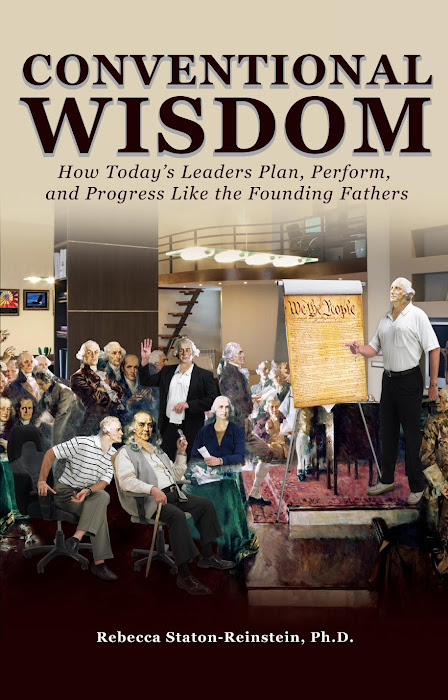
Want to know more about the leaders in today’s blog and others who have transformed their organizational cultures to improve bottom- and top- line results? Check out Conventional Wisdom: How Today’s Leaders Plan, Perform, and Progress Like the Founding Fathers.

Sunday, January 16, 2011

Thank you Jefferson and Madison for Religious Freedom

Imagine my surprise. It was a chill December day as I drove through rural South Carolina on my way home from a visit with my sister. As I flipped around the radio dial I found some easy-listening jazz and settled back to enjoy the winter landscape flying by my window. Now here’s the surprising part. When the commercial break arrived, I found I was listening to WLGI, a 50,000 watt radio station in Williamsburg County, S.C…but not just any small station…This was run by a local Bahá’i community institute. Bahá’i in the rural south?
My reaction in finding the radio station was, “Only in America!” I immediately fired off a text message to a Bahá’i friend in Brussels. Then I reflected a little more…The Bahá’i are persecuted, excluded, and murdered in their native Iran and have been since the 19th century. Here in the U.S. about 130,000 Bahá’i live and worship freely.

Then I reflected a little more…Only a few short months ago the TV was full of reports of a Florida preacher who threatened to burn a Koran and bitter opponents of an Islamic Center in lower Manhattan taking to the streets.

All these reflections and more bring me to the importance of today. On January 16, 1786 the Virginia legislature adopted the Virginia Statute for Religious Freedom. In 1993, the U.S. Congress commemorated this historic occasion by establishing National Religious Freedom Day.

Thomas Jefferson wrote the historic legislation but it took his friend, James Madison, to push it through the state legislature, opposed all the way by Patrick Henry. The immediate impact was to disestablish the Anglican Church as the official state church and stop laws persecuting other religions.

During the hot debates over the Statute, which would deprive the Anglican church of state tax revenues, representatives tried to limit the coverage to Christians. Madison successfully stopped the effort. Jefferson wrote he was delighted the move "was rejected by the great majority, in proof that they meant to comprehend within the mantle of its protection, the Jew and the Gentile, the Christian and Mahometan, the Hindoo, the infidel of every denomination."

The essence of the statute is clear: "all men shall be free to profess, and by argument to maintain, their opinion in matters of religion, and that the same shall in no wise diminish enlarge, or affect their civil capacities." Original intent is crystal clear in these and many statements by Madison, Jefferson, and others.

Later, when Madison took up his duties in the first U.S. Congress, his first duty was to draft a set of amendments to the new Constitution he helped create. The first of these comes down to us as the First Amendment, establishing religious freedom and separation of church and state. Madison drew on the Virginia Statue and his life-long devotion to freedom of conscience.

So celebrate Religious Freedom Day, by the dictates of your own conscience, not just today, but every day. Whether you embrace a particular religion, no religion or something in between, the spirit of this day belongs to you.

The Bahá’i belief of our universal family living in peace sure brings that message home.

* * * * * *
© Rebecca Staton-Reinstein, President, Advantage Leadership, Inc. http://www.advantageleadership.com/

If you’re unfamiliar with the Bahá’i Faith, it was founded in 1852 by a Persian nobleman while imprisoned in Teheran for his religious beliefs. Bahá'u'lláh, a monotheist, believed all humans are part of the same family and ultimately believe in the same god. He emphasized the importance of the messages and messengers of all religions, and living a moral, ethical, peaceful life while serving other. (Learn more at http://www.bahai.org/)

Jefferson included authorship of the Virginia Statute and the Declaration of Independence and the founding of the University of Virginia as the 3 accomplishments to be placed on his grave stone.