Monday, September 24, 2012

"Why train 'em? They'll only leave!"

Those were the very words my department head Lenny, said to me some decades ago when we told him we wanted more training. Can you believe it? Of course you can. You've heard the same thing from bosses yourself.

This was misguided then and it's even more so now.

We're coming out of a very tough period for most companies. Everyone knows that when budget cutting is on the table, training gets the ax first. So what's new?

According to a new study published in the Harvard Business Review and highlighted in the Kansas City Star, high achievers who are 30 and under are abandoning ship in droves with an average stay of 18 months. Why? Simple. Lack of training and mentoring for growth.

Imagine that? Young workers want to grow and develop? Isn't that what every management guru since the beginning of time has been telling would-be managers? "Your job is to grow your people." Didn't managers get the memo? Evidently not.

People who have been following the discussions about the millennial generation (Gen Y) have decried the fact they grew up thinking everything they did deserved a "good job" and they all got a prize. But guess what, the reality is that every employee needs and deserves the chance to grow and develop. This isn't a new phenomenon. We are Homo sapiens -- the thinking ones. These young workers are just acting on what is deep-seeded in everyone. We want to learn and grow.

Although my old boss is long gone, his attitude isn't. Here are a few ideas to reverse the trend.
  1. Spend time with all employees finding out what their interests and talents are.
  2. Figure out how to develop those interests and talents for mutual benefit.
  3. Provide formal and informal training and mentoring.
  4. Encourage individual initiative and growth.
  5. Be ready to say "goodbye."
The best boss I ever had was Joe Caccavo. He reported to Lenny but he was not going to allow his views to affect our team. Joe developed a team of dedicated people who would have followed him to the ends of the earth. (Note: we were also civil service and unionized. Joe could not give us promotions or raises.) So how did he do it?
  1. Joe spent time with each of us just talking. He was genuinely interested in understanding our aspirations and talents and then doing what he could to fostering them.
  2. Joe kept looking for ways to give each of us opportunities to develop our talents on the projects we worked on. He allowed us to try different roles and tasks and discover where our real contributions lay.
  3. Joe set up "lunch and learn" sessions in the conference room one a week. They were voluntary but we never missed a one. He supplied the pizza and the knowledge. There was no budget but he found some local professors who were willing to come in once a month and give us more advanced training -- roast beef sandwiches on the menu for those sessions!
  4. He encouraged us to take additional courses on our own and join professional groups that provided educational programs. He attended those meetings with us and helped us network. He let us know when we made mistakes and inspired us to correct them. He was no "softy" and knew how to deliver tough love when we needed it.
  5. No one wanted to leave Joe's team. But Joe knew we needed to move on if we were going to continue to grow and develop. When I went to tell him that after 5 years I was going for a corporate position, Joe was thrilled. Because Joe had supported my development, his team had 5 years of results that benefited the organization. Other teams seldom kept people more than a year (yes even in that protected world.)
So which sort of boss are you? Joe or Lenny? I always tried to follow Joe's example and I still encourage my clients to do the same. If fact, my first advice when times are tough and budgets need to shrink? Increase training! After all, if you want people to do more with less, you need to train and mentor them to do that. Otherwise, they'll hit the road as soon as they can.
*     *     *     *     *     *     *     *
(c) Rebecca Staton-Reinstein, president, Advantage Leadership, Inc.
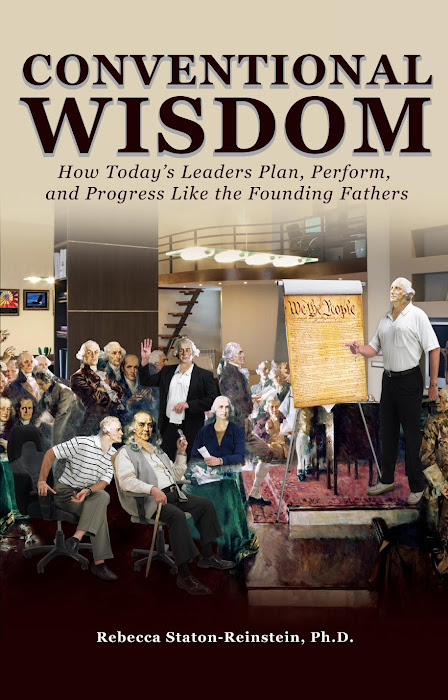
Author: Conventional Wisdom: How Today's Leaders Plan, Perform, and Progress Like the Founding Fathers. (This link takes you to a special page for a special offer not available publicly.)


Tuesday, September 18, 2012

Happy Birthday, US Constitution

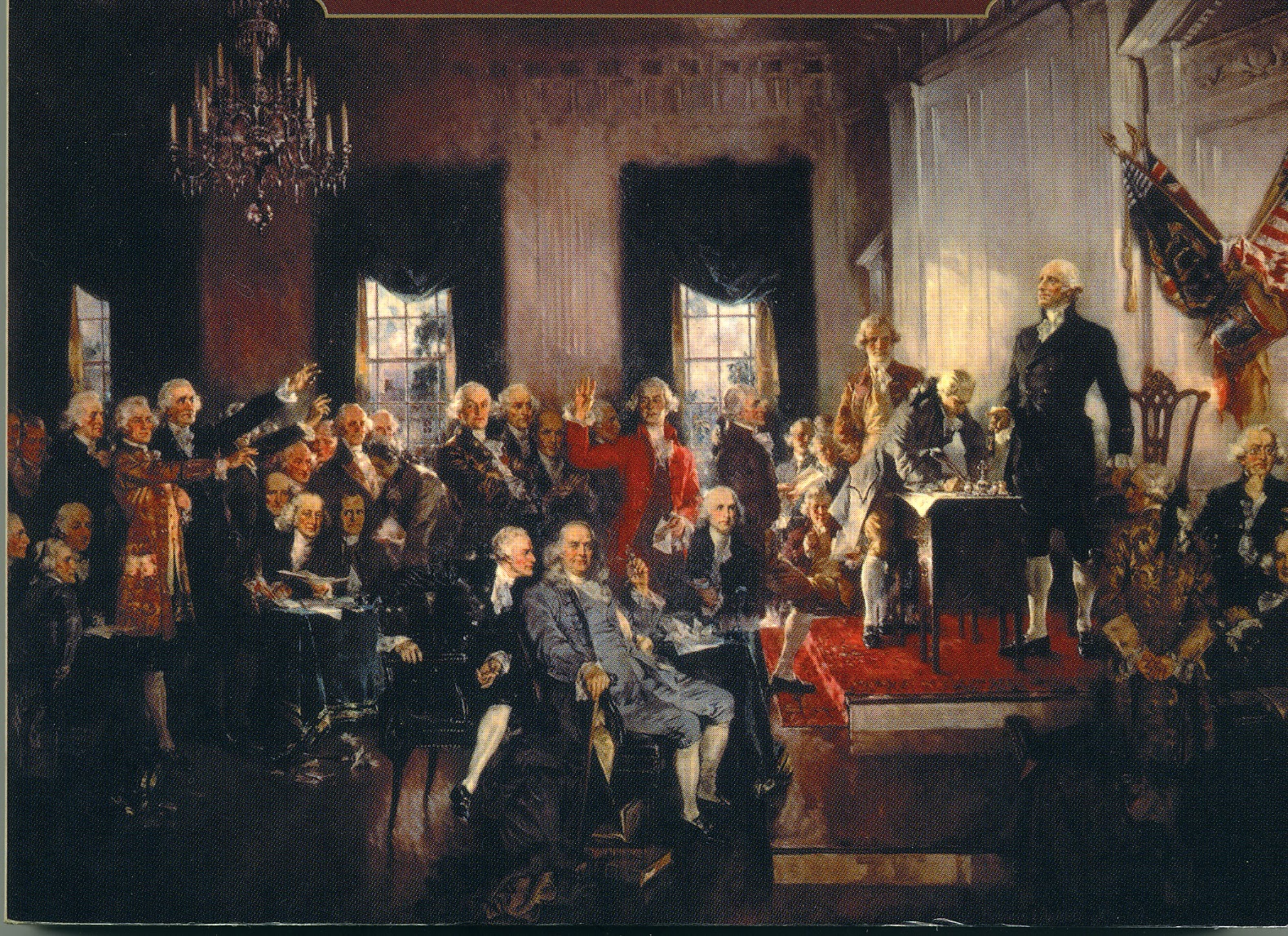
On September 17, 1787, delegates lined up to put their names on the document they had agonized over for the last four sweltering months in the Pennsylvania State House. Through it all, James Madison sat near the front of the delegates' meeting hall taking notes in his own shorthand of all the debates, discussions, and final compromises that made it into the document.
 
Three delegates refused to sign in the very end, holding out for a Bill of Rights. Others of the original 55 representatives from 12 states had drifted away or left in disgust. Rhode Island was not represented. It had refused to participate. Despite everything, with political divides as deep as any today, the remaining delegates signed and sent the new Constitution to Congress to pass on to State ratifying conventions.
 
Visualize Benjamin Franklin in his eighties, overweight and crippled with a gout attack. He asks James Wilson to read his remarks, which are addressed directly to the handful of delegates who announced they would not sign the Constitution.

I confess that I do not entirely approve this Constitution at present…[H]aving lived long, I have experienced many instances of being obliged…to change opinions even on important subjects…[T]he older I grow, the more apt I am to doubt my own judgment and pay more respect to the judgment of others…I cannot help expressing a wish that every member of the convention who may still have objections to it, would … doubt a little of his own infallibility…and put his name to this instrument.

Franklin speaks down the centuries to leaders. Although the three reluctant delegates were not swayed that day, Franklin captured a key element of great leaders. They all know they make bad decisions sometimes. They know they are fallible and question their preconceived notions.
 
As our presidential election draws near, the attack ads continue relentlessly, and candidates play fast and loose with the facts, heed Franklin's advice. Celebrate this Constitution and pay more respect to the judgment of others.
*     *     *     *     *     *     *     *     *
 
To find out more about this important day in U.S. history, the strategic planning and leadership of the framers, and the wisdom of today's strategic leaders, read Conventional Wisdom: How Today's Leaders Plan, Perform, and Progress Like the Founding Fathers. (This link takes you to a special page for a special offer not available publicly.)


Saturday, July 14, 2012

Black Lung Is Back: For My Family It Never Left

NPR highlighted new evidence that the killer of coal miners - Black Lung - is back. http://tinyurl.com/88c76uq For my family, it never left. In the early part of the last century, my maternal grandfather, Rufus Necessary, was a coal miner in Wise County in Southwest Virginia. He had a wife, Lula, and several children; 2 daughters and 2 sons. He came down with black lung prior to 1912. The mining company moved him into the office to do bookkeeping. Sometime in 1912 just before the birth of his youngest child, he died. Lula and the children were taken in by relatives but it was not a permanent solution. The family decided to distribute the older children to various relatives nearby. That left an 18 month old baby girl who bore her father's name, Rufus Necessary.

Ruth nee Rufus at 2 with Mike the dog
What was to become of her? None of the family members wanted to take on a younin' so through the local church network the word went out. Living not too far away in the little town of Appalachia were a childless couple, Rob and Lottie Jett. They adopted the little girl and changed her name to Ruth Jett. Rob worked for a small coal-hauling railroad where he had started out as a telegrapher and worked his way up to finally becoming a superintendent. Little Ruth grew up in somewhat more fortunate circumstances in the little town. Almost unheard of at the time, she eventually went to William and Mary and started a new life as a teacher. She eventually married and had a family, continued teaching and studying, and ended up with masters degrees in English and Counseling and a PhD in English education. She finished her long career as a professor at a local college in Roanoke, Virginia.

But Ruth still bore the scars of the death of her father. She loved her adopted parents and they doted on her. As an adult she was close to one of her brothers and they visited back and forth. Still there was a gnawing feeling of loss and abandonment flying under the surface. Black lung had stripped her of her biological family.

The mining companies and industry groups continued to deny reality and death certificates almost never bore the words "black lung" as cause of death. Today with a resurgence of the disease exacerbated by the addition of silica to the deadly coal dust not much changes. The industry denies, allies in Congress want to investigate the folks who did the latest study, the President doesn't want to push the issue in an election year, and with the general gridlock, there is no hope of action now.

 In 1912, Lula Necessary was faced with a bleak future and devastating choices. She had no government safety net, no access to the courts, and no skills with which to make a living and support her kids. She had to give away her children and hope for the best. Records show she eventually found work as a domestic servant and may have married. Her children all did well and entered the middle class as professionals. Rufus and Lula's grandchildren also became professionals and raised families of their own. None of us bear the scars but we do have the sad family memories and an abiding belief that it should not have to happen to others.

My mother, Ruth/Rufus, and her family were victims exactly 100 years ago. In that time, how many more miners and their families have been destroyed?

Why am I posting this on my strategic leadership blog? Simple,

Black Lung is back because of lack of leadership at every level. The feds, the states, the coal companies, the unions, and industry associations have all been complicitous.

100 years is too long to wait for the elimination of this killer.

Where are the leaders?

Wednesday, July 4, 2012

Dirtiest Election Ever: July 4th Battle of the Titans

Thomas Jefferson. John Adams. Comrades in the revolutionary struggle. Friends. Allies. Not in 1800.

In 1800 they squared off against one another in what many historians rate as the dirtiest election ever. They were the public face of the newly minted political parties; Adams for the Federalists and Jefferson for the Republicans. They were locked in a battle with few rules and fewer scruples.

But that wasn't always the case. In 1776 they were members of the historic Continental Congress. They were ahead of many of their contemporaries in realizing the need to break from Britain. Although Jefferson was relatively new to the Congress and Adams was a seasoned veteran, Adams recognized the talents of Jefferson immediately. They were designated a committee along with Ben Franklin to draft a document for the Congress to declare independence. Adams immediately suggested Jefferson pen the draft for them to review.


The rest, as they say, is history. Jefferson penned the document, the Congress did a little editing, and then they members signed. The official signing date was set for July 4, 1776 and has been celebrated ever since. Adams believed the day should be marked with fireworks and celebrations and tonight I'll be off to watch some locally and listen to my husband play in the Greater Miami Symphonic Band. It will be a joyous celebration.

But there is another anniversary to notice today. After many years of close friendship and public service, Jefferson and Adams entered our first federal government in 1788. Adams became George Washington's Vice President and Jefferson Secretary of State. The slow unraveling of a long relationship began as they drifted to different ends of the political spectrum. By the third national election in 1796, the proto-parties had emerged and with some maneuvering behind the scenes by Alexander Hamilton, Adams, the Federalist, became president while Jefferson, the Republican, became Vice President. The split became complete and set the stage for the battle of titans in 1800.

With Jefferson's victory, Adams infamously lit out of town early on inauguration day to avoid formally passing the reigns of government to his bitter foe. And so the animosity festered below the surface for years. Almost a decade later, their mutual friend Benjamin Rush began a quiet campaign to reunite the former friends. For the last years of their lives they renewed that relationship forged in the crucible of the Revolution and wrote a series of letters not just for one another but for us. In the process, the terrible memories of the 1790s and early 1800s fell away, and a remarkable friendship emerged again. They talked history, politics, farming, and aging. These letters should be required reading for every citizen. There is no better insight into the minds of two of the revolutionary brotherhood.

But here's where truth is stranger than fiction. In 1826 both titans turned down requests to speak at the 50th anniversary of the Declaration of Independence celebrations. Both replied they were ill and not feeling well. As the day drew near, both men took to their beds, terminally ill. Jefferson drifted in and out of consciousness. Sometime in the early hours of July 4th he seemed to rally and asked, "Is it the 4th yet?" Adams woke briefly in the afternoon and said, "Jefferson still lives." But Jefferson was already gone and Adams joined him.

After an almost life-long relationship with its depths and heights, these two extraordinary founders of the republic died exactly 50 years after bringing the founding document into existence and more importantly dedicating themselves to founding our country. You cannot make this stuff up.

So are there any lessons for leaders, for politician, for individuals? Perhaps only one: Do not allow politics or other such foolishness to separate you from other people. Friendship - true relationships - are more important than ideology and other inanities. If Jefferson and Adams could survive the dirtiest election ever and reconnect, there is some hope for our own fractured country.

* * * * * * * *
What's your idea: Do you have friends and do you maintain relationships with people you disagree with in politics? Please post your comments.
* * * * * * *
©Rebecca Staton-Reinstein,  http://advantageleadership.com/section/Our_Team/3/ president, Advantage Leadership, Inc.  Http://www.AdvantageLeaership.com
Want to know more about the tumultuous fights at the Constitutional Convention and the election of 1800? Check out
Conventional Wisdom: How Today's Leaders Plan, Perform, and Progress Like the Founding Fathers http://advantageleadership.com/section/Conventional_Wisdom/17/

I NEED YOUR HELP: I'm beginning research for my new book on the influence of leaders on their organizations (Washington's Shadow) and I'm interested in your experiences or ideas for case studies. Do you know a leader who has had a profound influence shaping the organization's culture and changing it for the better? (I'm not interested in negative stories which are much more common.) Drop me a note:


Rebecca@AdvantageLeadership.com  mailto:Rebecca@AdvantageLeadership.com

http://www.youtube.com/watch?v=3ZF_JGFu6Zw&feature=relmfu

Wednesday, June 20, 2012

Dirtiest Election Ever: Voter suppression, a time-honored tradition?

If you’re following U.S. politics, you know the current contest between Governor Romney and President Obama is getting nastier with each passing day and will soon surpass the primaries for down-n-dirty campaigns.

People decry how nasty campaigns have become, but the nastiness was injected almost from the beginning. Many historians put the campaign of 1800 at the top of the list for dirty contests.

That election pitted the sitting president, John Adams, against his Vice President, Thomas Jefferson. 1800 was the first big contest between two distinct emerging parties. Adams represented the Federalists while Jefferson stood for the Republicans (predecessor of today’s Democrats.)

Although it wasn’t considered gentlemanly to actually campaign, Adams and Jefferson worked the levers behind the scenes, the totally partisan press stirred the pot, and their surrogates were out there campaigning. Jefferson was especially adept at the anonymous press articles and getting his friends to “leak” his letters.

But what about the electorate?

Today there is a raging controversy about voter suppression. In my home state of Florida, the state is suing the Federal Government to get access to citizenship records and the Feds are suing the state for violating the Voting Rights Act. At this writing the issue is not resolved.

But are the notions of who is eligible to vote and voter suppression really new? Of course not! The very existence of the Voting Rights Act testifies to the history of suppressing the vote of African Americans and others. (In full disclosure, I benefited directly from the Voting Rights Act. Until the law passed, I could not vote in Indiana where I was a town resident and university student.)

Blacks, Indians, women, and propertyless whites were denied access to voting from the beginning of the Republic. But a twist on voter suppression was actually written into the Constitution – the infamous Three-Fifths Rule.

In Article I, Section 2, which describes the qualifications for Representatives, here’s what our founding fathers agreed to in 1787:

Representatives and direct Taxes shall be apportioned among the several States which may be included within this Union, according to their respective Numbers, which shall be determined by adding to the whole Number of free Persons, including those bound to Service for a Term of Years, and excluding Indians not taxed, three fifths of other Persons.

First, let’s decode it: “three fifths of other persons” means each enslaved person was to be counted in determining the total population as 3/5 of a person. This increased the number of people counted in the population to determine congressional districts inflating representation. However, these “other persons” were not allowed to vote.

The practical effect of this notorious clause was to provide more electoral votes to states with large enslaved populations than they would have had based on the white population. This skewing of the electoral vote meant Jefferson had a distinct advantage over Adams. In fact, it helped elect the Virginia dynasty – Jefferson, Madison, and Monroe. (For dedicated political junkies, check out Negro President: Jefferson and the Slave Power by Garry Wills for a detailed look at the implications for electoral votes.)

In 1800 the issue was gerrymandering the Electoral College to suppress the vote of states without a large enslaved population.

This odious section of the Constitution was not eliminated until the 14th Amendment was passed in 1868. Even then, Indians were still excluded. In 1870 the 15th amendment was passed finally providing:

The right of citizens of the United States to vote shall not be denied or abridged by the United States or by any State on account of race, color, or previous condition of servitude.

Women were not a part of the voting system (with a few exceptions) until passage of the 19th Amendment in 1920.

What are the lessons for today?

Lessons for political leaders:

Tempus fugit: The Roman poet Virgil is credited with adding this handy phrase to our lexicon when he wrote, “fugit irreparabile tempus.” Time flees irretrievably. While politicians in every age get mired in the immediate mandate to get elected and re-elected, they fail to notice history is leaving them behind. The wrongs will eventually get righted and they will be on the wrong side of history.

Carpe diem: The Roman poet Horace coined this useful phrase as, “Carpe diem quam minimum credula postero.” Seize the Day, putting as little trust as possible in the future. For politicians this could be interpreted as, “Do what is right today and don’t wait for a ‘better time’ at some date in the future.” Gradualism and hope are not successful strategies for change.

Usque ad: All right I’m pushing the Latin translation but, roughly, it means “inclusive.” In terms of political leaders this means including every citizen on the voting rolls, educating them, and getting them out to the polls. Some countries have mandatory voting, which probably world not work here. But the embarrassingly low turnout, even for presidential elections, erodes democracy.

Lessons for leaders and managers:

Tempus fugit: The time to fight bias, especially unconscious bias in the work place is now. Time is fleeing and every day that passes without tapping into the totality of human potential sets companies, governments, and nonprofits/NGOs back. In a globally connected world, there is no rational, financial or organizational reason to exclude the creative capacity of every human mind.

Carpe diem: Every year the Catalyst Award seeks out companies that have unearthed their hidden biases, broken down the barriers, and tapped every employee’s potential contribution. There is always a bottom-line upside.

Usque ad: Inclusiveness can easily slip into the buzz-word-du-jour waste bin. Yet, as the most successful leaders have figured out inclusiveness and celebrating diverse ideas, opinions, and insights leads to the innovation necessary to compete successfully today. Why would you exclude anyone? Which ideas can you afford to miss?

Lessons for personal action:

Tempus fugit: Time flees while you divert your mind with ____ (fill in the blank.) The election draws near. Inform yourself on the issues, choose your candidate, and go to work for him or her.

Carpe diem: Speak out. Look for every opportunity to support full voter registration and get-out-the-vote efforts. Voter fraud is not threatening our democracy…Voter apathy is.

Usque ad: Insist your candidates embrace inclusiveness, not only in their campaigns, but in their support of full voter participation. The actual number of fraudulent voters is miniscule and non-consequential. The impact of non-participation is devastating. Turning this around could change the game entirely for all of us of every political stripe.

* * * * * * * *
What's your idea: Can we progress from our checkered history on voter suppression and apathy to full participation? Please post your comments.
* * * * * * *
Next: Is money the great corrupter of politics?

* * * * * *
©
Rebecca Staton-Reinstein president, Advantage Leadership, Inc. 

Want to know more about the tumultuous fights at the Constitutional Convention and the election of 1800? Check out
Conventional Wisdom: How Today's Leaders Plan, Perform, and Progress Like the Founding Fathers

I NEED YOUR HELP: I'm beginning research for my new book on the influence of leaders on their organizations (Washington's Shadow) and I'm interested in your experiences or ideas for case studies. Do you know a leader who has had a profound influence shaping the organization's culture and changing it for the better? (I'm not interested in negative stories which are much more common.) Drop me a note:


http://www.youtube.com/watch?v=3ZF_JGFu6Zw&feature=relmfu


Sunday, June 17, 2012

Dirtiest Election Ever: Are foreign affairs so foreign?

European policies stymie American growth
Foreign countries threaten American existence
African pirates disrupt shipping
Headlines from today’s news? They could have just as easily been blazoned across the papers of 1800. During every election cycle, people are more focused on domestic issues; situations affecting them every day in obvious ways. Unless there is some huge threat, foreign affairs fall way down the list of criteria for choosing a candidate.

In 1800, the types of foreign threats the U.S. faced were eerily similar to those that affect us today. Perhaps the biggest were those growing out of the ongoing wars in Europe, especially the monumental battles between England and France.

President George Washington had insisted on a position of neutrality in the face of these conflicts. However, neither England nor France recognized our stance and attacked our shipping with impunity. Under President John Adams we engaged in the Quasi-War with France as our shipping was attacked on the high seas and in the Caribbean. England routinely boarded our merchant ships and impressed sailors they claimed were British citizens. They also barred us from the Caribbean. Pirates along the infamous Barbary Coast of Africa and in the Mediterranean routinely attacked our ships, held the captains for ransom, and enslaved the crew.   

The World in 1800

By 1800, the battle lines were pretty firmly drawn. John Adams was always distrustful of France since his days as a diplomat there. He and the Federalist Party leaned towards England. In fact, he was disliked in his own party for not going to war with France. The Federalist, concentrated in New England and South Carolina, wanted to reestablish profitable trade with England. There were even calls for secession.

Thomas Jefferson and his Republican Party disliked the British and wanted stronger ties to France. During the French Revolution, Jefferson supported the new order even when it turned into the Terror. In 1800 he was accused of being a Jacobin – a term the electorate translated as far more than a Francophile. They accused him of wanting to abolish private property and religion and turn their daughters into prostitutes in Temples of Wisdom!

In the midst of all this, Adams had sent delegates to England to negotiate a new Treaty, which was universally hated because people saw it as a complete capitulation to the British. He was given no credit for keeping the fragile new nation out of wars we would have surely lost.

Character assassination was the game of the day, just as now. Each side tried to paint the other as traitors to the American people.

What can leaders learn from this for today’s elections?

In the political realm, people like to say, “Politics ends at the water’s edge.” They recall times in our history when this was the dominant approach. However, those moments are not the norm as much as we might wish them to be. What can we ask of the presidential candidates? Articulate a coherent, comprehensive policy that makes it possible to choose. (Of course, that requires an electorate that educates itself on the issues, makes rational decisions, and goes to the polls. Because none of these conditions has ever been met in our history, this may be asking too much.)

Lessons for Business Leaders

Foreign affairs matter: In a global economy, virtually no business is isolated from what happens elsewhere. Consider in greater depth all the ramifications of outsourcing or trading with any country. By now companies understand there is more to the equation than lower production costs or opening new markets. Weigh these other factors and consequences seriously in making decisions. Help everyone understand how these decisions affect them and fit with the mission.

Foster understanding: In global companies or those that do business directly in other countries, insist on cultural understanding and sensitivity. These include learning the language and engaging with people. Too often employees live in cultural isolation. Unconscious bias is rampant and undiagnosed. Assess your situation independently and take action to correct your issues.

Forget isolation: Even in companies that do no direct business with other countries, do not isolate yourself and your staff from what is going on in the rest of the world. Help people understand how all the pieces of the global puzzle fit together. Educate yourself and your staff about the issues. Look for opportunities to engage with people from other countries. The “isolationist” position is unsustainable in today’s world. We cannot afford the fear, mistrust, anger, and xenophobia isolation breeds. It’s always in our interest to know and understand the world as it exists not as we might like it to be.

Both John Adams and Thomas Jefferson interpreted their work and interactions in Europe through their own biases. Adams tended to reject outright people, nations, and customs that were different. Jefferson, although more open, accepting, and even embracing of various European cultures, was ready to overlook any negative by reinterpreting everything through his political philosophy. Neither approach serves today’s political and business leaders.
* * * * * * * *
What's your idea: Can we actually adapt ourselves, our businesses, and our country to a global world? Please post your comments.
* * * * * * *
Next: Voter suppression, a time honored tradition?
* * * * * * ©Rebecca Staton-Reinstein, president, Advantage Leadership, Inc. 
Want to know more about the tumultuous fights at the Constitutional Convention and the election of 1800? Check out
Conventional Wisdom: How Today's Leaders Plan, Perform, and Progress Like the Founding Fathers

I NEED YOUR HELP: I'm beginning research for my new book on the influence of leaders on their organizations (Washington's Shadow) and I'm interested in your experiences or ideas for case studies. Do you know a leader who has had a profound influence shaping the organization's culture and changing it for the better? (I'm not interested in negative stories which are much more common.) Drop me a note:
Rebecca@AdvantageLeadership.com 


Monday, June 4, 2012

Dirtiest Election Ever: Beyond the F-Bomb

Every time a politician drops the F-bomb, the media are all atwitter. (Can Twitter be atwitter?) They run the clip over and over BLEEPING politely at the crucial moment so as not to offend us. The current two candidates for president are not the sort of folks who will be caught using this anglosaxonism although their associates may be. Jefferson and Adams in the election of 1800 usually preferred the perfect barbed comment also.

So what? Move off the "networks" and onto the cable channels and the F-Bomb is just another word among many floating across the airwaves. But looking back to the really nasty election of 1800 and its parallels with 2012, what is the story when it comes to salty language and attack words?

Today as in 1800 there were words that people thought too rude for public discourse. But what was happening behind the scenes? There folks weren't as gentlemanly as we like to think, especially when talking among themselves.

George Washington had a towering temper he kept in check for the most part. When he let it rip he could toss the verbal bombs with the best of them. When delegates to the Constitutional Convention sat with their pipes and port after dinner, they often swapped bawdy stories, just as people do today. One of their favorite games was inventing wilder and wilder puns about Gouverneur Morris' wooden leg and his way with the ladies. James Madison was infamous among his contemporaries for his off-color stories.

It's true they didn't throw the F-Bomb but they certainly came close. John Adams was no fan of Alexander Hamilton and in a letter to Benjamin Rush in 1806 let fly with this diatribe against Hamilton for remarks he had made denigrating George Washington.


John Adams
Although I read with tranquility and suffered to pass without animadversion in silent contempt the base insinuations of vanity and a hundred lies besides published in a pamphlet against me by an insolent coxcomb who rarely dined in good company, where there was good wine, without getting silly and vaporing about his administration like a young girl about her brilliants and trinkets, yet I lose all patience when I think of a bastard brat of a Scotch pedlar daring to threaten to undeceive the world in their judgment of Washington by writing an history of his battles and campaigns. This creature was in a delirium of ambition; he had been blown up with vanity by the tories, had fixed his eyes on the highest station in America, and he hated every man, young or old, who stood in his way or could in any manner eclipse his laurels or rival his pretensions. . . 

Pretty strong stuff...but not as strong as these "gentlemen" wrote under pen names in the popular press skewering one another and accusing one another of the worst intentions, treason, and more. Generally they lambasted one another with innuendo as well as direct attacks. In fact, what can be a delicious pastime is dissecting their elaborate language and watch as they slip the verbal knife between the ribs and give a fatal twist.

We seldom hear such creativity today where it's so easy to just go for the flat obscenity rather than the creative crudity. I was impressed when George Will called Donald Trump a bloviating ignoramus. The founding fathers would have liked that.

But are there any Leadership Lessons in all this?  Perhaps a few:
  • Leaders control themselves: George Washington was prickly and thin skinned and took offence easily. Yet his advice to himself and others was to show restraint of "tongues and pens." He kept his temper in check most of the time. "Losing it" on a regular basis causes people to disengage. 
  • Leaders cultivate creativity: "Bloviating" is such a yummy word and I'm sure many people scurried to google its meaning. (Synonym for blow hard) In our general anti-intellectual climate, leaders encourage their people to think and grow and become more articulate.
  • Leaders do not condone crudity: Leaders know that some language offends some people just like the bawdy stories and sexist remarks that have disappeared for most workplaces. They do not insist on better communication because of "political correctness." They want to be inclusive; they want everyone to be engaged.
Just because the founding fathers weren't saints doesn't mean we do not honor and respect them. We admire them because, like us, they were all too human, capable of pettiness and backbiting, and sometimes behaving badly. We can learn from them precisely because they are human. We can learn from their mistakes and when they triumphed over their human nature. And we can learn from their fierce honesty because they would call a bloviating ignoramus a bloviating ignoramus!
*     *     *     *     *     *     *     *

What's your idea: Can we joust with more inventive language without bloviating? Please post your comments.
* * * * * * *
Next: How foreign are foreign affairs?

* * * * * *
©Rebecca Staton-Reinstein, president, Advantage Leadership, Inc.
Want to know more about the tumultuous fights at the Constitutional Convention and the election of 1800? Check out Conventional Wisdom: How Today's Leaders Plan, Perform, and Progress Like the Founding Fathers

I NEED YOUR HELP: I'm beginning research for my new book on the influence of leaders on their organizations (Washington's Shadow) and I'm interested in your experiences or ideas for case studies. Do you know a leader who has had a profound influence shaping the organization's culture and changing it for the better? (I'm not interested in negative stories which are much more common.) Drop me a note:


We've started a companion YouTube series and the introduction is up. Check it out.