Monday, September 21, 2009

George Who?


You know the drill...Jay Leno stops people on the street and asks them simple questions and that's where the fun begins. Recently he stopped a nice young man and asked him to name some Founding Fathers. "Founding Fathers of what?" he asked rather belligerently. OK, maybe it was staged...but...

Only a quarter of high school students in a recent poll could identify the first president of the U.S. Few could list the 3 branches of government. Forget about any real understanding of our our system of government and how it works. The findings of the latest poll reflect many other more scientifically sound studies that show up year after year.

Thomas Jefferson sums it up best: If a nation expects to be ignorant and free, in a state of civilization, it expects what never was and never will be.
Whether you are a Democrat, Republican, Independent, or have some other affiliation, the lack of knowledge of our history and understanding of our government is frightening. It could foreshadow disaster.

What is to be done?

  • Develop an engaging curriculum at every level of eduction from elementary school through college; involve educators, parents, students, historians, and instructional designers

  • Train teachers at every level to become knowledgeable and involved; provide them with materials and support to develop lessons that capture students' interests

  • Bring history to life with field trips to local historical sites and visits to local government meetings; Every student should visit Washington, D.C. at least once during his or her 12 years in school

  • Focus less on standardized testing and more on involving students in recreating critical events from our history, debating the great issues, applying lessons to their own lives.
This will not be easy. Political debate will rage around the curriculum and determining the "correct" facts and their interpretation. But as the PBS series on the Civil War and the HBO series on John Adams have shown, when you present history in a compelling way, people will be involved and come away glad to have learned something about two crucial periods in our history that still have echos in the present.

When the John Adam series was first running on TV, Greg Swienton, CEO of Ryder System, would gather anyone who was interested to discuss the previous nights episode. These were lively ad hoc conversations. Imagine that in your busy work place. When was the last time you gathered to chat about history? When was the last time you talked with your kids or grandkids about history or took them to visit a historic site or city council meeting?

If a nation expects to be ignorant and free, in a state of civilization, it expects what never was and never will be.

(c) Rebecca Staton-Reinstein, http://www.advantageleadership.com/


Saturday, August 29, 2009

The Lions Sleep...


The Lion of the Senate, Ted Kennedy, has passed from the scene and both Democrats and Republicans, allies and opponents lionize his contributions of four decades plus service. All of them seem to agree that what made him such a legislative master was his ability to find common ground. On the Senate floor he might roar and attack but behind the scenes he was ready with a joke, a helping hand, and a genuine desire to work out a solution. At his wake earlier this evening, one of the speakers talked about his lack of pettiness or personal rancor.

What struck me about all of this were the parallels with my own favorite legislator, James Madison. Jemmy like Teddy mastered the art of being an effective legislator. From his mid-twenties on, he served in a series of legislative bodies and was seldom out of office. He started in the colonial Virginia House of Burgesses and moved through the independent Assembly and into the Continental Congress. His most important contribution was helping pass religious freedom legislation and to fight Patrick Henry’s favorite cause, state funding for religious institutions.

Madison is called the Father of the Constitution with good reason. He used the skills he had honed in the rough-and-tumble legislatures of the Revolution and post-Revolutionary period to make sure we built a more perfect union. Jemmy was one of the conspirators who brought the Constitutional Convention into existence. (Patrick Henry stayed home saying he smelled a rat!) He had done extensive homework and showed up early to meet the delegates, take their measure, and begin building relationships. He had a draft of a new constitution introduced as the Virginia Plan. He spoke on every issue, forcefully and often persuasively. He worked in committees and behind the scenes, looking for common ground, striking deals, and building consensus. He socialized and told great, if off-color stories, and seemed to be everywhere doing the one-on-one of good political organizing. In other words he was a great legislator.

Once the Constitution was finished he worked with Alexander Hamilton in a white heat of creativity to author the Federalist, one of the great political documents of all time, arguing persuasively for ratification. Of course he was elected to the Virginia ratifying convention and although he was very ill, probably as a result of his four months of non-stop work in the convention followed by months of work on Federalist, he faced down Patrick Henry’s bombast and dramatic attacks on the new Constitution. He worked his legislative skills to their limits and brought in a paper thin victory.

With the formation of a new Congress, there was a groundswell of support to appoint Madison to the Senate. But now political payback was at work. Patrick Henry blocked his nomination, still smarting from his most recent defeat and never forgiving him for the defeat of state support of religion. Although Henry also attempted to gerrymander his district later, Madison was elected to the House of Representatives every time he ran.

In the new Congress, Madison was in his element and served as Washington’s right-hand man, making sure his legislative agenda was realized. Madison first drafted and then engineered the passing of the Bill of Rights. But perhaps one of his most interesting feats was passing Hamilton’s financial legislation. Here we see a skilled legislator at work. Even though Madison was skeptical of the financial and monetary policy in the bill, he agreed to support it. He worked behind the scenes to line up enough votes so it could pass (and he could save face with constituents and vote against it.)

For most of his life, he was known to be a passionate supporter of republican values and government without being ideological, petty, or back biting. He did not hold grudges and worked to find common ground. But as Washington entered his second term, Madison teamed up with his best friend Thomas Jefferson and fell into the ideological trap as they worked to destroy Hamilton and form the first political party in the modern sense, the Republican Party which morphed into the Democratic Republican party which became the Democratic Party. (Note – the modern Republican party arose in the years before the Civil War.)

Once Jemmy went down this ideological trail, his effectiveness as a legislator declined. When he entered the Executive branch as Jefferson’s Secretary of State and later as President, he was out of his area of real expertise. The master legislator disappeared and the adequate, but not distinguished, executive took his place. In retirement, the gifted Madison returned, without rancor again, reconsidering earlier positions, and looking for common ground.

Perhaps Ted Kennedy’s most enduring legacy will be as a role model for accepting ones gifts, ones true talents, and building them into a lifetime of passionate service. Jemmy could have learned a few things from Teddy…and visa versa. At their best, both men showed us what legislators should be – people who get things done by looking for ways to compromise, to work together, to be collegial, and to eschew ideological and petty rancor, payback, and meanness. Jemmy and Teddy were lions many of today’s legislators should learn from…the lions are sleeping...but hopefully others will awaken...

(C) Rebecca Staton-Reinstein

Friday, August 7, 2009

Most people are about as happy as they decide to be

What a great thought. I've carried this saying, attributed to Abraham Lincoln, around with me for 27 years. It jumped back into my mind yesterday when I read an article in USA Today discussing the latest research on happiness that came to the same conclusion.

At the same time, I was skimming though some articles in Training magazine reporting on a Deloitte study of executives and their attitudes about the economy and their companies. For the first time in a long time, there was a vast increase in those who thought things were going to turn around in the not-too-distant future. Doom and gloom were lifting. So they should be happy, right?

Buried in the report were some other findings however. The number-one focus of most of these executives -- note I did not say leaders -- was laying off more people. They were concerned about losing people once things turned around. In fact, the HR and leadership journals have been full of articles on retaining high-potential employees and grooming them for the future. So are these execs planning for how to keep these hi-pos once things loosen up? Most are not!

Studies show that Gen Xers and Millennials will jump ship as soon as new opportunities start to materialize. Wouldn't it make sense to plan for what's coming that will have a big impact on a company's ability to recover and grow again? Strategic leaders are planning. After all, they have that vision of the future and are planning how to get there. But their non-strategic counterparts are still mired in the present and the past.

Instead of planning how to take advantage of opportunities that are starting to arise, instead of actively growing the folks they'll need to be able to mobilize, instead of seizing the moment, they slashing staff, eliminating training, pushing everyone beyond their limits, and generally making themselves and everyone around them 'unhappy.'

Strategic leaders, not only think things are getting better, they're acting on their 'happiness.' They're investing in and nurturing their folks. They are planning and executing their plans to retain, engage, and develop the folks that will make their vision a reality. That's the difference between occupying a leadership title and being a leader. Strategic leaders are happy.

So I'm with Abe. Let's get happy!

Tuesday, July 28, 2009

Compromise -- good idea or bad idea?

Whether in the board room, the Congress, or dinner table debate, at some point someone will suggest a compromise. Then what happens? Some folks believe you should stick to your 'principles' and never give an inch. Others just want the debate to end so they'll jump at the chance. Neither extreme leads to good decisions or even good compromises. The U.S. Congress is debating health care/insurance reform at the moment and we see both types of extreme behavior on both sides of the aisle. In the end, there will be some sort of legislation passed and it will be a compromise...that's the way the system is set up. In fact, it took a major compromise to set up Congress in the first place.

The Constitutional Convention of 1787 was not that much different from today's Congress. It had a variety of opinions and special interests contending with one another. It had people who were adamant on many issues. Perhaps the most contentious debate was around representation --would it be equal numbers of representatives from each state or representation based on population. The smaller states wanted equal representation as they currently had in the Congress formed under the Articles of Confederation. They feared the power of the larger states and believed they would be gobbled up without equal voting power. The large states had been constantly frustrated by the ability of small states to stimmey legislation because representation did not rest on population. Both sides drew a line in the sand...or the dusty, musty floor of the Convention meeting room. This contintious issue threatened to derail the entire convention and people were ready to bring it to a close rather than give even an inch.

The arguments were bitter, lofty, extreme, and heart-felt. Virtually no one was neutral. Then on June 11, Roger Sherman (that stern looking gentleman above) put forward a motion. It was not accepted immediately and needed to go through more debate, but in the end, the Great Compromise, as it came to be called, would be accepted. The two houses of the new Congress would be selected differently. The upper House (Senate) would be based on equal representation for each state. The lower House (Representatives) would be chosen by population. It was not an easy compromise but it was 'great.' There was lots more discussion -- the devil is always in the details -- but the compromise stuck.

It's impossible to predict what might have happened had Sherman not stepped forward and had not the majority of votes finally gone for the Compromise. Many historians believe the Convention would have broken up and the fragile Union would have quickly disintegrated and been divided up by the European powers perched on the borders.

Almost exactly one year later the required ninth state ratified the new 'compromise' Constitution and the news was officially handed to Congress July 2, 1788. That compromise saved the Union because the delegates were able to back off a little from their 'principles' and see that survival of the country -- the greater good -- was more important.

So the question for each of us today, whether in our companies, nonprofit boards or government entities, is the same one that faced the framers. Is this the point to give up 100% of nothing to embrace 50% of something that will serve the greater good? This is never an easy question because it means we won't get everything, or even a lot, of what we want. Can we live with it? Can we support it so that we will make progress, if haultingly? For strategic leaders, like Sherman and James Madison, George Washington, Ben Franklin and others at the Convention, the answer was yes. We owe them a huge debt of gratitude.

Will your followers, staff or constituents be able to thank you for compromising for the greater good?

Tuesday, July 14, 2009

Hard heads for hard times


It was one of those magical days in Paris, just around Bastille Day 2006. I was zooming around the streets with folks from a mastermind retreat on Segways. You've seen these contraptions -- they look like a scooter with out the back end. There is no motor - your body position keeps them going. Some folks find them great fun or at least useful. I wasn't so sure. But I was getting the hang of it and it was an adventure. Then some folks stepped right in front of me...did I mention there are no brakes? The machine stopped dead and the law of physics took over...in other works, I fell backwards and my head hit the pavement...luckily I was wearing a helmet. My companions rushed over but all that was hurt was my pride...it goeth before a fall, you know.

I was thinking about that Segway ride and that fall and my hard head. My mother always claimed I had a hard head. I've come to believe it's a good thing. In fact, as a small business owner, it may be one of my most important assets in these hard times.

These are not times for the faint-of-heart to be in business...there are tough decisions every day. Every aspect of the business must be examined while asking that simple strategic question: Is this going to help me accomplish my mission or will it move me away from it?

You see the question is NOT, "should I spend this money on X?" It's not even "will this give me return on investment?" And it's definitely not, "Where can I cut expenses more?"

In hard times, you must be hardheaded and ask a different set of questions: "Of all the things I could be spending my time and money on, which will move me toward accomplishing my goals?" "What are my priorities for success?" "What will I lay aside so my energies are focused on the most important things?"

Sure it's tough out there. Everyday we could hear some bad news...as predictable as the thunder storms that roll through here in South Florida almost every afternoon. Let the economic storms roll. This hardheaded business owner is taking a page from the Founding Fathers. They certainly faced hard times...there was a price on their heads...but they focused their energies on success. They envisioned a republic that had never existed before. They made it a reality. Their hardheaded determination helped inspire that first Bastille Day.

So remembering all that serves as a guide for today. When you fall off your plan, get up and go again. Create a different future and hardheadedly make it happen. Innovate. Invigorate. Instigate.

Tuesday, June 9, 2009

A sad day for strategic leaders

Today I learned that Edward G. Novak passed away. Ed was an extraordinary person and a strategic leader. I first met him when he spoke at a software quality conference several years ago. He wasn't the first executive to speak at such a conference but he was the first to bring along his staff member who managed his projects. He featured her as a co-speaker and demonstrated not only his own qualities as a leader but his willingness to give public acknowledgement of the accomplishments of a so-called subordinate.

At the time he spoke, he was a Senior Vice President with Bank of America. He was a life-long banker with a reputation as someone who could engage employees and customers and still meet business goals. He built strong teams where ever he went. For many years he was a member of the Board of Trustees for the Baltimore Museum of Industry and also chaired that board. His leadership came through time and again as he helped this important preserver of Baltimore's rich heritage thrive even in tough times.

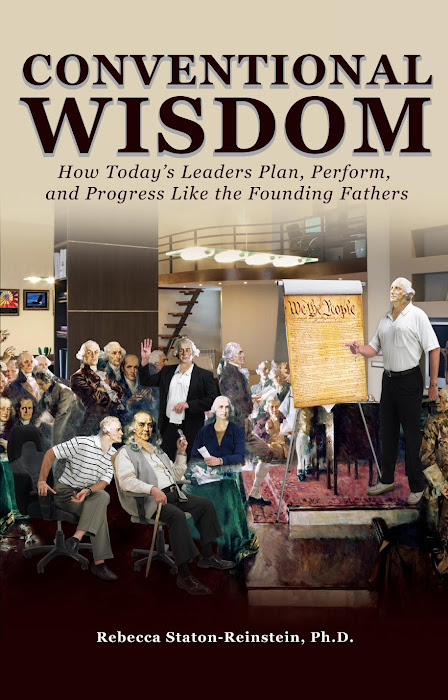
As an executive, Ed excelled at Hoshin planning and always looked for the best practices. When asked why he brought along his project manager to speak at the conference he replied, "I didn't know any better. I thought everybody teamed up." When I interviewed him for my book, Conventional Wisdom: How Today's Leaders Plan, Perform, and Progress Like the Founding Fathers, I explored his ideas on team building. Here is what he said.

"My job is to deal with clients and work with our technology partners...I'm a banker. I don't know the technology side. I knew my weaknesses and knew I needed somebody who understood technology and could get our vision built. My value would be understanding our business. I saw, from day one, that it was a partnership. We would partner to be successful...It wasn't any stroke of brilliance. This was the only way I could think of going about it to be successful.
Novak's modesty aside, his way of partnering for success has become a best practice within the bank and is widely emulated."
Ed left us too soon but he leaves behind a legacy of great leadership, service to his community, and many warm friendships. Farwell friend.

Sunday, May 24, 2009

World-Changing Anniversaries


This week marks two world-changing anniversaries -- they will go unnoticed on your Outlook calendar or CNN's news crawl. You won't hear your favorite NPR or PBS commentator wax eloquent about these propitious days. The blogosphere and talk show hosts, left, right, and center, will not be foaming at the mouth about them...BUT...

On May 25, 1787, the U.S. Constitutional Convention officially opened in Philadelphia. Delegates from 12 of the 13 states were drifting in with different agendas and expectations. Some thought they were just going to spend a few weeks making some amendments to the existing Articles of Confederation that had governed the new nation for a handful of years. Some weren't sure what was going to happen but they knew something had to be done to get the country out of the crisis at hand. A few had come to defend the status quo and try to stop any changes from being passed. And then there was that core group of conspirators that were preparing to commit treason for the second time...but more about them later...

What was that crisis facing the U.S. in 1787? A few years after the hard-fought Revolution, the country was on the verge of collapse.
  • With no central currency or monetary policy, states printed their own worthless paper money, driving triple-digit inflation.
  • Inflation led to foreclosures on many farms in the largely agricultural nation.
  • Taking matters into their own hands and led by Revolutionary soldier Captain Shays, a gaggle of Massachusetts farmers closed down the courts that were taking their farms, and marched on the arsenal in Springfield, declaring a second revolution. Although they were routed by the state militia, Shays' Rebellion sent a shock wave through the country.
  • The British, Spanish, and French were circling like vultures waiting to pick apart the new nation like road kill.
  • Meanwhile the states were feuding with one another over boundaries, fishing and navigation rights, and trade. Several were preparing to go to war while others considered abandoning the fragile union and going it alone or allying with a foreign power.
  • And what of the Confederation Congress? It was impotent since it could not impose any legislation on the sovereign states and could only beg for money, which was seldom forthcoming. The Articles could not be amended unless all 13 states agreed and that seldom happened.
Back to those treasonous conspirators...James Madison, Alexander Hamilton, Ben Franklin, and a handful of others decided that the time had come to overthrow the Articles of Confederation and establish a new constitution that would have authority over the states. To this end they called the convention, connived to get Congress to approve the session, and enlisted George Washington to come as a representative from Virginia and provide the political cover they needed to create the new constitution.
Of course, the Convention, as one of its first acts, elected Washington to preside over the meeting. And this brings us to our second important date, May 29, 1787.
On this day, the conspirators tipped their hand to the shock of many of the delegates. Edmund Randolph, the Governor of Virginia and host of the Convention, rose to present his opening remarks on the crisis and then read out the Virginia Plan. Authored for the most part by James Madison, it laid out a radical proposal for a republican form of government with representation of the people in a tripartite organization of legislative, executive, and executive branches. These were designed to check and balance one another. This bombshell plan became the agenda for debate that lasted for another four months. But in the end, the Constitution that we know today was written and then ratified by enough states to go into effect.

As the Convention ebbed and flowed, the delegates used many of the techniques we recognize today as strategic planning. In my new book, Conventional Wisdom: How Today's Leaders Plan, Perform, and Progress Like the Founding Fathers, 20 contemporary leaders describe how they use these same techniques.

  • Luda Kopeikina, CEO of Noventra, describes how she encourages debate and idea generation.
  • John Zumwalt describes how he uses a common mission to drive successful action at PBSJ just as that quintessential mission statement, the Constitution's Preamble, sets out our country's mission.
  • Howard Putnam, an early CEO at Southwest Airlines, used his planning session to set the floundering company on a new path and unite his team behind it.
  • Michael Howe describes his evolution as a strategic leader who decided to change the face of health care.
  • Alan Levine, now Secretary of Health and Hospitals for Louisiana, relates how he turned a county health care system into a world-class operation delivering high value to patients and lower costs to tax payers.

What can we learn from these remarkable anniversaries?

In times of crisis -- seek bold, break-through solutions -- reject the status quo and your comfort zone -- stick to your mission.

(c) Rebecca Staton-Reinstein

Check out the book for more tales of strategic leadership both at the Constitutional Convention and in today's successful organizations. http://ConventionalWisdomCenter.com/

To keep up with the latest news, sign up for the newly revamped Conventional Wisdom (Strategic Advantage) newsletter http://www.AdvantageLeadership.com/newsletter.html