Monday, April 19, 2010

A Spirit-ed Debate

We've all heard and seen the headlines, "Spirit to charge $45 for carry-on luggage!" Lots of strum and drang. Some congressmen even want to "protect" us with new regulations. Wait a minute...what's going on?

Let's step back for a minute and take a more objective look at Ben Baldanza and his Spirit Airlines. (Let me make it clear. I'm NOT defending his decisions, just describing a few facts.) When Baldanza took over the South Florida based airline, he had a vision. He wanted to make Spirit and its home airport (Ft. Lauderdale/ Hollywood, FL) international. He had noticed the demographic shifts of people from various parts of Latin America moving north from the Miami area to the Ft. Lauderdale area. As he reasoned, "Why should they have to go all the way to Miami to fly back home?"

It's that sort of questioning that has marked Baldanza's thinking throughout his long career in the the airline business. He also made another important decision when he became CEO at Spirit. He realized that there were two basic models for an airline. At one end was Singapore Air with it's superb service, high-end amenities, and reputation for pampering everyone. At the other end of the spectrum was Ryan Air, a no-frills airline in the extreme. It competes on low fares with an a la carte system where you pay for everything you want.

Baldanza says that the problem with most airlines is that they try to live somewhere in the middle but don't deliver either great service or very low prices. So he decided to remold Spirit in the Ryan image. You get a fairly low fare (sometimes even a $9 special) and then pay for everything else...everything. OK. You know that going in so it's no surprise. As most airlines tried to survive the economic difficulties over the last few years, they also started adding on charges for basics (or what used to be considered basics) although not lowering their fares particularly.

So it comes as no surprise that Spirit will start charging for carry-ons that must go in the overhead bins with the fee based on whether you belong to a special membership or when and where you check in. The $45 is only for people who show up at the gate without paying for the bag ahead of time. Baldanza believes that this is all fair (no pun intended) because you only pay for the services you want. He thinks it will get some folks to check those bags and relieve the congestion getting on and off the plane. (We'll see...we'll also see if people will pay it or choose to fly another carrier. Ryan Air was forced to back off its plan to charge for use of the bathroom on short flights.)
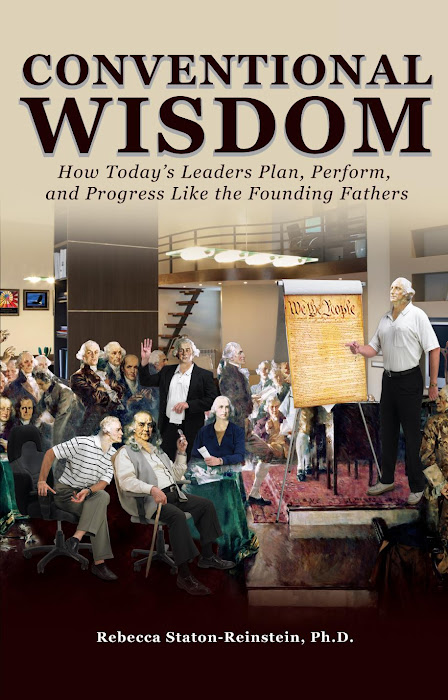
But is Baldanza to be vilified? Not in my opinion. He made a business decision in line with his business model. The customers will determine if it's a good one or not. But there's more to Baldanza than this one decision. I had the privilege of getting to know him and profile him in my book on strategic leadership, Conventional Wisdom: How Today's Leaders Plan, Perform, and Progress Like the Founding Fathers. The picture above is a classic Ben Baldanza moment. Just like his planes, his offices are no frills also -- a non-descript industrial building in an office park...no marble entrance hall, just a buzzer and no receptionist...no outrageous perks...just a plain utilitarian office. Why the vacuum cleaner? Because Baldanza uses it to keep his office tidy himself.
He meets with employees regularly, getting their ideas and feedback, gives out his email address and replies, and is generally considered an excellent leader and manager. As his assistant remarked out of the blue one day as I sat waiting for a meeting, "He's the best boss I've ever had!" Even the interviewer on a recent CNN interview spontaneously remarked that Baldanza seemed like a very likable guy he'd like to work for.
It's important to separate out the disagreement with Baldanza's business decision and understanding his business strategy and his track record as a good leader, visionary, and a "nice guy." If you don't like the extra charges, don't fly those airlines that have them.
Oh, and no matter which airline you fly, could I plead with you (as a minimalist, frequent business traveler) not to drag on all of your worldly possessions, overstuffed giant suitcases, and shopping bags crammed with stuff?
***** ***** *****
Rebecca Staton-Reinstein, President, Advantage Leadership, Inc. www.AdvantageLeadership.com Looking forward to your comments. And check out more about Baldanza in Conventional Wisdom.

Thursday, April 15, 2010

Happy Belated Birthday, Mr. Jefferson!


This week was the birthday of Thomas Jefferson, author of the Declaration of Independence, third president of the U.S., and founder of the University of Virginia. The latter is one of the achievements he was most proud of and wanted on his tombstone.

He conceived of the University as a very different place from the academic institutions of his day. One of his ideas was to create an "academical village." Today that same vision is driving another leader in the same direction.

George Hanbury, the new president of Nova Southeastern University arrived there after successful stints as city manager of cities that needed a major turn around. His record in Portsmouth, Virginia and Ft. Lauderdale, Florida are substantial and might have led a lesser leader to retire on his laurels. Not Dr. Hanbury.

This excerpt from Conventional Wisdom: How Today's Leaders Plan, Perform, and Progress Like the Founding Fathers details some of Hanbury's achievements at Nova as COO as he worked to implement Jefferson's vision.

Hanbury rediscovered Jefferson's vision as he did his doctoral work at Florida Atlantic University and when he arrived at Nova in 1998 he was eager to bring it to reality. Jefferson's idea of the "academical village" was a place where academics and the real world could be brought together for students to benefit from both. He saw a place where students would have a practical as well as theoretical education, where commerce and study could blend.

"It takes a visionary to look at a 1970s shopping center and wasteland of abandoned parking lots and see a revolutionary new community combining commercial space, state-of-the-art research facilities, living and recreational space, and college class rooms. Yet that's what he saw...

When I first came to Nova...it just seemed like a natural that what Jefferson was professing...[wanting] students to appreciate how theory was supportive of practice, and without practice, theory was no more than an exercise. Practice without theory would just remain stagnant and there would be no expansion.

I thought if we wrapped the buildings around the parking decks, and then made it an attractive area for people who want to live and work and do research and connect all that to a doctoral research university with high-speed connections to all other research universities in the state, you'd really have quite an economic engine."

So Jefferson's "academical village" is emerging in Davie, Florida, spurred on by Hanbury, whose vision is ever evolving and who, himself combines theory and practice quite neatly in building the university.

Happy birthday, Tom, your ideas are alive and well and continuing to evolve and see the light of day.

***** ***** *****
Want to apply the wisdom of the founding fathers such as Jefferson or contemporary leaders such as George Hanbury? Read Conventional Wisdom or contact me to discuss how their insights can be helpful to you and your business.
Rebecca Staton-Reinstein, President, Advantage Leadership, Inc.


Monday, March 22, 2010

Is Washington broken?


Making sausage is yucky

The talking heads have been going on for some time about how broken our government is and how disgusted everyone is about watching the "sausage making." Maybe so...If you were watching C-SPAN (or one of the networks covering the health care debates and votes) last night, you got a glimpse of the "process," the "rules," the jawboning, and arm twisting. But is that really a demonstration of a broken system? Was there some halcyon day in the past with the two parties discussed issues calmly and rationally and then agreed without rancor?

Not really.
Back to the first big controversy
Travel back to the very first Congress...that's right...back to 1789. There were no parties yet. (They would arise in George Washington's second term.) However, there were "factions." Groups of representatives were beginning to congeal around specific issues representing the wide variety of opinions in the country. In fact, ratifying the Constitution and setting up the government had been widely debated and many states ratified by paper-thin margins. North Carolina and Rhode Island were still not on board. So the beginnings of our government were not all sweetness and light.

The first big issue to get the blood boiling was "assumption." The states and the Continental Congress had run up huge debts during the Revolutionary War and the European creditors were howling for their money and threatening to cut off all credit to the fledgling country. Alexander Hamilton, the Secretary of the Treasury, had brought to Congress an extensive bill to create a financial system for the U.S. The plan was for the federal government to 'assume' the debt, set up a national bank, issue bonds, and establish what we would recognize as a modern financial system.

The push back and opposition were immediate and fierce. The details are not as important as the general principles that fire today's health care and other debates. What is the role of government? What is the balance of power between the states and the federal government? Big government or small?

Leading the opposition to Hamilton's plan was James Madison. Before the evolution of party leaders and whips, he had assumed those roles and was the principle leader in the House of Representatives charged with implementing President Washington's agenda. But when it came to assumption, Madison balked, and began to retreat from his former partner in writing the Federalist. The impasse was as heated and nasty as any we have seen lately. Remember there were no rules for the press so that papers and pamphlets contained anything and everything...more akin to our blogosphere than the modern press.
The deal is struck
One evening Thomas Jefferson, Secretary of State, invited Hamilton and Madison to an intimate little dinner party. Although they were all quite coy later about what transpired that evening, the results were soon apparent. Madison twisted enough arms to that assumption passed the house with a few votes to spare and he could vote against the bill and keep his seat with his anti-assumption constituents. Then he engineered the quid pro quo -- the vote to establish the new capitol on a parcel of land in northern Virginia not far from GW's home. (Hamilton worked behind the scenes to forestall New York and Pennsylvania who were vying for the honor.)

So there we are...the first Congress operated just like the present one...horse trading, arm bending, rule bending, backroom (dining room) deals. The vast majority of legislation is always a compromise of some sort. We are too diverse a country for it to be otherwise. Sometimes the deals are pretty despicable and sometimes relatively benign...but there are always deals.

The founders were enamoured with the Roman Republic and wanted to emulate it in many ways. But the Roman Senate was no gathering of saints any more than the state legislatures and Continental Congress where most of the new Representatives to the first Congress cut their political teeth.
Operating as designed
So, no, the U.S. government is not broken. It operates as designed with its checks and balances, backroom deals and public posturing. It's designed to come back to the center more or less and designed to be messy like all creative processes. Only dictatorships operate without the mess.
* * * * * * *

Read more about the founders and their leadership styles and processes...and meet modern leaders who use their same approaches. httl://www.ConventionalWisdomCenter.com and read Conventional Wisdom: How Today's Leaders Plan, Perform, and Progress Like the Founding Fathers.

Monday, February 15, 2010

It's the Year of the Tiger...Dump those resolutions!

It's officially the Year of the Tiger and a welcomed relief it is...

But before we look forward, let's look back for a moment. If you celebrate the western new year by making resolutions, you've probably broken or forgotten them by now. And it's just as well. Resolutions don't work...something you've already figured out for yourself. But why don't they work?

  • Resolutions are tactical. They are isolated bits of activity, unrelated to anything else.

  • Resolutions don't come with an action plan. They are usually a description of some result we want but are really just a wish.

  • Resolutions have no staying power. They arise from good intentions but are not tied to daily life.

If you really want to see results, you have to have a plan, a strategic plan, that's attached to your overall direction in life, your vision of the future, your path. In other words, planning for your life is just like planning in business. Vision --> Mission --> Goals --> Strategy --> Objectives --> Tactics/Actions --> RESULTS

George Washington comes to mind as a role model for life plans. As a young man, he decided to shape his character and become an admirable human being. He laid out a plan that he followed throughout his life. He set goals and had an action plan to reach those goals. He knew he wasn't a saint. For example, he had a legendary temper but he worked hard to not let it rip every time he was angered. As he matured, he realized that history would be watching and he amplified his efforts...all with a plan.

"I walk on untrodden ground. There is scarcely any part of my conduct which may not hereafter be drawn into precedent." He would agree with Ben Franklin, "One man of tolerable Abilities may work great Changes, and Accomplish great Affairs among Mankind, if he first forms a good Plan and...makes the Execution of that same Plan his sole Study and Business."

So throw out those resolutions, put together a plan worthy of yourself and this auspicious year. Be brave like the Tiger and plan for your success.

(c) Rebecca Staton-Reinstein, President, Advantage Leadership, Inc. http://www.advantageleadership.com/


Monday, November 16, 2009

The Buck Stops Here


I was just thinking about Harry Truman's immortal words as I was conducting a seminar for civilian managers at a military installation recently. Like all employees, they are held accountable for their results and like all supervisors, they are held accountable for the results of their teams. The definition of management is getting results through others.


The first rule of accountability is NO WHINING...or as my British daughter would say, NO WHINGING!


Because I fly so often, I'm especially affected by stories relating to air travel and several incidents over the last year bring home 'give-'em-hell' Harry's message.


Think about that plane load of people stranded for 9 hours on a plane on the tarmac and unable to go inside the terminal. Officials scrambled to tell us why they couldn't do anything about it -- it's not my fault; don't blame me -- was the sub-text of every statement.


Or what about the pilots who flew past Minneapolis -- each new whinge was more outrageous than the one before.


Or take a more tragic example, the crash outside Buffalo where the pilots failed to get enough rest and follow procedure and the airline executives refused any responsibility for underpaying pilots and skimping on training. It was a recipe for disaster but everyone looked for someone else to blame.


You can add your own favorite examples. The message is still the same. When I was interviewing executives for Conventional Wisdom: How Today's Leaders Plan, Perform, and Progress Like the Founding Fathers, one of the things I wanted to know is how they handled mistakes. Every one of them had a similar response.


  • Acknowledge the mistake as soon as possible

  • Take responsibility -- even if you don't think it's your fault

  • Move quickly to fix the situation

  • Figure out what went wrong and act to prevent it in the future.

It's a simple formula. Yet it seems impossible for many people to follow. If you don't follow it, you cannot claim to be much of a manager or leader, no matter what your title. Back to Harry for what to do if you can't follow the formula:


If you can't stand the heat, get out of the kitchen...and stop whinging!

(c) Rebecca Staton-Reinstein, Advantage Leadership, Inc.

Thursday, October 15, 2009

October is International Strategic Planning Month

This month the planet is celebrating International Strategic Planning Month. Why not join in the celebration?

What does your own plan look like? Tattered around the edges? Way off projected revenue and profit? Forgotten in some dusty corner? Not updated since February?

Or maybe you're one of those successful people who has a plan and keeps it up-to-date. You use the plan to guide your work, adjust it as necessary, and use it as a living document. If so, you celebrate ISP every month.

I was on a TV interview show recently with the CEO of a Fortune 500 company. He emphasized the need for executing the plan and adjusting the plan based on conditions on the ground. Now this is an important and even critical part of planning that too many people forget about.

Those of us who do create a strategic plan every year are often optimistic about what we can accomplish. We do the best job we can to analyze the environment in which we will be operating but none of us has a crystal ball...Stuff happens.

Unfortunately, too many folks drop the plan and start reacting to those unexpected events -- usually negative events -- and then we are into a downward spiral of firefighting.

When this year started, the ink on my plan was barely dry when the economic melt down hit me and my business hard. It was a scary couple of months -- disaster loomed and businesses were folding right and left. I was just as scared and worried as anyone else.

What I did was go back to the drawing board. I rewrote my plan, set new goals, devised new strategies, and set out on a new execution path. Everything I tried didn't work but some things did. As my friend the CEO said, "you can have the most elegant strategy, but when you hit the beach, it's execution that counts." Usually I'm not a big fan of war analogies in business but this is one of the times when the metaphor fit...and worked. I had to be more nimble, more creative, and more survival oriented than at any time in my business life.

The payoff? It's October and I'm still in business celebrating International Strategic Planning month. My plan? I just finished a new update that will take me through the second quarter of 2010. I may revise it a gain in 3 months -- the plan is only as good as the execution.

What about you? Have you made your plan for 2010? Now's a good time. Remember the old chestnut that's still floating around because it's true -- Fail to Plan -- Plan to Fail!

Want to know more about the Do's and Don'ts of Strategic Planning? Download it for free today. http://tinyurl.com/yfp6zfo

(c) Rebecca Staton-Reinstein and Advantage Leadership, Inc.

Wednesday, September 30, 2009

Plan is a 4-letter word!

"Listen, Rebecca, nobody has time for this planning stuff in this economy. They just need to survive. Planning's for when things calm down."

That was the 'conventional wisdom' from a chum of mine recently. Well, I beg to differ -- I'm not being self serving -- so here's the 'evidence.'

The September 25 - October 1 edition of the South Florida Business Journal reported in two separate articles on local banks that are doing well because of their planning. We could all take a lesson from them.

Coral Gables, Florida is the home of Gibraltar Private Bank and Trust. Several years ago the bank, founded by Steve Hayworth in 1994, was acquired by Boston Private Financial Holdings. It has just been repurchased by Hayworth and a group of investors.

Hayworth said he moved to repurchase the bank because he felt it was in the best interests of his clients. The bank will stick to its business model.

"In this environment, I see an opportunity for an integrated private bank and wealth management," Hayworth said. "We are very focused on private banking and wealth advisory services for professionals and affluent families."
"The bank will stick to its business model." This is one of the keys to Gibraltar's success for many years, first as it prepared itself for acquisition, then as it prospered under the Boston company's auspices, and now as it strikes out on its own again. Steve Hayworth and Gibraltar were featured as a case study on the power of strategic planning and leadership in Conventional Wisdom: How Today's Leaders Plan, Perform, and Progress Like the Founding Fathers. They attributed their phenomenal growth and doubling their assets in four years to the robust strategic plan they put together and FOLLOWED. In fact, they coined a telling phrase, "The Plan is the Boss." When other banks were faltering, going under, or just flailing about in an economic downturn, Gibraltar and Hayworth stuck with their plan and forged ahead.
In the same issue of SFBJ an unrelated story featured the Florida Shores -- Southeast Bank, founded by Steven Hickman in 2006 in Pompano Beach, Florida. Obviously this wasn't a great time to start a new bank and the bank and Hickman took a lot of flack for their slow initial growth. According to the Business Journal

Hickman said he wanted a manageable rate of growth that stuck to the bank's business plan. Because of that, Florida Shores has a relatively clean balance sheet.

"A lot of the banks that grew faster are paying the price now," he said. "We have good capital and plenty of money to lend."
"Manageable rate of growth that stuck to the bank's business plan." There's that pesky planning again! Hickman, in an email, was quick to give credit to his entire team for being the fastest-growing South Florida bank. But as was clear from the leadership philosophy he shared in Conventional Wisdom: How Today's Leaders Plan, Perform, and Progress Like the Founding Fathers, Hickman had been an expert and booster of strategic planning since his early days in the banking business. He knew its power in helping keep any venture on track and successful over the long haul. The proof of the power of that approach is in his balance sheet.

Planning in tough times? Is it a must for survival? Think about the framers of the U.S. Constitution, also featured in Conventional Wisdom. The United States were hardly united. Europe had cut off our credit, inflation was rampant, and foreclosures were devastating the farm-based economy. The latter led directly to Shays' Rebellion where local farmers in Massachusetts closed down the bankruptcy courts and marched on the state arsenal. Foreign powers were perched on our borders just waiting to pick off the disintegrating states like road kill. In fact, the U.S. faced the most threatening crisis in its history, rivaled only by the winter of 1776-7, the Civil War, and the Great Depression. Tough times indeed!

So what was the response to this tough time? 55 men assembled in Philadelphia in the summer of 1787 to hammer out a strategic plan for the nation. That's right...a strategic plan...The Constitution. Want to know more? Check out Conventional Wisdom. Want to get through these tough times? Make a plan Stan and Fran! Create a strategic plan with short term actions that will move you toward your long-term goals. If you flail you fail. Or as that sage, business guru Yogi Berra said, "If you don't know where you're going, any road will do."

I don't know about you, but I'm following the lead of Hayworth, Hickman, and the framers.

(c) Rebecca Staton-Reinstein and Advantage Leadership, Inc.