Posts
Posts


Let's Ban "MISTAKES WERE MADE!"
Mistakes were made...Every time I hear that phrase I cringe...How
about you?
Mistakes were made--so
vague, so passive, so un-leaderlike.
Yet, people keep using it. It screams
out from the headlines and assaults our ears from the TV.
Mistakes were made. At
first it looks like the leader is taking responsibility for the mistakes. But
study your English grammar a little more closely and another picture emerges.
Mistakes
were made. What does it really mean? 'Mistakes' is the subject of the
sentence in this passive voice. But the object of the sentence--by whom--is
implied. By whom? We don't know.
 Mistakes were made.
What the leader is really saying is, "OK, folks, we tried to hide the
mistakes but now you've got the evidence so we have to say something that
sounds like we're on top of it and sounds like we're taking responsibility. It
also buys us time to decide whom to sacrifice...whom to throw over the back of
the troika to the wolves--the press, the public, or the employees? Maybe, while
they're gnawing on those bones, we can think of something else to divert their
attention."
Mistakes were made.
What the leader is really saying is, "OK, folks, we tried to hide the
mistakes but now you've got the evidence so we have to say something that
sounds like we're on top of it and sounds like we're taking responsibility. It
also buys us time to decide whom to sacrifice...whom to throw over the back of
the troika to the wolves--the press, the public, or the employees? Maybe, while
they're gnawing on those bones, we can think of something else to divert their
attention."
Mistakes were
made, indeed! The first mistake is that we made a bad
decision. But then we compound it by ignoring it, covering it up, blaming someone
else or taking actions that are incorrect. There is only one correct
answer.
"I made a mistake. I
take responsibility. Here's what I'm doing to fix it." And on a personal
note, "Here is what I've learned and how I will apply that in the future."
And, by the way, "I will take the consequences."
I interviewed a wide
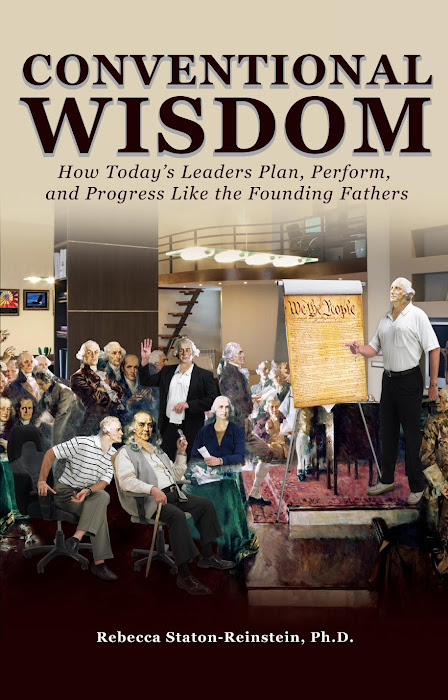
variety of leaders for my book on strategic leadership, Conventional
Wisdom: How Today's Leaders Plan, Perform, and Progress Like the Founding
Fathers. I chose them because they had a track record for translating their
visions into reality and transforming their organizations. I asked each,
"What was your worst business decision and what did you do about it?"
They all had similar reports. These are typical:
"There was a story in
the newspapers about a major mistake that we made. You can make excuses for it
or you can be transparent about what happened. I sat with the media and I
walked them through it and they accurately described it to the public. I hope
other companies who read the story will learn from it. But the key is to take
an adverse incident like that and turn it into something that we can learn from
so it doesn't happen again."
"Mistakes? I've made
some doozies! The ones I've always regretted were the ones where I reacted and
said something I didn't mean or that was based on wrong information. One was
very visible and I was confronted by a reporter with an email that I had sent.
I learned a lot from by boss that day about what a great executive does. He
told me to go immediately to everyone on the list and apologize and be humble.
It was hard but I did it. The press kept going but all but one individual was
satisfied. I learned a lot from that."
How do you create that
environment of responsibility for the entire company? Listen to another
CEO:
"I want everyone to
see our corporate values walking down the hall every day. Let's combine the
mind and the heart. It's all about having a mission, and a culture. They've
heard so much about making money, budget, and business plans. When we switched
back to emphasizing the mission, the values and the culture, the metrics
followed and we went from single digit returns to double digit returns."
Nary a one of the CEOs I
interviewed said 'mistakes were made' or any of its variants. Their message was
clear. Real leadership, strategic leadership, is about taking responsibility
every day for the decisions you make and living your values in your actions.
I heard a story on the
news some years ago that brought it all home in a different context. A high
school student's parents were suing a teacher and the school system. The
student, who had a good record, made a decision to turn in a class project late
after a school trip. The teacher had made it plain that late projects would not
be accepted so the student earned a failing mark. The student made the decision
not to turn the project in before the trip. Now the parents are suing for the
trauma to their daughter. Mistakes were made! What lesson is this young person
learning? What lessons are we teaching our employees and colleagues?
I have some advice: Let's
ban that despicable phrase, 'Mistakes were made,' from the language. Let's take
full responsibility for our bad decisions, learn from them AND take the consequences.
Let's demonstrate our values 'walking down the hall.'
What's the "mistakes" culture like in your organization? Are
people rewarded for accepting full responsibility or are the thrown under the
bus? Does every leader take responsibility for his or her mistakes? Or is blame
the name of the game and "mistakes were made."
Learn more about your work environment and receive feedback about how it
compares to other places. Take our survey, labeled the Whacky Workplace. http://tinyurl.com/jl9cn8p You will
also receive a copy of our comprehensive study when it is published next year.
© Rebecca Staton-Reinstein and Advantage Leadership
Read more about what successful strategic leaders
do about handling their mistakes in Conventional Wisdom: How Today's
Leaders Plan, Perform, and Progress Like the Founding Fathers.
Join me on LinkedIn.
Rebecca Staton-Reinstein,
President, Advantage Leadership, Inc.
320 S. Flamingo Road, Suite 291,
Pembroke Pines, FL 33027