Tuesday, August 24, 2010

Brits Burn White House TODAY!

Yes, the British did burn the White House on this day (August 24) in 1814...just thought I'd throw in a screeching headline because they are all the rage as the media cover big events.  What was going on back in 1814? Why were the British so mad? Probably they were retaliating for the U.S. burning public buildings in York (Toronto) Canada...all part of the War of 1812.

The soldiers added insult to injury by eating the food set out on the dining room table and sarcastically drank to "Jemmy's health" with his fine wines in crystal glasses...then burned the house, capitol, and assorted other official buildings.

It was a bitter day in U.S. history after several humiliating defeats in the war. President Madison was not at home to great his unwelcome guests but was on horseback in the field with his army. He was the last Commander in Chief to actually take part in a battle. It was all the more surprising because of his frail physique.

Of course, Madison is not known for his military prowess. He has no eponymously named buildings in Washington, his face does not stare out from Mt. Rushmore, nor does he grace any money. But we should be thinking about James Madison today, on the anniversary of the burning of his official residence because of his pivotal role in the Constitution and the Bill of Rights. They are his monument.

What would Madison make of the current roiling debates about building an Islamic Center in New York City? There are several clues -- more than that, well established facts. Here's a brief entry from Wikipedia that summarizes those facts.

As a young lawyer, Madison defended Baptist preachers arrested for preaching without a license from the established Anglican Church. In addition, he worked with the preacher Elijah Craig on constitutional guarantees for religious liberty in Virginia.[10] Working on such cases helped form his ideas about religious freedom. Madison served in the Virginia state legislature (1776–79) and became known as a protégé of Thomas Jefferson. He attained prominence in Virginia politics, helping to draft the Virginia Statute for Religious Freedom. It disestablished the Church of England and disclaimed any power of state compulsion in religious matters. He excluded Patrick Henry's plan to compel citizens to pay for a congregation of their own choice.

Madison's cousin, the Right Reverend James Madison (1749–1812), became president of the College of William & Mary in 1777. Working closely with Madison and Jefferson, Bishop Madison helped lead the College through the difficult changes involving separation from both Great Britain and the Church of England.

Madison wrote widely about the issue of freedom of conscience and religion. Unlike Jefferson and Franklin for example, he was a religious person and a member of the Episcopal faith. During the fight to ratify the new Constitution, many opponents demanded the addition of a bill of rights. Madison, at first opposed such a list as both unnecessary and inadequate but was eventually convinced that it was important to gain support for the Constitution. He digested the hundreds of proposed amendments down to a manageable few and shepherded them through the first Congress to become the first 10 amendments,  the Bill of Rights. He crafted the first amendment based on the Virginia statute (written by Thomas Jefferson) that he got through the Virginia legislature.

Madison paid a price for opposing the powerful Henry on the religious freedom issue and winning the Constitution ratification debate in Virginia. Henry blocked his appointment as a Senator and supported powerful candidates against him in his congressional district. Madison prevailed.

As he did with the Baptists and other so called dissenting faiths in Virginia, he stood for absolute freedom of religion. When he helped dismantle the official religion of Virginia (his own Episcopal Church) he made it clear what the original intent of the First Amendment was.

The demagoguery that has replaced debate of the issue of the Sufi mosque would have disturbed Madison greatly. The religious hatred, intolerance, and lies that have circulated and not been refuted by so-called responsible politicians would have made him physically ill. There is no way of knowing what position Madison would have taken on the location of the center. But we do know what he said on the freedom to practice ones religion and the absolute separation of church and state.

196 years ago, our capitol was in flames and our president was leading an army to defend our country and the Constitution and Bill of Rights he helped author. I think Jemmy's advice to those who support and oppose the building of the mosque might have been the following:
  • read your history -- including the Constitution and Bill of Rights
  • dial back the rhetoric and emotion -- discussion and dialogue work where demagoguery doesn't
  • remember why we were fighting 200 years ago...
The world is watching -- will we actually uphold the separation of church and state, the freedom of religion and the freedom to assemble, and the great promise of pursuing life, liberty, and the pursuit of happiness?

*   *   *   *   *
(c) Rebecca Staton-Reinstein, President, Advantage Leadership, Inc.
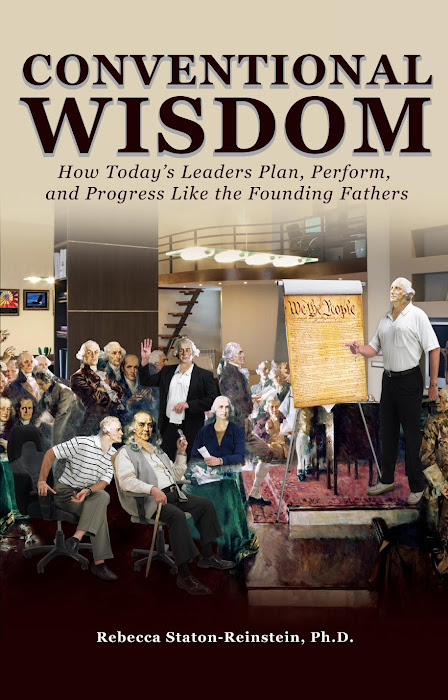
Author: Conventional Wisdom: How Today's Leaders Plan, Perform, and Progress Like the Founding Fathers   http://www.conventionalwisdomcenter.com/

Monday, July 19, 2010

Don't know much about historeeee...

You may not remember the old pop song with that refrain but it could be the theme song of way too many people. My sister called the other night and told me about a meeting she went to in her town. The discussion got pretty hot and heavy and one woman pulled out her pocket-sized copy of the Constitution and waved it around as she made her points, disagreeing with whatever was being said.

Now my sister is not the shy retiring type that I am -  ;-)  - and so she asked her, "Did you actually read the Constitution?" "Well, no...but I know what it says..." and went on with her harangue, misquoting and mangling the document -- rhetorically not physically.

To my sister and me, it was a reminder us of being dragged off to tent revivals by our grammaw where various lay preachers would thump the good book, tell us what it said, and threaten us if we doubted them.

The problem with the thumpers is that in the words of the founding fathers, the constitution, or the bible or other holy books, you can cherry pick phrases that agree with your beliefs and ignore those that don't. If your audience doesn't know any better and hasn't studied the details themselves, you can say just about anything. Psychologist know that if the idea is repeated often enough, you will come to believe if, even when faced with hard facts to the contrary.

Here's an example from a letter to USA Today (7/1/10) from a writer commenting on the passing of Senator Robert Byrd of West Virginia.

Our Founding Fathers did not intend congressional positions to be life-long ones. They felt that it was the duty of our leaders to give of their time and manage their states temporarily, and that this was in the best interests of their constituents...
We have senators...[who] have become professional politicians.

He goes on to support term limits AND age limits.

There are many good arguments for and against term limits...but how the founding fathers "felt" is not among them. There were among the founders those who saw it as their duty (or privilege) to serve in government for a while and then return to private life. George Washington is a good example.

But not all the "fathers" followed that path nor believed it was the best path. Three examples from three different political philosophies come to mind. Patrick Henry was one of the most powerful professional politicians in Virginia and served in a variety of positions in the state including the governorship. He was a strong "states rights" defender and foe of the new federal Constitution because it removed the absolute power of the states.

John Adams started out as a lawyer but was soon drawn into the Continental Congress and became a professional politician, serving as a representative in the Continental Congress, and as a diplomat in France and England. With the establishment of the new federal government he became Vice President and then President. He was a Federalist and only left office when defeated by Jefferson in the election of 1800.

James Madison beginning in his mid-twenties was only out of public office for a couple of years. He served in county and state legislatures, the Continental Congress, worked with Alexander Hamilton and Ben Franklin to engineer the Constitutional Convention, served in the new Congress, was Secretary of State under Jefferson, and finally served as a two-term president. Although starting out with a strong nationalist/federalist bent, he moved away from this by Washington's second term and worked along side Jefferson to found the Republican Party (which later morphed into the Democratic Party.)

My point is that the letter writer didn't know some basic history, which he could have discovered in a  history book, on the web, or (in the olden days) in school. But that seems too hard. I recently set my Google Alerts to look for references to the Founding Fathers -- everybody adopts them to prove their points. I'm on a quest to confront ignorance with facts.

The founding fathers were as complex, complicated, and conniving as any modern politician or leader. They were humans. They had their points of greatness and their follies. We should admire them, not because we can find some words they uttered that fit our political views but because of what they did, sometimes in spite of themselves, to create a system of government that works and is self-correcting through the will of the people.

Before you adopt their words to prove yourself right, read the entire body of their work. Learn what books they were reading and what philosophers influenced their thinking. Know what was going on in the wider world and in their world.

Learn a little more about historeeeee....
*    *    *    *    *    *    *    *
(c) Rebecca Staton-Reinstein, President , Advantage Leadership, Inc.

Want to know a little more about historeee and contemporary leaders? Check out Conventional Wisdom: How Today's Leaders Plan, Perform, and Progress Like the Founding Fathers. Available on Amazon.

Want to read a couple of chapters first? Send an email to Rebecca@AdvantageLeadership.com with "Chapters" in the subject line.

Thursday, July 8, 2010

Proclaim Liberty July 8, 1776 & 2010

Proclaim LIBERTY throughout all the Land unto all the Inhabitants thereof ...thus begins the inscription of one of the America's favorite icons. Visiting the bell again a few months ago I was struck by all the languages and cultures that were swirling around the bell in its museum across from Independence Hall. As I snapped this picture, I realized what an important symbol this is, whether the many myths about it are true or not.

On July 8, 1776, so the story goes, the bell which hung in the tower you can see in the background, rang out for the first time to summon the people to hear the first public reading of the Declaration of Independence. Imagine yourself standing there in front of what was then the Pennsylvania State House...it was hazy, hot, and humid...they you heard those inspiring words for the first time...

We hold these truths to be self-evident, that all men are created equal, that they are endowed by their Creator with certain unalienable Rights, that among these are Life, Liberty and the pursuit of Happiness.

Even when we're not living up to them, this is the essence of who we want and strive to be.

The insurgents who had been meeting as the Continental Congress had signed this declaration and were officially in rebellion against the established government. This wasn't some lame manifesto with more slogans than substance. The signers were committing treason and were ready to put it all on the line...Listen to how they closed it:

And for the support of this Declaration, with a firm reliance on the protection of Divine Providence, we mutually pledge to each other our Lives, our Fortunes, and our sacred Honor.

In the end, it really doesn't matter whether the bell was actually hanging in the crumbling tower...What does matter is that both the signers and the people knew that they were declaring LIBERTY. At that moment, every person in the colonies had to make a choice...were they with the rebels or with the King? For many, this was a wrenching choice and it tore many families apart. Ben Franklin's own son sided with the British and they never spoke again.

If you haven't read the Declaration since high school, take a look and read it today, hearing it fresh for the first time...read it to your kids and grandkids...suggest your friends read it. http://www.ushistory.org/Declaration/document/index.htm

As you do, let those words sink in...all men are created equal...Life, Liberty and the pursuit of Happiness...we mutually pledge to each other our Lives, our Fortunes, and our sacred Honor.

Whether you're a Republican, Democrat, Independent, Libertarian, Tea Partier, Green Partier, something else or nothing...Ask yourself a few of questions:
  • Are you really Behaving as if all people are created equal?
  • Are you really Behaving honorably?
  • Are you really Behaving as if Liberty for everyone is what it's all about?
The Declaration's signers left us many traditions and, as I wrote in my last blog, one was for contentious debate. What I want to suggest is that we don't need to venerate that tradition. If we're really being faithful to our best traditions -- our ideals -- our guiding values -- then we'll recognize that the Declaration is for all of us, no matter what our political persuasion; that those who believe differently from us have the LIBERTY to do so; that when we demonize our opposition and claim a 100% lock on the truth, we are violating the sacred trust the founders passed down to us.

Enjoy the 234th anniversary of that first reading of the Declaration -- enjoy reading it again yourself -- and treat your fellow humans a little better.
*     *     *     *     *
(c) Rebecca Staton-Reinstein, President, Advantage Leadership, Inc.
*     *     *     *     *
Want to know more about the founders and framers and how we can apply their positive and negative lessons today? Half off sale continues to celebrate all of the important anniversaries linked to the Declaration and the creating and ratifying of the U.S. Constitution. Conventional Wisdom: How Today's Leaders Plan, Perform, and Progress Like the Founding Fathers at 50% off is available ONLY on this HIDDEN web page. This is a limited offer so get your copy today. If you'd rather buy it on Amazon and miss out on this offer, click on over.

Sunday, July 4, 2010

Feudin', Fightin' & Fussin' on the Fourth

I'm sick of it! Right Wingers, Left Wingers, and No Wingers...Get your facts straight...or I'll call down the wrath of Founding Fathers Past!

Got your attention? Here's what set me off on this beautiful 4th of July holiday...everybody trying to appropriate our founding fathers and mothers for their own purposes...Prove your point with logic, facts, and reason or get off the stage. (See my special offer at the end.)

What folks say: Politics are more divisive than ever...there was a time when we used to disagree without being disagreeable...viciousness in opposing parties is something new...let's bring back civility...

Folks, here's the fact...we have never been a country of sedate, soothing debate. Our founding fathers and mothers were brilliant and courageous but when it came to politics, it was no holds barred. The point was (as it still is) to prevail. They didn't cuss as much, but they were not above sexual innuendo, lying, or character assassination when it came to political opponents.

Ron Chernow (author of the excellent biography, Alexander Hamilton) wrote a delightful article in the Wall Street Journal. It starts,

Americans lament the partisan venom of today's politics, but for sheer verbal savagery, the country's founders were in a league of their own.

Chernow points out, "Despite their erudition, integrity, and philosophical genius, the founders were fiery men who expressed their beliefs with unusual vehemence." They didn't stop at criticizing one another’s politics; their barbs were often personal.

John Adams called Hamilton the "bastard son of a Scotch peddler," while James Callender exposed Hamilton's affair with his friend’s wife. Newspaper man Samuel Adams, seen as a great patriot in his own day and ours, was not above the fray. "Truth was his first victim...To radicalize the populace Adams had adopted a total disregard for it. In his writings he employed slanderous lies, unvarnished propaganda, and rabble-rousing rhetoric. He whipped the people of Massachusetts and many other colonies into an anti-British fury."

The favored form of political trash talk was the pamphlet and newspaper column, written under classical Roman pseudonyms or derived from clever puns. They hammered away at one another with great relish and no restraints. They would have embraced Tweeting and Blogging as great inventions and set out with glee to rip one another apart.

Thomas Jefferson, whose stirring prose in the Declaration of Independence animates this 4th of July and embodies our most noble ideals, shrunk from doing his own dirty work. As the formation of our first parties heated up, (Hamilton headed the Federalists and Jefferson, the Republicans) he called on his buddy, Jemmy Madison, "'For God's sake, my dear Sir, take up your pen, select the most striking heresies, and cut him (Hamilton) to pieces in the face of the public.' When Madison rose to the challenge, he sneered in print that the only people who could read Hamilton's essays with pleasure were 'foreigners and degenerate citizens among us.'" Jefferson who applauded Callender's attacks on Hamilton was not so enthusiastic when Callender turned on him exposing his affair with "dusky Sally," his slave and half-sister of his deceased wife. (quote from Chernow)

In the records of debates in the Constitutional Convention and state ratifying conventions, the rhetoric escalates, with wild accusations flying that might make some of our media mavens of mayhem blush. Remember, this was an era when people would be called to the "field of honor" (challenged to a duel) for an implied slight. Calling someone a liar to his face was such a justification. Listen to this exchange during the debate over the power of large states and small. Gunning Bedford, a "fat, tempestuous delegated from Delaware" drags his bulk in front of the delegates and in a frenzied harangue spits out, "I do not, gentlemen, trust you. If you possess the power, the abuse of it could not be checked; and what then would prevent you from exercising it to our destruction?...Is it come to this, then, that the sword must decide this controversy, and the horrors of war must be added to the rest of our misfortunes?..Sooner than be ruined, there are foreign powers who will take us by the hand."

Madison, one of the most brilliant debaters and politicians of the era, summed it up, "If men were angles, no government would be necessary." The debates roiling the late 18th and early 19th century were fierce. Federalists and Republicans accused one another of treason. They could turn on former allies over night. Madison and Hamilton engineered the Constitution Convention and co-authored the Federalist Papers (with contributions from John Jay) in its defense. Madison pushed Hamilton's financial reforms through Congress. (He twisted enough arms behind the scenes to secure passage so he could argue and vote against it in public to maintain his constituents back home. Sound familiar yet?) After the new parties formed, Madison assailed his former ally, never missing a chance to paint him in ignoble terms.

I don't like the partisan bickering, shouting, and backbiting. AND I admire Hamilton, Jefferson, Adam, Madison, and the framers and founders. My gripe is about our lack of historical knowledge, our tendency to make stuff up, and the habit of partisans of every stripe to lie to defend their cause. Let's face the brutal facts -- ones we like and ones we don't -- and debate with a goal of coming to consensus or close to it.

That was Washington's great desire. He truly hated the partisan wrangling, the unbridled press, and the inability of people to rise above their passions. Though he occasionally fell victim to his own monumental temper, mostly he was that wise, impartial leader we all admire. So on this wonderful 4th of July, while we're barbecuing, watching fireworks, or hitting the mall, let’s ask ourselves this: Am I following along in our country's long tradition of bashing and demonizing those with whom I disagree, or am I trying to follow Washington's advice and have "restraint in tongue and pen?" If you are going to evoke the founders and framers, read some real history and get it right!

-----

Want to know more about the founders and framers and how we can apply their positive and negative lessons today? CLICK HERE: Half off – 4th of July sale – Conventional Wisdom: How Today’s Leaders Plan, Perform, and Progress Like the Founding Fathers. Available ONLY on this HIDDEN web page. This is a limited offer so get your copy today. Rather buy it on Amazon (and miss out on this offer?)
® Rebecca Staton-Reinstein (all quotes fully cited in Conventional Wisdom except one about Sam Adams from Eric Burn’s Infamous Scribblers.

Monday, June 7, 2010

John Wooden: An Extraordinary Leader Departs

John Wooden was an extraordinary leader. Every leader or aspiring one can learn from him. While most of the obituaries and tributes point out his phenomenal record as the coach of the UCLA men's basketball team and former players hail his profound influence on their lives, there was so much more to this man. He was the epitome of leadership under pressure. Sports fans will remember him sitting there through every game, pretty calm, that rolled up program in his hand. Whether the team was winning or losing, he seemed unflappable. In fact, one of the few times he ever seemed to lose his cool was when he believed the players were not giving the game everything they were capable of. Here's what Wooden had to say about losing and winning.

To me, success isn't outscoring someone, it's the peace of mind that comes from self-satisfaction in knowing you did your best. That's something each individual must determine for himself. You can fool others, but you can't fool yourself.
Many people are surprised to learn that in 27 years at UCLA, I never once talked about winning. Instead I would tell my players before games, 'When it's over, I want your head up. And there's only one way your head can be up, that's for you to know, not me, that you gave the best effort of which you're capable. If you do that, then the score doesn't really matter, although I have a feeling that if you do that, the score will be to your liking.' I honestly, deeply believe that in not stressing winning as such, we won more than we would have if I'd stressed outscoring opponents.
There's no great fun, satisfaction or joy derived from doing something that's easy. Failure is never fatal, but failure to change might be.
Your strength as an individual depends on, and will be in direct proportion to, how you react to both praise and criticism. If you become too concerned about either, the effect on you is certain to be adverse.
I always taught players that the main ingredient of stardom is the rest of the team. It's amazing how much can be accomplished if no one cares who gets the credit.
I have often said, 'The mark of a true champion is to always perform near your own level of competency.' We were able to do that by never being satisfied with the past and always planning for what was to come. I believe that failure to prepare is preparing to fail. This constant focus on the future is one reason we continued staying near the top once we got there.
...I was as concerned with a player's character as I was with his ability.
While it may be possible to reach the top of one's profession on sheer ability, its impossible to stay there without hard work and character. One's character is what you really are. Your reputation is only what others think you are. I made a determined effort to evaluate character. I looked for young men who would play the game hard, but clean, and who would always be trying to improve themselves to help the team. Then if their ability warranted it, the championships would take care of themselves.

These simple but profound insights are applied by great leaders...the others whether in business, politics, government, of nonprofits or NGOs could change their direction and results immediately by following them. Wooden's record is a testament to the power of his leadership: no losing seasons in his 27 years, 10 national championships in 12 years - 7 in succession, world record for winning 88 games in a row. But sports records eventually fall. Leadership records do not, and applied leadership lessons can live forever. Are you ready to learn from Wooden? Do you have the character and ability and willingness to do the hard work? If so...

*     *     *     *     *     *
(c) Rebecca Staton-Reinstein, President, Advantage Leadership, Inc.

Quotes originally from an ad in the Wall Street Journal in 1986 and reprinted in Dr. Deming: The American Who Taught the Japanese about Quality, Rafael Aguayo, Simon & Schuster, 1990

Thursday, May 27, 2010

223 years -- good enough track record?

223 years ago in May 1787, the U.S. Constitutional Convention opened on May 25 and began its debates. They were wrestling with how to form an effective republican government. They were responding to crises of huge proportions; a national legislature unable to act because of deep divisions, massive government debt, widespread foreclosures, foreign enemies prepared to strike, and extensive domestic strife.

Sound familiar?

On May 29, Edmund Randolph put forth the Virginia Plan -- authored by James Madison -- as an outline for the constitutional debates. Deliberations raged for four long months in the Philadelphia heat. At the end the produced the U.S. Constitution that was ratified the following year after extensive, rancorous debate in state ratifying conventions. This historic document is a strategic plan that has stood the test of time.

A few years ago, author David McCullough gave a speech at a leadership seminar entitled, "Knowing History and Knowing Who We Are." In it he quoted Daniel Boorstin, the late Librarian of Congress, saying 'trying to plan for the future without a sense of the past is like trying to plant cut flowers.' McCullough continued, "We're raising a lot of cut flowers and trying to plant them...One of the truths of history...is that nothing ever had to happen the way it happened...We just don't know how things are going to turn out for us, they [the revolutionary generation] didn't either...[John Adams in a letter to his wife wrote,] 'We can't guarantee success in this war, but we can do something better. We can deserve it.' Think how different that is from the attitude today when all that matters is success."

McCullough goes on to decry our lack of knowledge, much less understanding, of history and concludes, "History isn't just something that ought to be taught...or encouraged because it's going to make us a better citizen." [It will make us a better citizen, a more thoughtful and understanding human being, and will cause us to behave better.] History "should be taught for pleasure: The pleasure of history, like art or music or literature, consists of an expansion of the experience of being alive, which is what education is largely about."

What pleasure, guidance or understanding can you gain from the history of the making of the U.S. Constitution? What pragmatic lessons are there for your leadership efforts? According to many contemporary executives, there is a lot to learn. I interviewed 20 of them as well as poured over the records of the Constitutional Convention. I discovered the common strategic approaches of historic and modern leaders as they work to deserve success.

Here's what former Supreme Court Justice Sandra Day O'Connor had to say:

Thank you for sharing with me your new book Conventional Wisdom: How Today's Leaders Plan, Perform, and Progress Like the Founding Fathers. Your research into the planning sessions of the Constitutional Convention and the struggles that our framers of the Constitution faced has been cleverly weaved into the strategies of modern business. I am pleased to have your book.

I have been persuaded to reopen a "secret" webpage for a limited time so you can take advantage of a special offer and improve your own performance and learn from these historic and modern mentors. I did it myself. The very process of writing the book was a major learning experience. The insights I gained and applied helped me survive the economic downturn and thrive now that things are improving. You can do the same.
Discover your own conventional wisdom... Click here for the special offer.

* * * * * * * * *

(c) Rebecca Staton-Reinstein, Ph.D., President, Advantage Leadership, Inc.

Sunday, May 23, 2010

Vote agin' 'em


That was my Aunt Letha's advice when it came to the democratic process...As every election neared she repeated her maxim: "I never voted FOR anybody in my life...I always vote agin' 'em!" She'd love the Tea Party and all the anti-incumbent ballyhoo in the media. Despite the fact she had a nice government job with the IRS she had a rather jaded view of government officials at every level.

Like many people, she had her own way of enforcing term limits -- throw the bums out.

At this point many months before the November elections, that's what lots of folks are saying and doing in state primaries. And in a democratic republic that certainly beats violence, coups, and take overs. I just returned from Lagos, Nigeria. While I was there, the president died. There was a peaceful transition as the acting president was sworn in. Many people breathed a sigh of relief...There had been military take overs in the past and few peaceful transitions. In Thailand opposition to the incumbent precipitated violence and death so votin' agin' 'em seems a better solution.
But is it? Let's get a little historical perspective on the situation. I just spent some time in Philadelphia and had a chance to visit Independence Hall and wander through the historic district thinking about the Continental Congress, the Declaration of Independence, the Constitutional Convention, and the U.S. Constitution. It got me to thinking about being agin' 'em.
Of course the representatives that assembled in the 1770s and 80s were agin' taxation without representation, the Townsend Acts, Stamp Act, Intolerable Acts, and all the rest. They believed their rights as British citizens were being violated. Their protests did turn violent at times although it's easier to remember civil disobedience like the Boston Tea Party. Right from the beginning there were those who were ready to break with England and those who wanted to mend the growing rift. Tempers flared on both sides as the definition of patriot shifted until it solidified once war broke out. Yes, the revolutionary generation was agin' many things.
However, they were the first to understand that being agin' the British wasn't enough. They also had to be FOR something. What that something was for them was the ideal of a republic -- a government that represented the people and was agreed to by the people. When the 55 representatives showed up to represent 12 states (Rhode Island refused to come) in 1787 to write a new constitution, they were ready to define in detail what they were for. Gouverneur Morris, representing Pennsylvania, encapsulated their goals succinctly in the Preamble.
The success the framers had both in working to get the new constitution ratified and then to establish the new government was based on the fact that they stood on a solid platform of ideals, pragmatism, and political savvy.
James Madison, who played such a crucial role in the constitutional efforts was a career politician. From his first public office in his early twenties he served in representative body after representative body, seldom being out of office for any length of time. He eventually reached the executive branch serving as Secretary of State and then president for two terms...even though he presided over an unpopular war (1812.) He was an "insider" who sometimes voted with his next election in mind instead of the "greater good." Although generally thought of as a "conservative" by today's litmus tests he might be vilified, especially for his adamant views (and voting record) on the strict separation of church and state. His views and votes on slavery would also get him in hot water today. But at the end of the day, he believed, as did many of the founders, that public service, politics, was an honorable and necessary profession.
So as dearly as I loved my Aunt Letha, and she was a treasure, I have to respectfully disagree with her. In every election, I look at candidates of every stripe and try to figure out what they are standing for, what they will try to accomplish, and what ideals they will work to put into practice. Do they have the character and stamina of a Madison...if so, I'll vote for 'em.
* * * * * * * * *

Rebecca Staton-Reinstein, President, Advantage Leadership, Inc. Author, Conventional Wisdom: How Today's Leaders Plan, Perform, and Progress Like the Founding Fathers