Monday, June 4, 2012

Dirtiest Election Ever: Beyond the F-Bomb

Every time a politician drops the F-bomb, the media are all atwitter. (Can Twitter be atwitter?) They run the clip over and over BLEEPING politely at the crucial moment so as not to offend us. The current two candidates for president are not the sort of folks who will be caught using this anglosaxonism although their associates may be. Jefferson and Adams in the election of 1800 usually preferred the perfect barbed comment also.

So what? Move off the "networks" and onto the cable channels and the F-Bomb is just another word among many floating across the airwaves. But looking back to the really nasty election of 1800 and its parallels with 2012, what is the story when it comes to salty language and attack words?

Today as in 1800 there were words that people thought too rude for public discourse. But what was happening behind the scenes? There folks weren't as gentlemanly as we like to think, especially when talking among themselves.

George Washington had a towering temper he kept in check for the most part. When he let it rip he could toss the verbal bombs with the best of them. When delegates to the Constitutional Convention sat with their pipes and port after dinner, they often swapped bawdy stories, just as people do today. One of their favorite games was inventing wilder and wilder puns about Gouverneur Morris' wooden leg and his way with the ladies. James Madison was infamous among his contemporaries for his off-color stories.

It's true they didn't throw the F-Bomb but they certainly came close. John Adams was no fan of Alexander Hamilton and in a letter to Benjamin Rush in 1806 let fly with this diatribe against Hamilton for remarks he had made denigrating George Washington.


John Adams
Although I read with tranquility and suffered to pass without animadversion in silent contempt the base insinuations of vanity and a hundred lies besides published in a pamphlet against me by an insolent coxcomb who rarely dined in good company, where there was good wine, without getting silly and vaporing about his administration like a young girl about her brilliants and trinkets, yet I lose all patience when I think of a bastard brat of a Scotch pedlar daring to threaten to undeceive the world in their judgment of Washington by writing an history of his battles and campaigns. This creature was in a delirium of ambition; he had been blown up with vanity by the tories, had fixed his eyes on the highest station in America, and he hated every man, young or old, who stood in his way or could in any manner eclipse his laurels or rival his pretensions. . . 

Pretty strong stuff...but not as strong as these "gentlemen" wrote under pen names in the popular press skewering one another and accusing one another of the worst intentions, treason, and more. Generally they lambasted one another with innuendo as well as direct attacks. In fact, what can be a delicious pastime is dissecting their elaborate language and watch as they slip the verbal knife between the ribs and give a fatal twist.

We seldom hear such creativity today where it's so easy to just go for the flat obscenity rather than the creative crudity. I was impressed when George Will called Donald Trump a bloviating ignoramus. The founding fathers would have liked that.

But are there any Leadership Lessons in all this?  Perhaps a few:
  • Leaders control themselves: George Washington was prickly and thin skinned and took offence easily. Yet his advice to himself and others was to show restraint of "tongues and pens." He kept his temper in check most of the time. "Losing it" on a regular basis causes people to disengage. 
  • Leaders cultivate creativity: "Bloviating" is such a yummy word and I'm sure many people scurried to google its meaning. (Synonym for blow hard) In our general anti-intellectual climate, leaders encourage their people to think and grow and become more articulate.
  • Leaders do not condone crudity: Leaders know that some language offends some people just like the bawdy stories and sexist remarks that have disappeared for most workplaces. They do not insist on better communication because of "political correctness." They want to be inclusive; they want everyone to be engaged.
Just because the founding fathers weren't saints doesn't mean we do not honor and respect them. We admire them because, like us, they were all too human, capable of pettiness and backbiting, and sometimes behaving badly. We can learn from them precisely because they are human. We can learn from their mistakes and when they triumphed over their human nature. And we can learn from their fierce honesty because they would call a bloviating ignoramus a bloviating ignoramus!
*     *     *     *     *     *     *     *

What's your idea: Can we joust with more inventive language without bloviating? Please post your comments.
* * * * * * *
Next: How foreign are foreign affairs?

* * * * * *
©Rebecca Staton-Reinstein, president, Advantage Leadership, Inc.
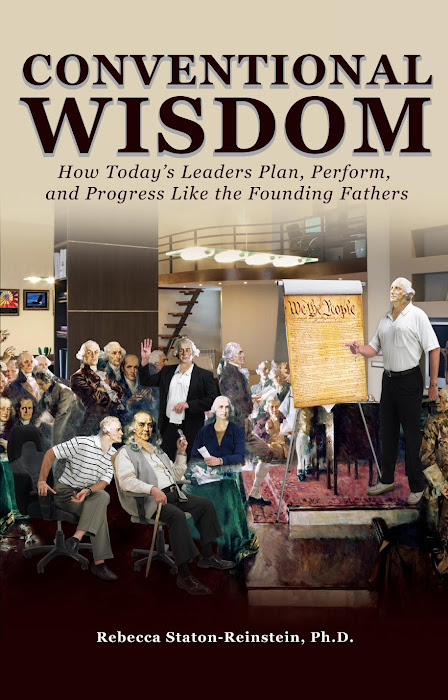
Want to know more about the tumultuous fights at the Constitutional Convention and the election of 1800? Check out Conventional Wisdom: How Today's Leaders Plan, Perform, and Progress Like the Founding Fathers

I NEED YOUR HELP: I'm beginning research for my new book on the influence of leaders on their organizations (Washington's Shadow) and I'm interested in your experiences or ideas for case studies. Do you know a leader who has had a profound influence shaping the organization's culture and changing it for the better? (I'm not interested in negative stories which are much more common.) Drop me a note:


We've started a companion YouTube series and the introduction is up. Check it out.

Tuesday, May 29, 2012

Dirtiest Election Ever: God or Not God, That is THE Question

Religion seems to always raise its specter during the silly season - the election cycle. This is one of the smarmier sides of politics - folks attacking Romney and his religion, Mormonism, as a cult and non-Christian; other folks accusing Obama of being either a secret Muslim or white-hating black Christian...

After a while it seems like outrages get more extreme...but is it anything new? Unfortunately not. The "dirtiest election ever" was held in 1800 when Thomas Jefferson faced off against John Adams...and guess what? Religion and accusations about religion were front and center. Remember, in 1800 ALL newspapers were affiliated with one or the other party. There was nothing that resembled unbiased journalism...and there were virtually no rules. NOTHING was sacred.

Jefferson, the Vice President, was the standard bearer for the Republicans. (No not the same party as the one today. Jefferson's Republicans morphed into the Democratic Republicans and later the Democratic Party.) Adams, the sitting President, represented the Federalists (who died off in the early 1800s.)

Both were "founding fathers" and recognized as great patriots.

Adams had been one of the first to push for a break with England and was a leading member of the Continental Congress and helped write the Constitution for the new State of Massachusetts. He had been part of the committee charged with writing the Declaration of Independence. He served as Washington's Vice President and kept the new country out of wars with England and France.

Jefferson was also part of the committee charged with drafting the Declaration. Adams  proposed Jefferson should create the draft to bring back for approval by Congress. Jefferson had served as war time governor of Virginia and was almost captured by the British. He had served as Adams' Vice President, Washington's Secretary of State, and,  earlier, been our representative to France.

Both men had sterling credentials...

This was the era of the Enlightenment that  swept Europe and the colonies. Adams, Jefferson, and the rest of the Revolutionary generation were weaned on John Locke's treatises. So it should come as no surprise that Jefferson was a Deist. In all probability so were Adams, Franklin, and Alexander Hamilton. The difference was these gentlemen never made public pronouncements or recorded their views in writing and Jefferson did.

If you're wondering what a Deist is...Essentially they believe god may have created the universe but does not intervene after the creation. Nature's laws can be studied and understood. There is no need for organized religion. Scriptures are interesting but not divine revelation. People must use and develop their rational capacities to solve the problems of the world. Logical belief for the children of the Enlightenment was heresy for the dominant Protestant culture of country in 1800. To add a little spice to the religious mixture, the late 18th century was the period known as the "Great Awakening" in America as a highly spiritual, evangelical spirit and "dissenting" religions spread across many states.

Jefferson had committed one huge sin in the eyes of many devout Christians (and political opponents.) He had written the Virginia Statute for Religious Freedom. Its goal was to disestablish the Episcopal Church as the official religion in the state, allow freedom of conscience for everyone, and no longer allow state taxes to go to support religious schools and churches. (His buddy, James Madison, a masterful politician, got it through the Virginia Assembly, used it as a basis for writing the First Amendment to the Constitution later, and incurred the wrath and retaliation of Patrick Henry.)

Jefferson created his own version of the bible

So let the games begin.

Adams was vilified as a monarchist, still a dirty word in 1800. He was accused of plotting to set up a hereditary monarchy beginning with his son John Quincy.

The common epithet thrown at Jefferson was atheist, an accusation attached to him throughout his long political career. During the 1800 elections cycle Jefferson's support of the French Revolution earned him yet another attack - Jacobin. Like his French counterparts, it was said he wanted to destroy religion and abolish churches and private property.

Jefferson was the subject of viral attacks in the press. Yes, that's nothing new - it just took a little longer as other papers and pamphlets copied the following from the Gazette of the United States, a Federalist paper, and spread it:

The Grand Question Stated: only question to be asked of every American...Shall I continue in allegiance to God and a religious president or impiously declare for Jefferson and no God? 

Substitute today's candidates and the effect is the same.

What are the lessons for leaders today?
  • Ignore labels: Successful strategic leaders know great ideas can come from anyone. They also know a religious or political label does not reveal how a person will behave and act. Bigotry, prejudice, and bias have no role for leaders. Savvy leaders search themselves for these traps and consciously refute them.
  •  
  • Advocate: Successful leaders will take their cue from James Madison. Madison was a religious man and member of the Episcopal Church. Yet it was he who brought his legislative skills to bear to oppose Patrick Henry and the Virginia elite and pass the Virginia Statue for Religious Freedom and penned the First Amendment to the US Constitution and shepherded it through the first Congress. It was Madison who championed the separation of church and state and opposed appointing a chaplain for Congress and opening sessions with prayer. Leaders advocate for the rights of those who have no advocate.
  •  
  • Practice What You Preach: Leaders put their faith or beliefs into action. We fault the founding fathers for their refusal to end slavery. Perhaps one of the most stunning exceptions was Robert Carter III, member of the Virginia elite. In 1791 he walked into the local courthouse and initiated the process to free all his enslaved people. He grew into his beliefs as part of the Great Awakening. He was a member of integrated churches, some of which had black clergy, and all of which preached complete equality. He freed over 450 people, more than anyone freed prior to emancipation 60 years later. Carter took what he believed to be the right action. His position was, "My plans and advice have never been pleasing to the world." Despite being ostracized by his fellow planters and ignoring the financial impact, he continued to support his former bondsmen, provided them land, and lived with them as neighbors.
  •  
  • Refute the Ridiculous: Leaders have the courage to refute the mud slung at their opponents. Throughout the down-and-dirty election of 1800, John Adams never refuted the attacks on Jefferson, nor did Jefferson refute those hurled at Adams. They were long-time friends and knew one another well. They knew the truth about one another. They missed an opportunity to demonstrate their greatness. Leaders defend the truth with enthusiasm as John McCain did in 2008 confronting the birthers.
What's your idea: Can we leave religion and matters of conscience out of politics and the workplace? Please post your comments.
* * * * * * *
Next: Discourse before the F-Bomb
* * * * * *
©Rebecca Staton-Reinstein, president, Advantage Leadership, Inc.
Want to know more about the tumultuous fights at the Constitutional Convention and the election of 1800? Check out Conventional Wisdom: How Today's Leaders Plan, Perform, and Progress Like the Founding Fathers

I NEED YOUR HELP: I'm beginning research for my new book on the influence of leaders on their organizations (Washington's Shadow) and I'm interested in your experiences or ideas for case studies. Do you know a leader who has had a profound influence shaping the organization's culture and changing it for the better? (I'm not interested in negative stories which are much more common.) Drop me a note:

Wednesday, May 23, 2012

Dirtiest Election Ever? Check out the media

The pundits and the media (ironically) decry the dirtiness or our politics - attack ads flourish and seem to have a real impact - SuperPACs now proliferate in the "new" no-holds-barred election cycle. Big money, dirty tricks, pants-on-fire lies and fabrications, and every low-down trick we know seem to be on display. It's all new, right? We used to have more well-behaved elections, right? The founding fathers didn't intend us to be so undignified, so down-in-the-gutter, so...

Sorry to disappoint all those folks who have never gone beyond Washington chopping down the cherry tree in their study of our history. Modern-day politicians are pikers by the founders' standards! They may even be laughing at the few "rules" we have set up.

(In full disclosure, I want to make my position very clear: I hate negative campaigning, dirty tricks, big money in the mix, and all the rest. But as a student of history and psychology, I know it ain't gonna change.)

The dirtiest election in our history? 1800, Jefferson vs. Adams. Yes, the first few elections had gone smoothly and pretty much as expected. Washington, who could have been elected every time, stepped down after two terms, establishing a precedent that would stand until Roosevelt's four terms and the predictable backlash establishing two terms as the rule. John Adams, not always the most popular of the "fathers," had served as Vice President for Washington's terms and was elected president.

But by the time of Adams election in 1796, the die was already cast. By then we had two parties who were at war with one another; The Federalists, headed by Alexander Hamilton and including Adams and the Republicans,* headed by Thomas Jefferson. Just to make things interesting, Jefferson the Republican would serve as Federalist Adams VP.**

Over the election cycle I will be looking at the big controversies in our present day and demonstrating how they mirror that critical election of 1800.

To kick it off, let's look back at where it all started for our republic.

No sooner did Americans stop fighting the British than they started fighting one another. After newspapers ceased to report on military exploits and denunciations of the Crown they began to fill their columns with the cannonades of politics. Having briefly put aside their old ways of lying and dissembling, exaggerating and trivializing, distorting and abusing and insulting, journalists turned to them again with a new and even more pointed vehemence as they began to consider the most important question of the time, possibly the most important question Americans have ever had to ask themselves: Now that we have won the right to govern ourselves, how, precisely, do we go about it?1

How indeed...The media of the late 18th and early 19th century had no rules. Every newspaper and pamphlet (the blogs of the day) was proudly partisan, secretly funded by candidates, and out to destroy the opposition.

What are the lessons for today's leaders?
  • Demand better.  Whether as corporate sponsors or consumers, leaders need to demand better reporting, better information, and better coverage. Trying to find out what's happening in the world is a frustrating undertaking. The BBC is still one of the best sources for in-depth, relatively unbiased reporting. Watching CNN outside the US also means getting some thoughtful straight-up reporting. But back at home? We're back in the 18th century with "infotainment" ruling the day - lots of chatty folks, teasers for absurd stories, and the occasional headline buried in the dross. Leaders demand better results from their staffs constantly, so apply that to the media.
  • Dig deeper. Thought leaders must push themselves to dig deeper into the situation. What's under the surface? What else is going on? Behind the screaming headline or breathless "news" reader, what are all the facts? If you want to blog or report or tweet or speak about what's going on, do your homework. Today we drown in lots of stuff floating around the Internet with no fact checking, verifying sources, or taking on any of the other disciplines of "serious" journalism. Leaders demand as much information and as many facts as possible before making decisions. Do the same before arguing your case. Separate opinion from a fact-based explanation.
  • Decide ethically. Leaders are clear about their values and filter their decisions through those. At the same time, leaders don't need to trash the opposition to make a case. Whether supporting your favorite candidate or touting your product and services, tell the truth. There is really no need to run down the other guy or the other product to demonstrate the value in your point of view or product. Discuss the benefits. Leave the trash talk for the entertainers.
What's your idea: Can we overcome our human nature and our history? Post your responses on the blog. http://conventionalwisdominstitute.blogspot.com/2012/05/dirtiest-election-ever-check-out-media.html

*     *     *     *     *     *     *
Next: God or No God, that is the question.

*Jefferson's Republicans morphed into the Democratic Republicans and then the Democratic Party. Hamilton's Federalists never held the presidency after Adams and faded from the scene in the early 19th century. Today's Republican Party formed in the 1850s and their first president was Lincoln.

**The Constitution initially required the top vote getter to become President and the second highest to become Vice President. Because of the disasters occurring in the 1800 election, it was changed to the present form of a "ticket" with the two people running together and no splitting of votes at this level.

1 Eric Burns, Infamous Scribblers: The Founding Fathers and the Rowdy Beginnings of American Journalism, Public Affairs, New York, 2006
*     *     *     *     *     *
©Rebecca Staton-Reinstein, president, Advantage Leadership, Inc.
Want to know more about the tumultuous fights at the Constitutional Convention and the election of 1800? Check out Conventional Wisdom: How Today’s Leaders Plan, Perform, and Progress Like the Founding Fathers

I NEED YOUR HELP: I'm beginning research for my new book on the influence of leaders on their organizations (Washington's Shadow) and I'm interested in your experiences or ideas for case studies. Do you know a leader who has had a profound influence shaping the organization's culture and changing it for the better? (I'm not interested in negative stories which are much more common.) Drop me a note: Rebecca@AdvantageLeadership.com

Sunday, April 15, 2012

Customer Service Ain't Dead Yet! 3 ways to make it work!

When the phone rang late one afternoon, I was surprised to hear the appointment person from the diagnostic center on the other end. She was calling to find out where my request for records was. OK, let's back up.  

I recently changed doctors and, because the medical industry lives in the 19th century, I had to take care of getting my medical records from Dr. A to Dr. B. When I did this about 6 years ago, I ended up transporting them myself. I'd called the diagnostic center, talked to a very helpful woman I'll call Rose and she said she'd fax me the request form.

Somehow the request form got deleted on my end but I didn't know. So at first I was surprised to get Rose's call. No problem - she'd send another one. OK - first surprise; she had followed up. But it gets even better. She gave me a direct phone number to call when I faxed the form back. She told me to tell the receptionist to come find her as she was usually away from her desk. OK - second surprise.  

When I called Rose, the receptionist said she'd go find Rose. OK - third surprise. Then I heard the receptionist put down the phone - no holding muzak hell - and after about 5 minutes Rose picked up the phone and proceeded to find the form, check it, and assure me she'd get the records sent that day. All pleasant, all helpful, and all the extra mile. OK- fourth surprise. 

I know this facility well and have been going there for almost 20 years. It's a very busy place and I'm sure lots of demands on the staff. But Rose took those extra few minutes to take care of a patient as if it mattered.  

I could fill this blog week after week with stories of bad customer service. My business takes me around the world and like any traveler I have horror stories to relate. But that's hardly news. Rose was big news.  

Here's how companies could replicate Rose:
  1. Hire for people-skills talent: Anyone who has flown Southwest Airlines knows the result of this rule. Let's face it, the job of flight attendant is tough and only made more so as airlines continue to treat passengers as a pain in the *%# as they cut back on everything except new ways to charge you for the privilege of getting from point A to point B. Instead, those folks at Southwest keep cracking jokes, singing, smiling, noticing, and doing everything they can to make it a pleasant trip.
Rose genuinely cared about people. In spite of the volume of work, she kept up with the requests and when mine didn’t appear, she called. This is different than going through the “have a nice day” check list.  

2.    Involve people in devising better systems to serve customers: The folks who know most about what bugs people are those on the front lines talking to them every day, whether the local barista or person on the phone in a far-off place. Ask them. Let them come up with a way to solve the problem or suggest better ways to help customers get what they want. 

Rose had come up with her own system for making sure patients/customers got what they needed. She convinced coworkers to make sure they let her know when someone needed help and she wasn’t available.  

3.    Recognize talent and let people ‘teach’ others: This institution happens to have a great reputation and sends staff through training for many things. However, each unit and doctor is responsible for additions to the ‘corporate’ initiatives. Savvy managers know they have valuable employees who figure things out and take initiative. Why not recognize that initiative and allow the exceptional person to ‘train’ the others? 

Rose set an example for other people. Caring is contagious. (Believe me; folks outside her area in other parts of this vast medical complex are not like Rose – just the ones in her little corner of the universe.) She took it on herself to see that other people were in cahoots to deliver exceptional service. 

So hats off to Rose! Thanks. You remind me of a young man in the Shanghai lost luggage department for an obscure airline…He called me long-distance a couple of times on his cell to find out if my luggage had been located as I made my way back from an extended trip to Asia. Meanwhile, the main carrier seemed to have trained folks to be as rude and unhelpful as possible…but that’s another story. Today, we’ll glory in the Roses of this world who take a few minutes to care.
*     *     *     *     *     *
©Rebecca Staton-Reinstein, president, Advantage Leadership, Inc.

Author: Conventional Wisdom: How Today's Leaders Plan, Perform, and Progress Like the Founding Fathers

No great historical links to the founding fathers in this post. Their letters home from the Constitutional Convention hit on all the same themes of poor service business travelers harp about today; poor food, inflated prices, lack of convertible currencies, inadequate expense budgets, slow reimbursements…plus they had to share rooms and sometimes beds with fellow (snoring) delegates! So maybe our complaints aren’t so bad.

Friday, April 6, 2012

Leadership Avoided? Rometty vs. Augusta

If particular care and attention is not paid to the ladies, we are determined to foment a rebellion, and will not hold ourselves bound by any laws in which we have no voice, or representation.
Abigail Adams
Abigail always spoke her mind and got right to the point. She's been on my mind the last few days because of the serendipitous convergence of two separate events.

On the national scene, this is week of the Masters golf championship played at the Augusta National Golf Club...or should we say the epitome of the "old boys" club. Locally, here in South Florida, Women Executive Leadership held its regular book club meeting. WEL works to put more women on corporate boards and in executive positions.

So what's going on?
 
The Augusta facts are fairly simple. The golf course opened in 1933. Women are not allowed to be members although they can play the course by invitation. The club excluded Blacks until 1990. IBM has been one of the major corporate sponsors for the Masters tournament at Augusta and the four previous CEOs were invited to join. Current CEO, Virginia M. Rometty, has not been invited.

The WEL book club discussed Knowing Your Value: Women, Money, and Getting What You're Worth, by Mika Brzezinski, co-host of MSNBC's Morning Joe. Her book discusses the struggles of women, even those in top positions, to get paid what they are worth or at least comparable to men who hold the same positions.
When the women's movement re-emerged in the early 1960s many of us believed the days of sexism were numbered just like de jure segregation. But as Mika and Virginia and many of us have discovered, we still have a way to go (despite what the cigarette commercial told us.) Not asking for what we want has been a major stumbling block for women. In our book club discussions several women pointed out how they had overcome this barrier -- all very inspiring and great role models and path breakers.

But wait a minute...It's 2012. 2012. Not 1933 when no one saw any problem keeping women out of a club. Not 1957 when we first met June Cleaver being the perfect housewife/mom. No, it's 2012 and not only is it time to end the nonsense of unequal pay which hurts companies who say they embrace diversity and empowerment and engagement and...

But where are IBM and Virginia Rometty in all this? Can you imagine the same situation if Augusta still didn't admit Blacks and IBM showed up to sponsor the Masters with a Black CEO?

Let's go back to Abigail again for some more of her conventional wisdom:
Arbitrary power is like most other things which are very hard, very liable to be broken.
Here's where a little leadership could come in. What if the CEO and her board simply said, very politely and ladylike of course, "Sorry, guys. We won't sponsor an event at your discriminating club."

But if such a conversation took place, it hasn't come to light yet. IBM's 14-member Board which boasts 3 women including Rometty, has a wonderful opportunity to take some leadership here. It's not about whether Rometty would like to be a member or not personally. Reportedly she's not an avid golfer. This is about standing up and saying, "This is not the way we do things at IBM. We don't need to have our name associated with your troglodyte policy. We'll look for other events to sponsor that reflect our corporate culture."

In fact, IBM has two pointed statements on its website, taking this exact stance:
Employee well-being and diversity
Employee well-being is incorporated in every aspect of IBM’s global business, from our strategic and business planning to our operations. IBM also has a longstanding commitment to diversity and considers it a competitive advantage in serving clients.
This strong foundation brings us to where we are today...This is the point where we can take best advantage of our differences — for innovation. Our diversity is a competitive advantage and consciously building diverse teams helps us drive the best results for our clients.
So now's the time for some leadership...from both men and women; the IBM Board and CEO, the Augusta membership, every woman who has yet to demand what she is worth, and every man or woman who has been complicit in keeping the biases alive.
Or we may just have ot invoke Abigail's rallying cry and...
*     *     *     *     *     *     *     *
(c) Rebecca Staton-Reinstein, President, Advantage Leadership, Inc.


Friday, March 23, 2012

Where is Stand Your Ground Leadership?

30 thousand people show up in Sanford, Florida. The BBC covers the rally. Morning Joe has serious, thoughtful, long discussions. One million people sign an on-line petition. After weeks of denial, avoidance, obfuscation, refusing to take any responsibility, and stonewalling, now a few anemic actions are taken in the State of Florida. (Full disclosure: my home since 1991.)

For those unfamiliar with the case here are the bare facts: (Timeline http://abcnews.go.com/blogs/headlines/2012/03/trayvon-martin-case-timeline-of-events/ )

On the night of February 26, 2012, teenager Trayvon Martin was returning from the store with candy and ice tea in a cloistered neighborhood in Sanford, Florida. George Zimmerman, a local self-appointed neighborhood watchman was cruising in his truck, armed with a 9 mm semi-automatic pistol. Moments later the kid was dead on the street and the police did not arrest Zimmerman who invoked Florida’s infamous Stand Your Ground law, which condones self-defense use of lethal force if you believe your life is in danger. The kid’s crimes? He was black. He brought Skittles to a gun fight.

What happened to the killer?
Nothing. Nothing!

Zimmerman went home, still packing. The cops, police chief, city manager, city council, and every other official went home, still wrapped in the odd notion of justifiable homicide of a kid who just wanted some snacks while watching the super bowl. No public statements of outrage or even a little handwringing over the tragic events.
The family demanded justice and got indifference. If this were the 1950s, maybe that would have been the end of it. But this is the age of the internet and the 24/7 news cycle. And this is not the South of the 1950s where I grew up and such travesties went unexamined. You can’t keep your dirty little secrets any more.

So yesterday 30,000 people showed up to say ENOUGH! By now a few small tokens of action have been taken.

But where were the leaders?

Where were the designated leaders who should have been standing their ground for justice and the American values we hear so much about in this political season?
  • Governor Scott finally made a public statement and started an investigation.
  • Authors of the original legislation said it didn’t apply in this case and defended the odious law.
  • The city council passed a nonbinding (?) 3-2 resolution suggesting the police chief step down.
  • The city manager, sounding like a corporate spokesman after an environmental disaster, stonewalled and said “we’re looking at it.”
  • The police chief finally went on leave.
Zimmerman is still wandering around out there, still armed. He appointed himself to: decide what a crime is and interpret the law; to bring the individual down; be judge, jury, and executioner.

Where are those defenders of the Constitution searching for original intent? Did James Madison intend to unleash vigilantes to stand their ground? Oops, Zimmerman wasn’t standing – he was running after the kid who was fleeing for his life.

This blog is usually reflecting on strategic leadership and our connection to the U.S. founding fathers. What has this to do with them? Everything…

True leaders stand their ground.

Certainly George Washington stood his ground when he faced enormous criticism from both political factions over remaining neutral in the endless wars between England and France.

John Adams stood his ground and lost his second presidential bid when he refused to go to war with France and pushed for a new treaty.

James Madison, no military man, stood his ground when he took his horse rode out to face the British invasion and defied his popular critics in the unpopular War of 1813.

In fact the Constitution exists because Madison, Franklin, Washington, and Hamilton and a few others stood their ground, conspired against the weak government under the Articles of Confederation, called the Convention, fought the new plan through state ratifying assemblies, and then made the experiment in republican government work.

So far, the elected and appointed leaders in this disgusting situation have not stood their ground. They have all been missing in action. The grieving family and their emerging multitude of supporters will overcome. Justice will eventually be done…that’s the power of a democratic society…if the leaders don’t lead, the people, standing their ground, will.

Of all the quotes on leadership that would fit this occasion, I’ll let founding mother, Abigail Adams, who always stood her ground, have the last word.

"We have too many high sounding words, and too few actions that correspond with them." 
*     *     *     *     *     *     *     *


Sunday, March 11, 2012

Poor Evelyn: My 9 steps to destroying a good employee

I didn't set out to destroy poor Evelyn...my intentions were to "help her grow." Unfortunately, my mother's constant admonishment was correct: The road to hell is paved with good intentions.

It started off well enough. I managed a small division in a big corporation and had been given permission to hire an employee. I posted the job internally (we wanted to hire from within) and a friend in another area called to tell me she had the perfect person. I trusted her and her praises of Evelyn were effusive. (Another adage comes to mind: If it sounds too good to be true, it is.)

I had a couple of interviews with Evelyn and so did my counterpart in an associated division and we agreed Evelyn would be good. (I made the final decision so no blame goes to my counterpart.) Evelyn came on board and we got to work.

Evelyn was a boon to my team that included some long-term consultants. We coordinated with my counterpart easily and ran our two divisions almost as a single self-directed work team. (Because of a reorganization, we had no direct "boss" for quite a while and sailed along.) Even once we were given a new manager, things continued to move very collaboratively, we were making progress on our goals, and Evelyn was catching on to the work. In fact, we were charged with developing new methodologies, standards, and procedures and she had good ideas. Several of us went to training programs and conferences together and were excited about even more new ideas we could apply back at the company.

It's hard to say where it started to go bad. Maybe it was a missed deadline here or an assignment that wasn't quite up to the mark there. Maybe it was just a "personality" thing or a "social" thing or a "thing" thing. Whatever it was, slowly Evelyn's performance and results began to slip a little. Knowing what I know now, I should have handled it very differently...

Instead, I became more and more frustrated, had more and more unproductive conversations with Evelyn, and griped to my colleagues. I got lots of advice (most of it bad) and followed it with continuing poor results. I lost my temper with Evelyn. I tried (too late) to set up a more structured approach to her assignments but by now it was really too late.

Evelyn was in a classic lose-lose situation. She really did not have the right talent. In Marcus Buckingham's First Break All the Rules, he talks about the need to match talent to the needs of the job. Skills by definition can be learned. Talent is that unique combination of what you are born with and what you develop to a high degree over your lifetime. Talent is evident in consistently high performance.
I had made several classic mistakes.
  1. I did not select for talent. I selected Evelyn because of her technical background and skills and experience with the company. I had not made a thorough analysis of the talents I needed. Once I learned the powerful technique of Behavioral Interviewing (selecting for needed talents) I never made another hiring mistake.
  2. I did not set out a clear plan. When Evelyn first joined the team, we did not sit down and develop a written plan together of her work and how it would contribute to our goals and objectives. She wasn't encouraged to develop a detailed tactical plan with some input and course correction from me. 
  3. I dumped instead of delegated. With no clear plan in hand, Evelyn did the best she could to figure out what was needed. It should be no surprise to know she often missed the mark. In good delegation, Evelyn would have a plan she had been involved in creating, with clear metrics and timetables AND EVERYTHING SHE NEEDED TO EXECUTE THE PLAN.
  4. I didn't "motivate." This is a tough one because in reality, you cannot motivate anyone. What I failed to do was understand what really inspired her and then set up a situation in which she would motivate herself. Instead, I constantly de-motivated her using the wrong carrots and sticks.
  5. I didn't coach. Coaching is really about sitting down regularly and going over results and discussing what went well and why and what went wrong and why. It's a perfect time to give praise and specific feedback about what worked. It's a time to ask the person to analyze what didn't go well and figure out what needs to be done to make it better. Encouragement not badgering is the key here. At the end of such a session, Evelyn would be ready to create a modified plan and get on with it.
  6. I let things slide. Avoiding conflict was a strong motivator at that moment. Like many poor managers, I let the little things slide when they could have been fixed quickly. I finally got to the point that most bad managers get to: I'll deal with it in the annual evaluation. What a cop out. By then it is always too late.
  7. I didn't seek coaching from experts. I relied on friends, colleagues, HR, and anyone else who would listen to my sad victim's tale. I didn't seek out the coaching and help of successful managers who would have set me straight, pointed out where I NEEDED TO CHANGE, and helped me correct my own poor management behavior.
  8. I allowed Evelyn to fail miserably. It all came to a head in an event where Evelyn was to conduct an important session with folks from other departments and facilitate implementing a new procedure. Within 30 minutes we had to pull the plug...it was all going down in flames...were this a cop show instead of a corporate meeting the room would have looked like the last act of Hamlet.
  9. I passed the problem to HR: Now came the final dereliction of duty. I went to HR, presented an indictment of poor Evelyn to my sympathetic buddies there and they showed me how to document everything, build a case, and get her fired. It was all very mechanical and legalistic. I was vindicated. Evelyn was all wrong. End of story.
There is no happy ending to this story and it took me a long time to admit my own part in the debacle. As it turned out the company had gotten itself into a pickle...we read about it on the front page of the papers one morning on the way to work and the entire department and its divisions were axed. Nothing personal, just a typical downsizing bloodletting that put hundreds of us on the street -- with nice severance packages to ease the blow.

This happened many years ago but I still think about Evelyn and how I botched our work together and her chances for success. She got another job - as we all did - companies were hiring and there was no stigma in having been kicked off a sinking ship. (In fact, we had our farewell party on Friday and I started my new job on Monday.)

I owe Evelyn a big debt of gratitude. Because the whole experience, which lasted for over a year, was so painful, I was forced to go over and over it in my mind for a long time. I had to tease out all the lessons and analyze them. I had to completely reconstruct how I went about managing my team. I had to make amends by becoming a better manager, never repeating the Evelyn story again. I took the amends further and for many years I have been educating and coaching new and experienced managers in how to create an engaged workforce and setting up programs that groom managers for success.

So Evelyn, where ever you are: I'm sorry I made your life so miserable. AND thank you for teaching me the lessons of good management I needed to learn and can now pass on to others.

*     *     *     *     *     *     *     *     *
(c) Rebecca Staton-Reinstein, president Advantage Leadership, Inc.
Author: Conventional Wisdom: How Today's Leaders Plan, Perform, and Progress Like the Founding Fathers

Want to improve your own management performance or develop the capabilities of your managers? Contact me to discuss bringing our unique Management Power Tools into your organization. We have also developed a special program for engineers and IT and technical professionals who find themselves in the uncomfortable world of managing people. We customize the program to your specific needs and organization and develop case studies based on your experience. The program can include education, coaching, and integration with your existing infrastructure.