Posts


In the recent “presidential” debate, just when we
thought it couldn’t get any lower, sure enough one of the candidates made a
vulgar allusion. (Yes, you had to have a dirty mind to catch it.) Of course the
media are all atwitter. (Can Twitter be atwitter?) They run the clip over and over,
pretending to be offended, but they run it ad nauseam.
 So what? Move off the networks and onto
the cable channels and the Anglo-Saxonisms flow regularly across the airwaves.
But looking back to the really nasty election of 1800 and its parallels with
2016, what is the story when it comes to salty language and attack words? At
the time Thomas Jefferson and John Adams faced off in what historians cite as
the dirtiest election ever, what was the state of public discourse? In some ways
it was as coarse as today.
Today, as in 1800, there were words people thought
too rude for public discourse. But behind the scenes? There folks weren't as
gentlemanly as we like to think, especially when talking among themselves. Adams’
surrogates claimed Jefferson was an atheist who wanted to turn churches into
brothels. Adams’ irascible personality and weight were always fair game for
“His Rotundness.”
George Washington had a towering temper he usually kept
in check. When he let it rip he could toss the verbal bombs with the best of
them. When delegates to the Constitutional Convention sat with their pipes and
port after dinner, they often swapped bawdy stories. One of their favorite games
was inventing wilder and wilder sexual puns about Gouverneur Morris' wooden leg
and his way with the ladies. James Madison was infamous among his
contemporaries for his dirty jokes.
It's true they didn't throw the F-Bomb but they
certainly came close. John Adams was no fan of Alexander Hamilton and in an 1806
letter to Benjamin Rush hurled this diatribe against Hamilton for his remarks
denigrating George Washington.
Although
I read with tranquility and suffered to pass without animadversion in silent
contempt the base insinuations of vanity and a hundred lies
besides published in a pamphlet against me by an insolent coxcomb who
rarely dined in good company, where there was good wine, without getting
silly and vaporing about his administration like a young girl about
her brilliants and trinkets, yet I lose all
patience when I think of a bastard brat of a Scotch pedlar daring
to threaten to undeceive the world in their judgment of Washington by writing
an history of his battles and campaigns. This creature was in a delirium of
ambition; he had been blown up with vanity by the tories, had fixed
his eyes on the highest station in America, and he hated every man, young or
old, who stood in his way or could in any manner eclipse his laurels or rival
his pretensions. . .
Pretty strong stuff...but not as strong as these
"gentlemen" wrote under pen names in the popular press skewering one
another and accusing one another of the worst intentions and even treason.
Generally they lambasted one another with innuendo as well as direct attacks. It
can be a delicious pastime to dissect their
elaborate language and watch as they slip the verbal knife between the ribs and
give a fatal twist.
Today it's so easy go for the obvious obscenity
rather than the creative cut. In the 2012 presidential race, George Will
wondered why Candidate Mitt Romney was embracing Donald Trump, whom he called a
“bloviating ignoramus,” certainly an arcane insult the founders could have
appreciated in their own rough and tumble elections.
Is this what we want to hear from our leaders? Has
reality become reality TV? Are there any Leadership Lessons in all this?
Perhaps a few:
· Leaders control themselves: George Washington was prickly, thin skinned, and
took offence easily. Yet his advice to himself and others was to show restraint
of "tongues and pens." He kept his temper in check most of the time. He
knew "losing it" on a regular basis causes people to disengage.
· Leaders cultivate creativity: "Bloviating" is such a yummy word, I'm
sure folks scurried to google its meaning (synonym for blow hard.) In our
general anti-intellectual climate, leaders encourage their people to think and
grow and become more articulate, communicate better for collaboration, without
reducing everything to the lowest common denominator.
· Leaders do not condone crudity: Leaders know language can offend like the bawdy
stories and sexist remarks disappearing from most workplaces. Leaders insist on
better communication not to be "politically correct" but to be
inclusive; they need everyone engaged. Leaders foster serious, passionate
debate and discussion to unearth the best solutions.
Just
because the founding fathers weren't saints doesn't mean we do not honor and
respect them. We admire them because, like us, they were all too human, capable
of pettiness and backbiting, and sometimes behaving badly. We learn from them
precisely because they made mistakes and then triumphed over their human
nature.
This
doesn’t mean we want this dubious name-calling, sexual-innuendo tradition to
continue. When I watch fired-up candidates yelling insults rather than debating
issues and policies, I flash on our sons as teenagers sitting on the sofa hurling
barbs and punching each other. Normal teenage malarkey...but not the vision of
leadership, functioning on the global stage or wrestling with intractable
conflicts and seeking resolutions and peace. I hope we deserve better.
Jefferson,
Adams, and the other founders showed us real leadership in tough times. They
rose above their character defects. Can we do the same as we select a world
leader?
* * * * * * * *
What's your idea: Can we joust
without bloviating?
* * * * * * *(c) Rebecca Staton-Reinstein and Advantage Leadership, Inc.
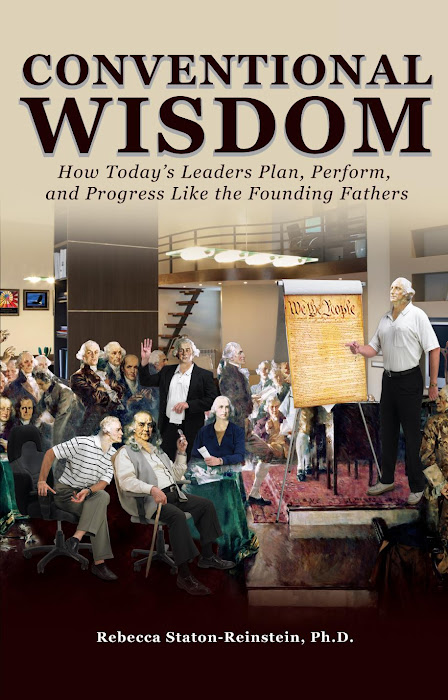
Want to know more about the tumultuous fights at the Constitutional Convention and the election of 1800? Check out Conventional Wisdom: How Today's Leaders Plan, Perform, and Progress Like the Founding Fathers
I started a companion video series during the 2012 elections that holds true today.
https://www.youtube.com/watch?v=RbcLmL3HuHo