Thursday, July 8, 2010

Proclaim Liberty July 8, 1776 & 2010

Proclaim LIBERTY throughout all the Land unto all the Inhabitants thereof ...thus begins the inscription of one of the America's favorite icons. Visiting the bell again a few months ago I was struck by all the languages and cultures that were swirling around the bell in its museum across from Independence Hall. As I snapped this picture, I realized what an important symbol this is, whether the many myths about it are true or not.

On July 8, 1776, so the story goes, the bell which hung in the tower you can see in the background, rang out for the first time to summon the people to hear the first public reading of the Declaration of Independence. Imagine yourself standing there in front of what was then the Pennsylvania State House...it was hazy, hot, and humid...they you heard those inspiring words for the first time...

We hold these truths to be self-evident, that all men are created equal, that they are endowed by their Creator with certain unalienable Rights, that among these are Life, Liberty and the pursuit of Happiness.

Even when we're not living up to them, this is the essence of who we want and strive to be.

The insurgents who had been meeting as the Continental Congress had signed this declaration and were officially in rebellion against the established government. This wasn't some lame manifesto with more slogans than substance. The signers were committing treason and were ready to put it all on the line...Listen to how they closed it:

And for the support of this Declaration, with a firm reliance on the protection of Divine Providence, we mutually pledge to each other our Lives, our Fortunes, and our sacred Honor.

In the end, it really doesn't matter whether the bell was actually hanging in the crumbling tower...What does matter is that both the signers and the people knew that they were declaring LIBERTY. At that moment, every person in the colonies had to make a choice...were they with the rebels or with the King? For many, this was a wrenching choice and it tore many families apart. Ben Franklin's own son sided with the British and they never spoke again.

If you haven't read the Declaration since high school, take a look and read it today, hearing it fresh for the first time...read it to your kids and grandkids...suggest your friends read it. http://www.ushistory.org/Declaration/document/index.htm

As you do, let those words sink in...all men are created equal...Life, Liberty and the pursuit of Happiness...we mutually pledge to each other our Lives, our Fortunes, and our sacred Honor.

Whether you're a Republican, Democrat, Independent, Libertarian, Tea Partier, Green Partier, something else or nothing...Ask yourself a few of questions:
  • Are you really Behaving as if all people are created equal?
  • Are you really Behaving honorably?
  • Are you really Behaving as if Liberty for everyone is what it's all about?
The Declaration's signers left us many traditions and, as I wrote in my last blog, one was for contentious debate. What I want to suggest is that we don't need to venerate that tradition. If we're really being faithful to our best traditions -- our ideals -- our guiding values -- then we'll recognize that the Declaration is for all of us, no matter what our political persuasion; that those who believe differently from us have the LIBERTY to do so; that when we demonize our opposition and claim a 100% lock on the truth, we are violating the sacred trust the founders passed down to us.

Enjoy the 234th anniversary of that first reading of the Declaration -- enjoy reading it again yourself -- and treat your fellow humans a little better.
*     *     *     *     *
(c) Rebecca Staton-Reinstein, President, Advantage Leadership, Inc.
*     *     *     *     *
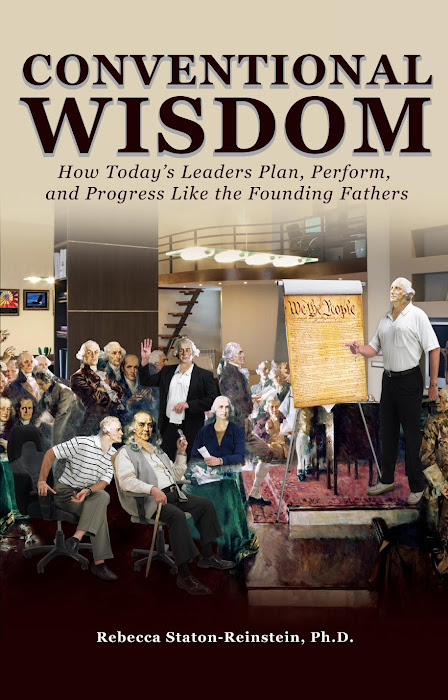
Want to know more about the founders and framers and how we can apply their positive and negative lessons today? Half off sale continues to celebrate all of the important anniversaries linked to the Declaration and the creating and ratifying of the U.S. Constitution. Conventional Wisdom: How Today's Leaders Plan, Perform, and Progress Like the Founding Fathers at 50% off is available ONLY on this HIDDEN web page. This is a limited offer so get your copy today. If you'd rather buy it on Amazon and miss out on this offer, click on over.

Sunday, July 4, 2010

Feudin', Fightin' & Fussin' on the Fourth

I'm sick of it! Right Wingers, Left Wingers, and No Wingers...Get your facts straight...or I'll call down the wrath of Founding Fathers Past!

Got your attention? Here's what set me off on this beautiful 4th of July holiday...everybody trying to appropriate our founding fathers and mothers for their own purposes...Prove your point with logic, facts, and reason or get off the stage. (See my special offer at the end.)

What folks say: Politics are more divisive than ever...there was a time when we used to disagree without being disagreeable...viciousness in opposing parties is something new...let's bring back civility...

Folks, here's the fact...we have never been a country of sedate, soothing debate. Our founding fathers and mothers were brilliant and courageous but when it came to politics, it was no holds barred. The point was (as it still is) to prevail. They didn't cuss as much, but they were not above sexual innuendo, lying, or character assassination when it came to political opponents.

Ron Chernow (author of the excellent biography, Alexander Hamilton) wrote a delightful article in the Wall Street Journal. It starts,

Americans lament the partisan venom of today's politics, but for sheer verbal savagery, the country's founders were in a league of their own.

Chernow points out, "Despite their erudition, integrity, and philosophical genius, the founders were fiery men who expressed their beliefs with unusual vehemence." They didn't stop at criticizing one another’s politics; their barbs were often personal.

John Adams called Hamilton the "bastard son of a Scotch peddler," while James Callender exposed Hamilton's affair with his friend’s wife. Newspaper man Samuel Adams, seen as a great patriot in his own day and ours, was not above the fray. "Truth was his first victim...To radicalize the populace Adams had adopted a total disregard for it. In his writings he employed slanderous lies, unvarnished propaganda, and rabble-rousing rhetoric. He whipped the people of Massachusetts and many other colonies into an anti-British fury."

The favored form of political trash talk was the pamphlet and newspaper column, written under classical Roman pseudonyms or derived from clever puns. They hammered away at one another with great relish and no restraints. They would have embraced Tweeting and Blogging as great inventions and set out with glee to rip one another apart.

Thomas Jefferson, whose stirring prose in the Declaration of Independence animates this 4th of July and embodies our most noble ideals, shrunk from doing his own dirty work. As the formation of our first parties heated up, (Hamilton headed the Federalists and Jefferson, the Republicans) he called on his buddy, Jemmy Madison, "'For God's sake, my dear Sir, take up your pen, select the most striking heresies, and cut him (Hamilton) to pieces in the face of the public.' When Madison rose to the challenge, he sneered in print that the only people who could read Hamilton's essays with pleasure were 'foreigners and degenerate citizens among us.'" Jefferson who applauded Callender's attacks on Hamilton was not so enthusiastic when Callender turned on him exposing his affair with "dusky Sally," his slave and half-sister of his deceased wife. (quote from Chernow)

In the records of debates in the Constitutional Convention and state ratifying conventions, the rhetoric escalates, with wild accusations flying that might make some of our media mavens of mayhem blush. Remember, this was an era when people would be called to the "field of honor" (challenged to a duel) for an implied slight. Calling someone a liar to his face was such a justification. Listen to this exchange during the debate over the power of large states and small. Gunning Bedford, a "fat, tempestuous delegated from Delaware" drags his bulk in front of the delegates and in a frenzied harangue spits out, "I do not, gentlemen, trust you. If you possess the power, the abuse of it could not be checked; and what then would prevent you from exercising it to our destruction?...Is it come to this, then, that the sword must decide this controversy, and the horrors of war must be added to the rest of our misfortunes?..Sooner than be ruined, there are foreign powers who will take us by the hand."

Madison, one of the most brilliant debaters and politicians of the era, summed it up, "If men were angles, no government would be necessary." The debates roiling the late 18th and early 19th century were fierce. Federalists and Republicans accused one another of treason. They could turn on former allies over night. Madison and Hamilton engineered the Constitution Convention and co-authored the Federalist Papers (with contributions from John Jay) in its defense. Madison pushed Hamilton's financial reforms through Congress. (He twisted enough arms behind the scenes to secure passage so he could argue and vote against it in public to maintain his constituents back home. Sound familiar yet?) After the new parties formed, Madison assailed his former ally, never missing a chance to paint him in ignoble terms.

I don't like the partisan bickering, shouting, and backbiting. AND I admire Hamilton, Jefferson, Adam, Madison, and the framers and founders. My gripe is about our lack of historical knowledge, our tendency to make stuff up, and the habit of partisans of every stripe to lie to defend their cause. Let's face the brutal facts -- ones we like and ones we don't -- and debate with a goal of coming to consensus or close to it.

That was Washington's great desire. He truly hated the partisan wrangling, the unbridled press, and the inability of people to rise above their passions. Though he occasionally fell victim to his own monumental temper, mostly he was that wise, impartial leader we all admire. So on this wonderful 4th of July, while we're barbecuing, watching fireworks, or hitting the mall, let’s ask ourselves this: Am I following along in our country's long tradition of bashing and demonizing those with whom I disagree, or am I trying to follow Washington's advice and have "restraint in tongue and pen?" If you are going to evoke the founders and framers, read some real history and get it right!

-----

Want to know more about the founders and framers and how we can apply their positive and negative lessons today? CLICK HERE: Half off – 4th of July sale – Conventional Wisdom: How Today’s Leaders Plan, Perform, and Progress Like the Founding Fathers. Available ONLY on this HIDDEN web page. This is a limited offer so get your copy today. Rather buy it on Amazon (and miss out on this offer?)
® Rebecca Staton-Reinstein (all quotes fully cited in Conventional Wisdom except one about Sam Adams from Eric Burn’s Infamous Scribblers.

Monday, June 7, 2010

John Wooden: An Extraordinary Leader Departs

John Wooden was an extraordinary leader. Every leader or aspiring one can learn from him. While most of the obituaries and tributes point out his phenomenal record as the coach of the UCLA men's basketball team and former players hail his profound influence on their lives, there was so much more to this man. He was the epitome of leadership under pressure. Sports fans will remember him sitting there through every game, pretty calm, that rolled up program in his hand. Whether the team was winning or losing, he seemed unflappable. In fact, one of the few times he ever seemed to lose his cool was when he believed the players were not giving the game everything they were capable of. Here's what Wooden had to say about losing and winning.

To me, success isn't outscoring someone, it's the peace of mind that comes from self-satisfaction in knowing you did your best. That's something each individual must determine for himself. You can fool others, but you can't fool yourself.
Many people are surprised to learn that in 27 years at UCLA, I never once talked about winning. Instead I would tell my players before games, 'When it's over, I want your head up. And there's only one way your head can be up, that's for you to know, not me, that you gave the best effort of which you're capable. If you do that, then the score doesn't really matter, although I have a feeling that if you do that, the score will be to your liking.' I honestly, deeply believe that in not stressing winning as such, we won more than we would have if I'd stressed outscoring opponents.
There's no great fun, satisfaction or joy derived from doing something that's easy. Failure is never fatal, but failure to change might be.
Your strength as an individual depends on, and will be in direct proportion to, how you react to both praise and criticism. If you become too concerned about either, the effect on you is certain to be adverse.
I always taught players that the main ingredient of stardom is the rest of the team. It's amazing how much can be accomplished if no one cares who gets the credit.
I have often said, 'The mark of a true champion is to always perform near your own level of competency.' We were able to do that by never being satisfied with the past and always planning for what was to come. I believe that failure to prepare is preparing to fail. This constant focus on the future is one reason we continued staying near the top once we got there.
...I was as concerned with a player's character as I was with his ability.
While it may be possible to reach the top of one's profession on sheer ability, its impossible to stay there without hard work and character. One's character is what you really are. Your reputation is only what others think you are. I made a determined effort to evaluate character. I looked for young men who would play the game hard, but clean, and who would always be trying to improve themselves to help the team. Then if their ability warranted it, the championships would take care of themselves.

These simple but profound insights are applied by great leaders...the others whether in business, politics, government, of nonprofits or NGOs could change their direction and results immediately by following them. Wooden's record is a testament to the power of his leadership: no losing seasons in his 27 years, 10 national championships in 12 years - 7 in succession, world record for winning 88 games in a row. But sports records eventually fall. Leadership records do not, and applied leadership lessons can live forever. Are you ready to learn from Wooden? Do you have the character and ability and willingness to do the hard work? If so...

*     *     *     *     *     *
(c) Rebecca Staton-Reinstein, President, Advantage Leadership, Inc.

Quotes originally from an ad in the Wall Street Journal in 1986 and reprinted in Dr. Deming: The American Who Taught the Japanese about Quality, Rafael Aguayo, Simon & Schuster, 1990

Thursday, May 27, 2010

223 years -- good enough track record?

223 years ago in May 1787, the U.S. Constitutional Convention opened on May 25 and began its debates. They were wrestling with how to form an effective republican government. They were responding to crises of huge proportions; a national legislature unable to act because of deep divisions, massive government debt, widespread foreclosures, foreign enemies prepared to strike, and extensive domestic strife.

Sound familiar?

On May 29, Edmund Randolph put forth the Virginia Plan -- authored by James Madison -- as an outline for the constitutional debates. Deliberations raged for four long months in the Philadelphia heat. At the end the produced the U.S. Constitution that was ratified the following year after extensive, rancorous debate in state ratifying conventions. This historic document is a strategic plan that has stood the test of time.

A few years ago, author David McCullough gave a speech at a leadership seminar entitled, "Knowing History and Knowing Who We Are." In it he quoted Daniel Boorstin, the late Librarian of Congress, saying 'trying to plan for the future without a sense of the past is like trying to plant cut flowers.' McCullough continued, "We're raising a lot of cut flowers and trying to plant them...One of the truths of history...is that nothing ever had to happen the way it happened...We just don't know how things are going to turn out for us, they [the revolutionary generation] didn't either...[John Adams in a letter to his wife wrote,] 'We can't guarantee success in this war, but we can do something better. We can deserve it.' Think how different that is from the attitude today when all that matters is success."

McCullough goes on to decry our lack of knowledge, much less understanding, of history and concludes, "History isn't just something that ought to be taught...or encouraged because it's going to make us a better citizen." [It will make us a better citizen, a more thoughtful and understanding human being, and will cause us to behave better.] History "should be taught for pleasure: The pleasure of history, like art or music or literature, consists of an expansion of the experience of being alive, which is what education is largely about."

What pleasure, guidance or understanding can you gain from the history of the making of the U.S. Constitution? What pragmatic lessons are there for your leadership efforts? According to many contemporary executives, there is a lot to learn. I interviewed 20 of them as well as poured over the records of the Constitutional Convention. I discovered the common strategic approaches of historic and modern leaders as they work to deserve success.

Here's what former Supreme Court Justice Sandra Day O'Connor had to say:

Thank you for sharing with me your new book Conventional Wisdom: How Today's Leaders Plan, Perform, and Progress Like the Founding Fathers. Your research into the planning sessions of the Constitutional Convention and the struggles that our framers of the Constitution faced has been cleverly weaved into the strategies of modern business. I am pleased to have your book.

I have been persuaded to reopen a "secret" webpage for a limited time so you can take advantage of a special offer and improve your own performance and learn from these historic and modern mentors. I did it myself. The very process of writing the book was a major learning experience. The insights I gained and applied helped me survive the economic downturn and thrive now that things are improving. You can do the same.
Discover your own conventional wisdom... Click here for the special offer.

* * * * * * * * *

(c) Rebecca Staton-Reinstein, Ph.D., President, Advantage Leadership, Inc.

Sunday, May 23, 2010

Vote agin' 'em


That was my Aunt Letha's advice when it came to the democratic process...As every election neared she repeated her maxim: "I never voted FOR anybody in my life...I always vote agin' 'em!" She'd love the Tea Party and all the anti-incumbent ballyhoo in the media. Despite the fact she had a nice government job with the IRS she had a rather jaded view of government officials at every level.

Like many people, she had her own way of enforcing term limits -- throw the bums out.

At this point many months before the November elections, that's what lots of folks are saying and doing in state primaries. And in a democratic republic that certainly beats violence, coups, and take overs. I just returned from Lagos, Nigeria. While I was there, the president died. There was a peaceful transition as the acting president was sworn in. Many people breathed a sigh of relief...There had been military take overs in the past and few peaceful transitions. In Thailand opposition to the incumbent precipitated violence and death so votin' agin' 'em seems a better solution.
But is it? Let's get a little historical perspective on the situation. I just spent some time in Philadelphia and had a chance to visit Independence Hall and wander through the historic district thinking about the Continental Congress, the Declaration of Independence, the Constitutional Convention, and the U.S. Constitution. It got me to thinking about being agin' 'em.
Of course the representatives that assembled in the 1770s and 80s were agin' taxation without representation, the Townsend Acts, Stamp Act, Intolerable Acts, and all the rest. They believed their rights as British citizens were being violated. Their protests did turn violent at times although it's easier to remember civil disobedience like the Boston Tea Party. Right from the beginning there were those who were ready to break with England and those who wanted to mend the growing rift. Tempers flared on both sides as the definition of patriot shifted until it solidified once war broke out. Yes, the revolutionary generation was agin' many things.
However, they were the first to understand that being agin' the British wasn't enough. They also had to be FOR something. What that something was for them was the ideal of a republic -- a government that represented the people and was agreed to by the people. When the 55 representatives showed up to represent 12 states (Rhode Island refused to come) in 1787 to write a new constitution, they were ready to define in detail what they were for. Gouverneur Morris, representing Pennsylvania, encapsulated their goals succinctly in the Preamble.
The success the framers had both in working to get the new constitution ratified and then to establish the new government was based on the fact that they stood on a solid platform of ideals, pragmatism, and political savvy.
James Madison, who played such a crucial role in the constitutional efforts was a career politician. From his first public office in his early twenties he served in representative body after representative body, seldom being out of office for any length of time. He eventually reached the executive branch serving as Secretary of State and then president for two terms...even though he presided over an unpopular war (1812.) He was an "insider" who sometimes voted with his next election in mind instead of the "greater good." Although generally thought of as a "conservative" by today's litmus tests he might be vilified, especially for his adamant views (and voting record) on the strict separation of church and state. His views and votes on slavery would also get him in hot water today. But at the end of the day, he believed, as did many of the founders, that public service, politics, was an honorable and necessary profession.
So as dearly as I loved my Aunt Letha, and she was a treasure, I have to respectfully disagree with her. In every election, I look at candidates of every stripe and try to figure out what they are standing for, what they will try to accomplish, and what ideals they will work to put into practice. Do they have the character and stamina of a Madison...if so, I'll vote for 'em.
* * * * * * * * *

Rebecca Staton-Reinstein, President, Advantage Leadership, Inc. Author, Conventional Wisdom: How Today's Leaders Plan, Perform, and Progress Like the Founding Fathers


Monday, April 19, 2010

A Spirit-ed Debate

We've all heard and seen the headlines, "Spirit to charge $45 for carry-on luggage!" Lots of strum and drang. Some congressmen even want to "protect" us with new regulations. Wait a minute...what's going on?

Let's step back for a minute and take a more objective look at Ben Baldanza and his Spirit Airlines. (Let me make it clear. I'm NOT defending his decisions, just describing a few facts.) When Baldanza took over the South Florida based airline, he had a vision. He wanted to make Spirit and its home airport (Ft. Lauderdale/ Hollywood, FL) international. He had noticed the demographic shifts of people from various parts of Latin America moving north from the Miami area to the Ft. Lauderdale area. As he reasoned, "Why should they have to go all the way to Miami to fly back home?"

It's that sort of questioning that has marked Baldanza's thinking throughout his long career in the the airline business. He also made another important decision when he became CEO at Spirit. He realized that there were two basic models for an airline. At one end was Singapore Air with it's superb service, high-end amenities, and reputation for pampering everyone. At the other end of the spectrum was Ryan Air, a no-frills airline in the extreme. It competes on low fares with an a la carte system where you pay for everything you want.

Baldanza says that the problem with most airlines is that they try to live somewhere in the middle but don't deliver either great service or very low prices. So he decided to remold Spirit in the Ryan image. You get a fairly low fare (sometimes even a $9 special) and then pay for everything else...everything. OK. You know that going in so it's no surprise. As most airlines tried to survive the economic difficulties over the last few years, they also started adding on charges for basics (or what used to be considered basics) although not lowering their fares particularly.

So it comes as no surprise that Spirit will start charging for carry-ons that must go in the overhead bins with the fee based on whether you belong to a special membership or when and where you check in. The $45 is only for people who show up at the gate without paying for the bag ahead of time. Baldanza believes that this is all fair (no pun intended) because you only pay for the services you want. He thinks it will get some folks to check those bags and relieve the congestion getting on and off the plane. (We'll see...we'll also see if people will pay it or choose to fly another carrier. Ryan Air was forced to back off its plan to charge for use of the bathroom on short flights.)
But is Baldanza to be vilified? Not in my opinion. He made a business decision in line with his business model. The customers will determine if it's a good one or not. But there's more to Baldanza than this one decision. I had the privilege of getting to know him and profile him in my book on strategic leadership, Conventional Wisdom: How Today's Leaders Plan, Perform, and Progress Like the Founding Fathers. The picture above is a classic Ben Baldanza moment. Just like his planes, his offices are no frills also -- a non-descript industrial building in an office park...no marble entrance hall, just a buzzer and no receptionist...no outrageous perks...just a plain utilitarian office. Why the vacuum cleaner? Because Baldanza uses it to keep his office tidy himself.
He meets with employees regularly, getting their ideas and feedback, gives out his email address and replies, and is generally considered an excellent leader and manager. As his assistant remarked out of the blue one day as I sat waiting for a meeting, "He's the best boss I've ever had!" Even the interviewer on a recent CNN interview spontaneously remarked that Baldanza seemed like a very likable guy he'd like to work for.
It's important to separate out the disagreement with Baldanza's business decision and understanding his business strategy and his track record as a good leader, visionary, and a "nice guy." If you don't like the extra charges, don't fly those airlines that have them.
Oh, and no matter which airline you fly, could I plead with you (as a minimalist, frequent business traveler) not to drag on all of your worldly possessions, overstuffed giant suitcases, and shopping bags crammed with stuff?
***** ***** *****
Rebecca Staton-Reinstein, President, Advantage Leadership, Inc. www.AdvantageLeadership.com Looking forward to your comments. And check out more about Baldanza in Conventional Wisdom.

Thursday, April 15, 2010

Happy Belated Birthday, Mr. Jefferson!


This week was the birthday of Thomas Jefferson, author of the Declaration of Independence, third president of the U.S., and founder of the University of Virginia. The latter is one of the achievements he was most proud of and wanted on his tombstone.

He conceived of the University as a very different place from the academic institutions of his day. One of his ideas was to create an "academical village." Today that same vision is driving another leader in the same direction.

George Hanbury, the new president of Nova Southeastern University arrived there after successful stints as city manager of cities that needed a major turn around. His record in Portsmouth, Virginia and Ft. Lauderdale, Florida are substantial and might have led a lesser leader to retire on his laurels. Not Dr. Hanbury.

This excerpt from Conventional Wisdom: How Today's Leaders Plan, Perform, and Progress Like the Founding Fathers details some of Hanbury's achievements at Nova as COO as he worked to implement Jefferson's vision.

Hanbury rediscovered Jefferson's vision as he did his doctoral work at Florida Atlantic University and when he arrived at Nova in 1998 he was eager to bring it to reality. Jefferson's idea of the "academical village" was a place where academics and the real world could be brought together for students to benefit from both. He saw a place where students would have a practical as well as theoretical education, where commerce and study could blend.

"It takes a visionary to look at a 1970s shopping center and wasteland of abandoned parking lots and see a revolutionary new community combining commercial space, state-of-the-art research facilities, living and recreational space, and college class rooms. Yet that's what he saw...

When I first came to Nova...it just seemed like a natural that what Jefferson was professing...[wanting] students to appreciate how theory was supportive of practice, and without practice, theory was no more than an exercise. Practice without theory would just remain stagnant and there would be no expansion.

I thought if we wrapped the buildings around the parking decks, and then made it an attractive area for people who want to live and work and do research and connect all that to a doctoral research university with high-speed connections to all other research universities in the state, you'd really have quite an economic engine."

So Jefferson's "academical village" is emerging in Davie, Florida, spurred on by Hanbury, whose vision is ever evolving and who, himself combines theory and practice quite neatly in building the university.

Happy birthday, Tom, your ideas are alive and well and continuing to evolve and see the light of day.

***** ***** *****
Want to apply the wisdom of the founding fathers such as Jefferson or contemporary leaders such as George Hanbury? Read Conventional Wisdom or contact me to discuss how their insights can be helpful to you and your business.
Rebecca Staton-Reinstein, President, Advantage Leadership, Inc.