Showing posts with label Gregory Swienton. Show all posts

Monday, September 21, 2009

George Who?


You know the drill...Jay Leno stops people on the street and asks them simple questions and that's where the fun begins. Recently he stopped a nice young man and asked him to name some Founding Fathers. "Founding Fathers of what?" he asked rather belligerently. OK, maybe it was staged...but...

Only a quarter of high school students in a recent poll could identify the first president of the U.S. Few could list the 3 branches of government. Forget about any real understanding of our our system of government and how it works. The findings of the latest poll reflect many other more scientifically sound studies that show up year after year.

Thomas Jefferson sums it up best: If a nation expects to be ignorant and free, in a state of civilization, it expects what never was and never will be.
Whether you are a Democrat, Republican, Independent, or have some other affiliation, the lack of knowledge of our history and understanding of our government is frightening. It could foreshadow disaster.

What is to be done?

  • Develop an engaging curriculum at every level of eduction from elementary school through college; involve educators, parents, students, historians, and instructional designers

  • Train teachers at every level to become knowledgeable and involved; provide them with materials and support to develop lessons that capture students' interests

  • Bring history to life with field trips to local historical sites and visits to local government meetings; Every student should visit Washington, D.C. at least once during his or her 12 years in school

  • Focus less on standardized testing and more on involving students in recreating critical events from our history, debating the great issues, applying lessons to their own lives.
This will not be easy. Political debate will rage around the curriculum and determining the "correct" facts and their interpretation. But as the PBS series on the Civil War and the HBO series on John Adams have shown, when you present history in a compelling way, people will be involved and come away glad to have learned something about two crucial periods in our history that still have echos in the present.

When the John Adam series was first running on TV, Greg Swienton, CEO of Ryder System, would gather anyone who was interested to discuss the previous nights episode. These were lively ad hoc conversations. Imagine that in your busy work place. When was the last time you gathered to chat about history? When was the last time you talked with your kids or grandkids about history or took them to visit a historic site or city council meeting?

If a nation expects to be ignorant and free, in a state of civilization, it expects what never was and never will be.

(c) Rebecca Staton-Reinstein, http://www.advantageleadership.com/


Wednesday, April 1, 2009

April 1 is not a foolish day

April 1 is an important day in American history, although few people know it. This is the anniversary of the first day the new Congress under the new Constitution met, had a quorum, and could conduct business. April 1, 1790. No foolin'...James Madison and the other delegates assembled to begin the business of putting the newly ratified Constitution into action. They began the business of ensuring the fragile union survived and grew strong.

This was no easy task. This was a new form of republican government. The delegates were serving two year terms in the newly established House of Representatives. They knew they would have some real power to get things done and to levy the necessary taxes to meet their obligations. Under the now-defunct Articles of Confederation, they were only able to beg the states to support initiatives with money. Now they represented specific geographical constituencies and each had a vote unlike the one vote per state under the Articles.

The crisis that brought on the Constitutional Convention and resulted in the new government was still raging; foreclosures, inflation, threatening foreign powers, creditors demanding payment for war debt, and more. The situation was not unlike today, although the country was more vulnerable than now.

As usual, James Madison had made a thorough study of the issues. He had the responsibility for seeing that George Washington's agenda made it through the new legislature. To gain ratification of the new Constitution, he had promised to bring a bill of rights into the amendment process. He would also have to see to it that the proposal for funding the debt and establishing a national bank would pass even though he had grave doubts about it. However, Alexander Hamilton, the new Secretary of the Treasury had convinced him it was a necessity to deal with their disastrous financial and credit situation.

Today's leaders face many of the same crises as the those in that first Congress. In fact the parallels are startling. They also face tough, even unpleasant choices. Several of the contemporary leaders profiled in my new book spoke at a seminar for local business people on March 27. They agreed with the premise that now is the time to focus on opportunity while doing what is necessary to get through the short term.

Greg Swienton, CEO of Ryder System, repeated his philosophy from his profile in the book. He has charged his team with looking for every alternative saving before letting an employee go. That means getting rid of things that make their lives more convenient or comfortable but do not actually contribute anything. He had already led the way by getting rid of the corporate jet when he became CEO.

Ben Baldanza, CEO of Spirit Airlines, was also on the panel and interviewed in the book. In a piece about him in the New York Times on Monday, the reporter was incredulous at his plain office in a nondescript office park. Baldanza was photographed with his own vacuum cleaner he uses to keep his office clean. But this is exactly the leadership image he is trying to set.

The key for all of the leaders on the panel is to focus on important isses with strong, decisive actions that are congruent with their larger mission.

So, no foolin'...take these leadership lessons to heart on this historic day.
(c) Rebecca Staton-Reinstein

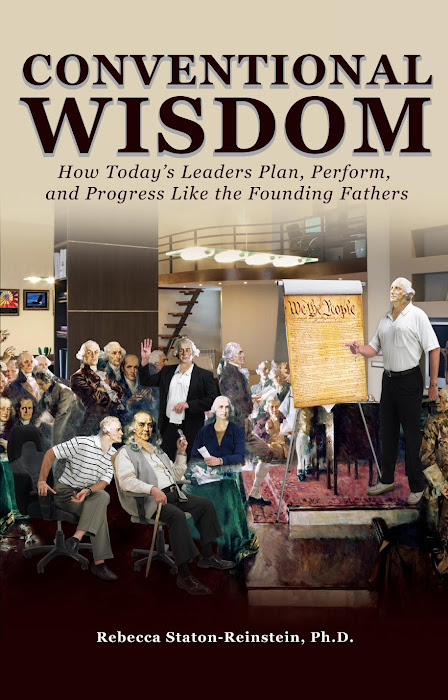
Read more about these modern leaders and those of the early republic today -- Conventional Wisdom: How Today's Leaders Plan, Perform, and Progress Like the Founding Fathers http://www.conventionalwisdomcenter.com/

The full panel included: Greg Swienton, CEO, Ryder System; Ben Baldanza, CEO, Spirit Airlines; John Stunson, City Manager, Oakland Park, Florida; George Hanbury, COO/EVP Nova Southeastern University; Evan Rees, former President, CNL Bank, now working full time to raise money for the Boy Scouts and the Partnership for the Homeless.

The panel presentation will be available soon on our website. http://www.advantageleadership.com/